

474
E. Rabinovici
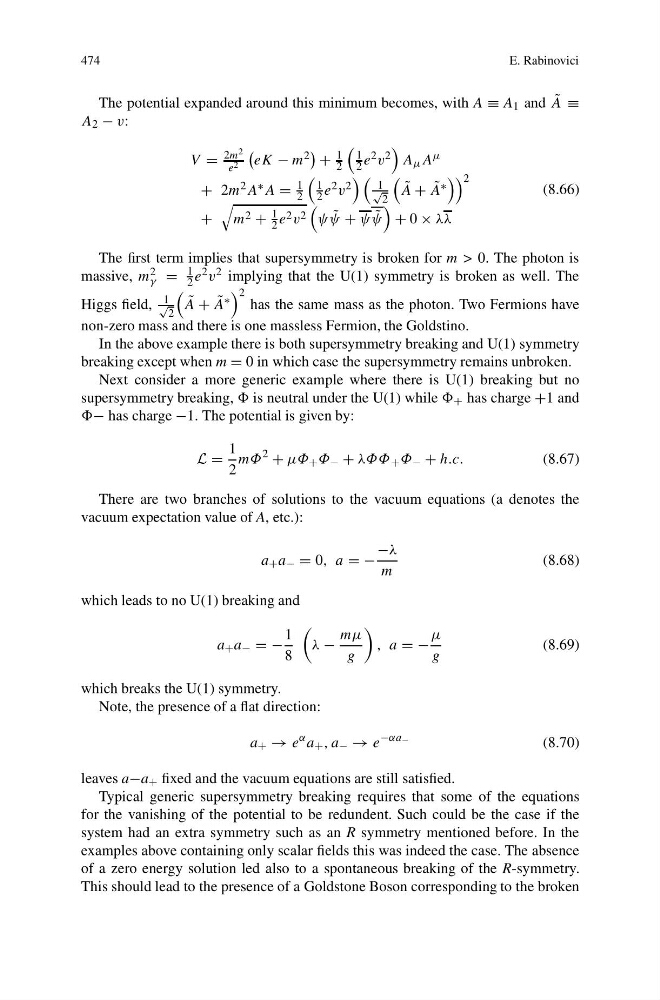
The potential expanded around this minimum becomes, with A ≡ A 1 and ˜
A ≡
A 2 − v:
V =
2m 2
e 2
eK − m 2 +
1
2
1
2 e 2 v 2
A μ A μ
+ 2m 2 A ∗ A =
1
2
1
2 e 2 v 2
1
√
2
˜
A + ˜
A ∗
2
+
m 2 +
1
2 e 2 v 2
ψ ˜
ψ + ψ ˜
ψ
+ 0 × λλ
(8.66)
The first term implies that supersymmetry is broken for m > 0. The photon is
massive, m 2
γ =
1
2 e 2 v 2 implying that the U(1) symmetry is broken as well. The
Higgs field,
1
√
2
˜
A + ˜
A ∗
2
has the same mass as the photon. Two Fermions have
non-zero mass and there is one massless Fermion, the Goldstino.
In the above example there is both supersymmetry breaking and U(1) symmetry
breaking except when m = 0 in which case the supersymmetry remains unbroken.
Next consider a more generic example where there is U(1) breaking but no
supersymmetry breaking, is neutral under the U(1) while + has charge +1 and
has charge −1. The potential is given by:
L =
1
2
mΦ
2
+ μΦ + Φ − + λΦΦ + Φ − + h.c.
(8.67)
There are two branches of solutions to the vacuum equations (a denotes the
vacuum expectation value of A, etc.):
a + a − = 0, a = −
−λ
m
(8.68)
which leads to no U(1) breaking and
a + a − = −
1
8
λ −
mμ
g
, a = −
μ
g
(8.69)
which breaks the U(1) symmetry.
Note, the presence of a flat direction:
a + → e
α a + , a − → e
−αa −
(8.70)
leaves a−a + fixed and the vacuum equations are still satisfied.
Typical generic supersymmetry breaking requires that some of the equations
for the vanishing of the potential to be redundent. Such could be the case if the
system had an extra symmetry such as an R symmetry mentioned before. In the
examples above containing only scalar fields this was indeed the case. The absence
of a zero energy solution led also to a spontaneous breaking of the R-symmetry.
This should lead to the presence of a Goldstone Boson corresponding to the broken
E. Rabinovici
The potential expanded around this minimum becomes, with A ≡ A 1 and ˜
A ≡
A 2 − v:
V =
2m 2
e 2
eK − m 2 +
1
2
1
2 e 2 v 2
A μ A μ
+ 2m 2 A ∗ A =
1
2
1
2 e 2 v 2
1
√
2
˜
A + ˜
A ∗
2
+
m 2 +
1
2 e 2 v 2
ψ ˜
ψ + ψ ˜
ψ
+ 0 × λλ
(8.66)
The first term implies that supersymmetry is broken for m > 0. The photon is
massive, m 2
γ =
1
2 e 2 v 2 implying that the U(1) symmetry is broken as well. The
Higgs field,
1
√
2
˜
A + ˜
A ∗
2
has the same mass as the photon. Two Fermions have
non-zero mass and there is one massless Fermion, the Goldstino.
In the above example there is both supersymmetry breaking and U(1) symmetry
breaking except when m = 0 in which case the supersymmetry remains unbroken.
Next consider a more generic example where there is U(1) breaking but no
supersymmetry breaking, is neutral under the U(1) while + has charge +1 and
has charge −1. The potential is given by:
L =
1
2
mΦ
2
+ μΦ + Φ − + λΦΦ + Φ − + h.c.
(8.67)
There are two branches of solutions to the vacuum equations (a denotes the
vacuum expectation value of A, etc.):
a + a − = 0, a = −
−λ
m
(8.68)
which leads to no U(1) breaking and
a + a − = −
1
8
λ −
mμ
g
, a = −
μ
g
(8.69)
which breaks the U(1) symmetry.
Note, the presence of a flat direction:
a + → e
α a + , a − → e
−αa −
(8.70)
leaves a−a + fixed and the vacuum equations are still satisfied.
Typical generic supersymmetry breaking requires that some of the equations
for the vanishing of the potential to be redundent. Such could be the case if the
system had an extra symmetry such as an R symmetry mentioned before. In the
examples above containing only scalar fields this was indeed the case. The absence
of a zero energy solution led also to a spontaneous breaking of the R-symmetry.
This should lead to the presence of a Goldstone Boson corresponding to the broken