

8 Beyond the Standard Model
469
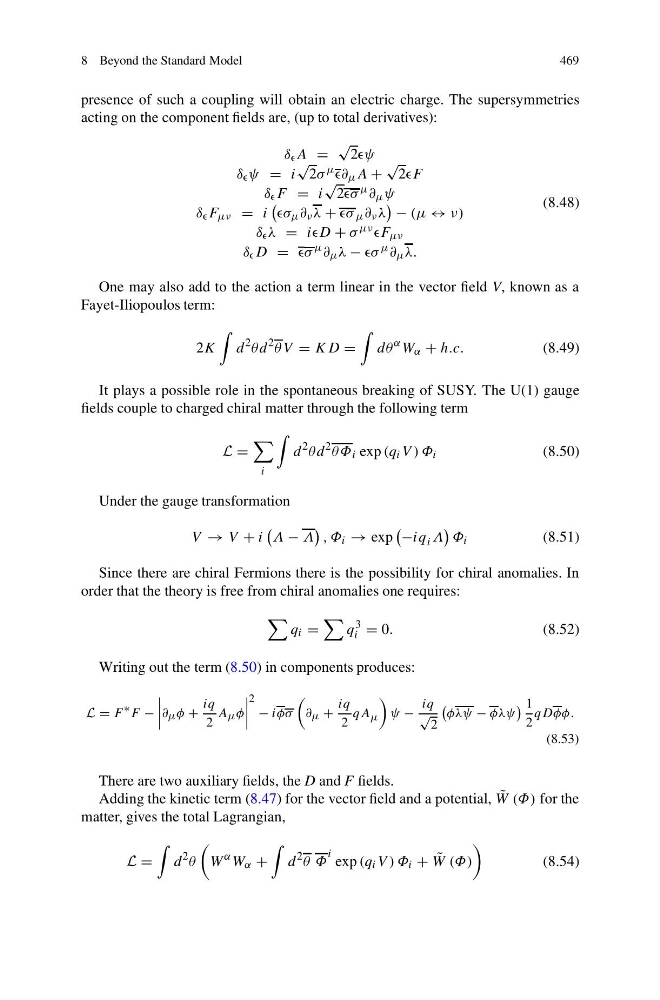
presence of such a coupling will obtain an electric charge. The supersymmetries
acting on the component fields are, (up to total derivatives):
δ A =
√
2
δ ψ = i
√
2σ μ μ A +
√
2
δ F = i
√
2σ μ ∂ μ ψ
δ F μν = i
μ ∂ ν λ + σ μ ∂ ν λ
− (μ ↔ ν)
δ λ = i + σ μν μν
δ D = σ
μ ∂ μ λ − μ ∂ μ λ.
(8.48)
One may also add to the action a term linear in the vector field V, known as a
Fayet-Iliopoulos term:
2K
d
2 θd
2 θV = KD =
dθ
α W α + h.c.
(8.49)
It plays a possible role in the spontaneous breaking of SUSY. The U(1) gauge
fields couple to charged chiral matter through the following term
L =
i
d
2 θd
2 θ Φ i exp (q i V ) Φ i
(8.50)
Under the gauge transformation
V → V + i
Λ − Λ
, Φ i → exp
−iq i Λ
Φ i
(8.51)
Since there are chiral Fermions there is the possibility for chiral anomalies. In
order that the theory is free from chiral anomalies one requires:
q i =
q
3
i = 0.
(8.52)
Writing out the term (8.50) in components produces:
L = F ∗ F −
∂ μ φ +
iq
2
A μ φ
2
− iφσ
∂ μ +
iq
2
qA μ
ψ −
iq
√
2
φλψ − φλψ
1
2
qDφφ.
(8.53)
There are two auxiliary fields, the D and F fields.
Adding the kinetic term (8.47) for the vector field and a potential, ˜
W (Φ) for the
matter, gives the total Lagrangian,
L =
d
2 θ
W
α W α +
d
2 θ Φ
i exp (q i V ) Φ i + ˜
W (Φ)
(8.54)
469
presence of such a coupling will obtain an electric charge. The supersymmetries
acting on the component fields are, (up to total derivatives):
δ A =
√
2
δ ψ = i
√
2σ μ μ A +
√
2
δ F = i
√
2σ μ ∂ μ ψ
δ F μν = i
μ ∂ ν λ + σ μ ∂ ν λ
− (μ ↔ ν)
δ λ = i + σ μν μν
δ D = σ
μ ∂ μ λ − μ ∂ μ λ.
(8.48)
One may also add to the action a term linear in the vector field V, known as a
Fayet-Iliopoulos term:
2K
d
2 θd
2 θV = KD =
dθ
α W α + h.c.
(8.49)
It plays a possible role in the spontaneous breaking of SUSY. The U(1) gauge
fields couple to charged chiral matter through the following term
L =
i
d
2 θd
2 θ Φ i exp (q i V ) Φ i
(8.50)
Under the gauge transformation
V → V + i
Λ − Λ
, Φ i → exp
−iq i Λ
Φ i
(8.51)
Since there are chiral Fermions there is the possibility for chiral anomalies. In
order that the theory is free from chiral anomalies one requires:
q i =
q
3
i = 0.
(8.52)
Writing out the term (8.50) in components produces:
L = F ∗ F −
∂ μ φ +
iq
2
A μ φ
2
− iφσ
∂ μ +
iq
2
qA μ
ψ −
iq
√
2
φλψ − φλψ
1
2
qDφφ.
(8.53)
There are two auxiliary fields, the D and F fields.
Adding the kinetic term (8.47) for the vector field and a potential, ˜
W (Φ) for the
matter, gives the total Lagrangian,
L =
d
2 θ
W
α W α +
d
2 θ Φ
i exp (q i V ) Φ i + ˜
W (Φ)
(8.54)