

470
E. Rabinovici
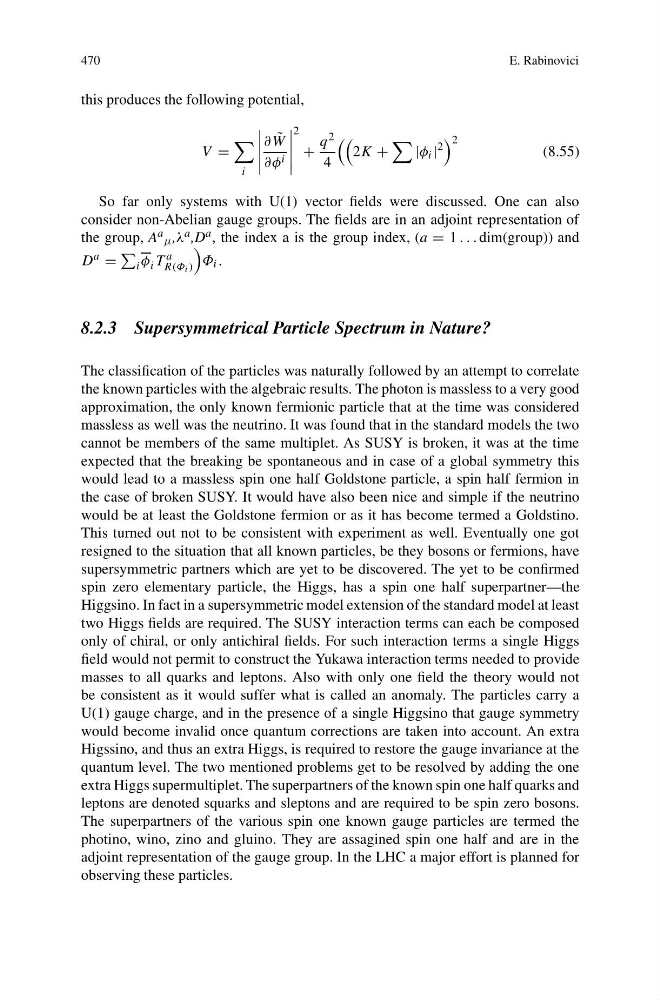
this produces the following potential,
V =
i
∂ ˜
W
∂φ i
2
+
q 2
4
2K +
|φ i |
2
2
(8.55)
So far only systems with U(1) vector fields were discussed. One can also
consider non-Abelian gauge groups. The fields are in an adjoint representation of
the group, A a μ ,λ a ,D a , the index a is the group index, (a = 1 . . . dim(group)) and
D a =
i φ i T a
R(Φ i )
Φ i .
8.2.3 Supersymmetrical Particle Spectrum in Nature?
The classification of the particles was naturally followed by an attempt to correlate
the known particles with the algebraic results. The photon is massless to a very good
approximation, the only known fermionic particle that at the time was considered
massless as well was the neutrino. It was found that in the standard models the two
cannot be members of the same multiplet. As SUSY is broken, it was at the time
expected that the breaking be spontaneous and in case of a global symmetry this
would lead to a massless spin one half Goldstone particle, a spin half fermion in
the case of broken SUSY. It would have also been nice and simple if the neutrino
would be at least the Goldstone fermion or as it has become termed a Goldstino.
This turned out not to be consistent with experiment as well. Eventually one got
resigned to the situation that all known particles, be they bosons or fermions, have
supersymmetric partners which are yet to be discovered. The yet to be confirmed
spin zero elementary particle, the Higgs, has a spin one half superpartner—the
Higgsino. In fact in a supersymmetric model extension of the standard model at least
two Higgs fields are required. The SUSY interaction terms can each be composed
only of chiral, or only antichiral fields. For such interaction terms a single Higgs
field would not permit to construct the Yukawa interaction terms needed to provide
masses to all quarks and leptons. Also with only one field the theory would not
be consistent as it would suffer what is called an anomaly. The particles carry a
U(1) gauge charge, and in the presence of a single Higgsino that gauge symmetry
would become invalid once quantum corrections are taken into account. An extra
Higssino, and thus an extra Higgs, is required to restore the gauge invariance at the
quantum level. The two mentioned problems get to be resolved by adding the one
extra Higgs supermultiplet. The superpartners of the known spin one half quarks and
leptons are denoted squarks and sleptons and are required to be spin zero bosons.
The superpartners of the various spin one known gauge particles are termed the
photino, wino, zino and gluino. They are assagined spin one half and are in the
adjoint representation of the gauge group. In the LHC a major effort is planned for
observing these particles.
E. Rabinovici
this produces the following potential,
V =
i
∂ ˜
W
∂φ i
2
+
q 2
4
2K +
|φ i |
2
2
(8.55)
So far only systems with U(1) vector fields were discussed. One can also
consider non-Abelian gauge groups. The fields are in an adjoint representation of
the group, A a μ ,λ a ,D a , the index a is the group index, (a = 1 . . . dim(group)) and
D a =
i φ i T a
R(Φ i )
Φ i .
8.2.3 Supersymmetrical Particle Spectrum in Nature?
The classification of the particles was naturally followed by an attempt to correlate
the known particles with the algebraic results. The photon is massless to a very good
approximation, the only known fermionic particle that at the time was considered
massless as well was the neutrino. It was found that in the standard models the two
cannot be members of the same multiplet. As SUSY is broken, it was at the time
expected that the breaking be spontaneous and in case of a global symmetry this
would lead to a massless spin one half Goldstone particle, a spin half fermion in
the case of broken SUSY. It would have also been nice and simple if the neutrino
would be at least the Goldstone fermion or as it has become termed a Goldstino.
This turned out not to be consistent with experiment as well. Eventually one got
resigned to the situation that all known particles, be they bosons or fermions, have
supersymmetric partners which are yet to be discovered. The yet to be confirmed
spin zero elementary particle, the Higgs, has a spin one half superpartner—the
Higgsino. In fact in a supersymmetric model extension of the standard model at least
two Higgs fields are required. The SUSY interaction terms can each be composed
only of chiral, or only antichiral fields. For such interaction terms a single Higgs
field would not permit to construct the Yukawa interaction terms needed to provide
masses to all quarks and leptons. Also with only one field the theory would not
be consistent as it would suffer what is called an anomaly. The particles carry a
U(1) gauge charge, and in the presence of a single Higgsino that gauge symmetry
would become invalid once quantum corrections are taken into account. An extra
Higssino, and thus an extra Higgs, is required to restore the gauge invariance at the
quantum level. The two mentioned problems get to be resolved by adding the one
extra Higgs supermultiplet. The superpartners of the known spin one half quarks and
leptons are denoted squarks and sleptons and are required to be spin zero bosons.
The superpartners of the various spin one known gauge particles are termed the
photino, wino, zino and gluino. They are assagined spin one half and are in the
adjoint representation of the gauge group. In the LHC a major effort is planned for
observing these particles.