

468
E. Rabinovici
B,D, A μ are real and C is complex. The Lagrangian has a local U(1) symmetry
with a gauge parameter, an arbitrary chiral field:
V → V + i
Λ − Λ
(8.41)
B, χ, and C are gauge artifacts and can be gauged away. The symmetry is actually
U(1) C as opposed to the usual U(1) R because although the vector field transforms
with a real gauge parameter, the other fields transform with gauge parameters that
depend on the imaginary part of
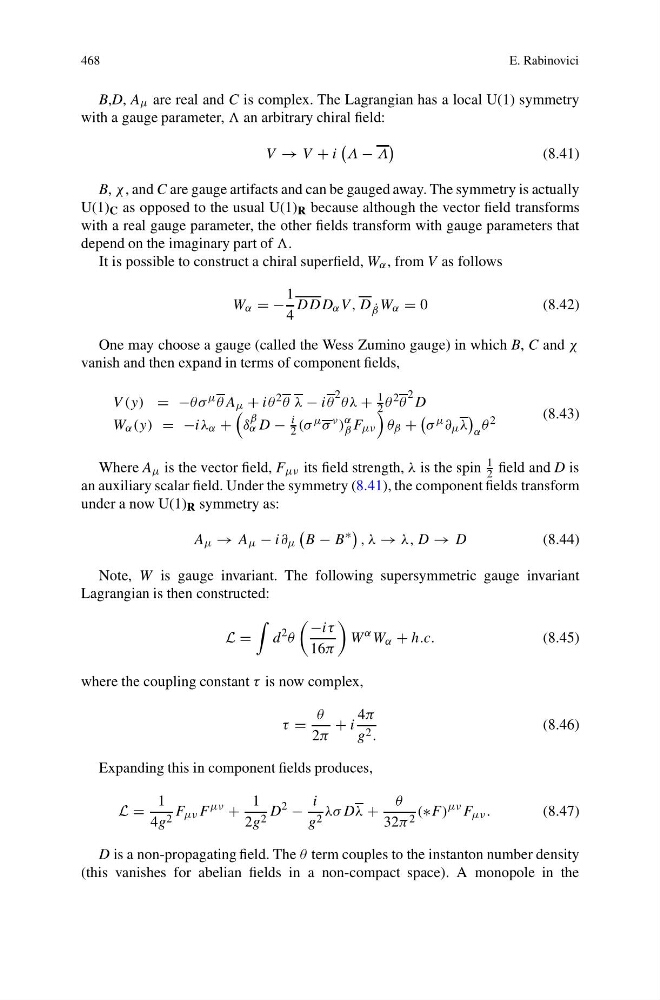
It is possible to construct a chiral superfield, W α , from V as follows
W α = −
1
4
DDD α V , D ˙
β W α = 0
(8.42)
One may choose a gauge (called the Wess Zumino gauge) in which B, C and χ
vanish and then expand in terms of component fields,
V (y) = −θσ μ θA μ + iθ 2 θ λ − iθ
2 θλ +
1
2 θ 2 θ
2 D
W α (y) = −iλ α +
δ
β
α D −
i
2 (σ μ σ ν )
α
β F μν
θ β +
σ μ ∂ μ λ
α
θ 2
(8.43)
Where A μ is the vector field, F μν its field strength, λ is the spin
1
2 field and D is
an auxiliary scalar field. Under the symmetry (8.41), the component fields transform
under a now U(1) R symmetry as:
A μ → A μ − i∂ μ
B − B
∗
, λ → λ, D → D
(8.44)
Note, W is gauge invariant. The following supersymmetric gauge invariant
Lagrangian is then constructed:
L =
d
2 θ
−iτ
16π
W
α W α + h.c.
(8.45)
where the coupling constant τ is now complex,
τ =
θ
2π
+ i
4π
g 2 .
(8.46)
Expanding this in component fields produces,
L =
1
4g 2 F μν F
μν
+
1
2g 2 D
2
−
i
g 2 λσ Dλ +
θ
32π 2 (∗F )
μν F μν .
(8.47)
D is a non-propagating field. The θ term couples to the instanton number density
(this vanishes for abelian fields in a non-compact space). A monopole in the
E. Rabinovici
B,D, A μ are real and C is complex. The Lagrangian has a local U(1) symmetry
with a gauge parameter, an arbitrary chiral field:
V → V + i
Λ − Λ
(8.41)
B, χ, and C are gauge artifacts and can be gauged away. The symmetry is actually
U(1) C as opposed to the usual U(1) R because although the vector field transforms
with a real gauge parameter, the other fields transform with gauge parameters that
depend on the imaginary part of
It is possible to construct a chiral superfield, W α , from V as follows
W α = −
1
4
DDD α V , D ˙
β W α = 0
(8.42)
One may choose a gauge (called the Wess Zumino gauge) in which B, C and χ
vanish and then expand in terms of component fields,
V (y) = −θσ μ θA μ + iθ 2 θ λ − iθ
2 θλ +
1
2 θ 2 θ
2 D
W α (y) = −iλ α +
δ
β
α D −
i
2 (σ μ σ ν )
α
β F μν
θ β +
σ μ ∂ μ λ
α
θ 2
(8.43)
Where A μ is the vector field, F μν its field strength, λ is the spin
1
2 field and D is
an auxiliary scalar field. Under the symmetry (8.41), the component fields transform
under a now U(1) R symmetry as:
A μ → A μ − i∂ μ
B − B
∗
, λ → λ, D → D
(8.44)
Note, W is gauge invariant. The following supersymmetric gauge invariant
Lagrangian is then constructed:
L =
d
2 θ
−iτ
16π
W
α W α + h.c.
(8.45)
where the coupling constant τ is now complex,
τ =
θ
2π
+ i
4π
g 2 .
(8.46)
Expanding this in component fields produces,
L =
1
4g 2 F μν F
μν
+
1
2g 2 D
2
−
i
g 2 λσ Dλ +
θ
32π 2 (∗F )
μν F μν .
(8.47)
D is a non-propagating field. The θ term couples to the instanton number density
(this vanishes for abelian fields in a non-compact space). A monopole in the