

3 The Standard Model of Electroweak Interactions
41
The denominator corresponds to the sum of the final states d ¯
u, s ¯
c, e − ¯
ν e , μ − ¯
ν μ ,
τ − ¯
ν τ (for the definition of d and s see Eq. (3.66)).
For t R = 0 the Z coupling to fermions in Eq. (3.17) can be cast into the form:
V ¯
ψ f ψ f Z =
g
2 cos θ W
¯
ψ f γ μ [g
f
V − g
f
A γ 5 ]ψ f Z
μ ,
(3.28)
with:
g
f
A = t
3f
L
, g
f
V /g
f
A = 1 − 4|Q f | sin
2 θ W .
(3.29)
and t
3f
L = ±1/2 for up-type or down-type fermions. In terms of g A,V given in
Eqs. (3.29) (the widths are proportional to (g 2
V +g 2
A )), the partial width (Z → ¯
f f )
in Born approximation (see the diagram in Fig. 3.2), for negligible fermion masses,
is given by:
(Z → ¯
f f ) = N C
αm Z
12 sin
2 2θ W
[1 + (1 − 4|Q f | sin
2 θ W )
2
]
= N C ρ 0
G F m 3
Z
24π
√
2
[1 + (1 − 4|Q f | sin
2 θ W )
2
].
(3.30)
where ρ 0 = m 2
W /m 2
Z cos 2 θ W is given in Eq. (3.55). The experimental values of the
Z total width and of the partial rates into charged leptons (average of e, μ and τ ),
into hadrons and into invisible channels are [5, 8] (see Chap. 6):
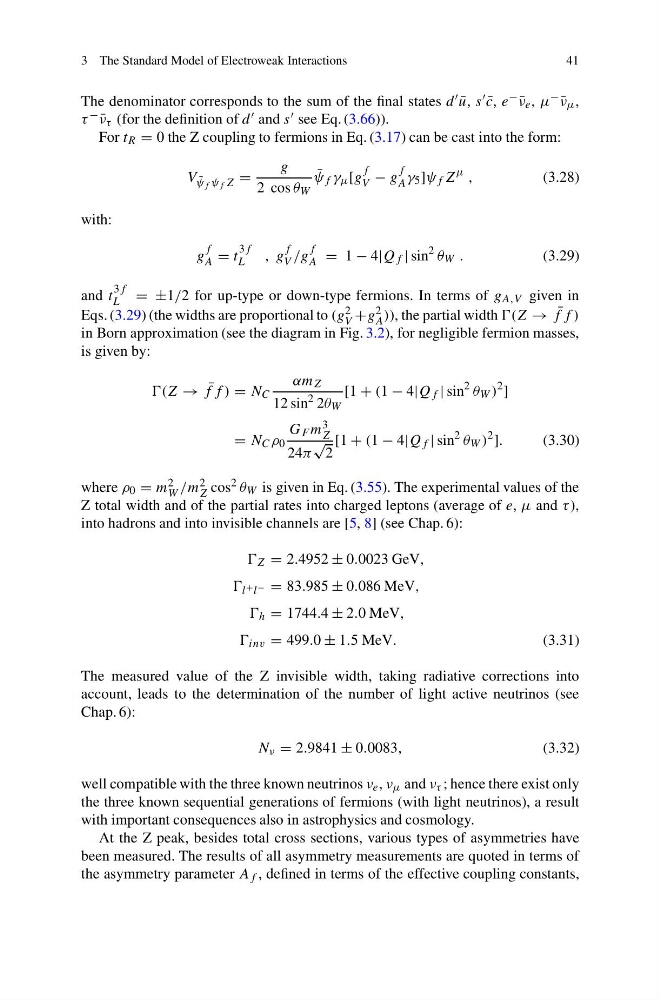
Z = 2.4952 ± 0.0023 GeV,
l + l − = 83.985 ± 0.086 MeV,
h = 1744.4 ± 2.0 MeV,
inv = 499.0 ± 1.5 MeV.
(3.31)
The measured value of the Z invisible width, taking radiative corrections into
account, leads to the determination of the number of light active neutrinos (see
Chap. 6):
N ν = 2.9841 ± 0.0083,
(3.32)
well compatible with the three known neutrinos ν e , ν μ and ν τ ; hence there exist only
the three known sequential generations of fermions (with light neutrinos), a result
with important consequences also in astrophysics and cosmology.
At the Z peak, besides total cross sections, various types of asymmetries have
been measured. The results of all asymmetry measurements are quoted in terms of
the asymmetry parameter A f , defined in terms of the effective coupling constants,
41
The denominator corresponds to the sum of the final states d ¯
u, s ¯
c, e − ¯
ν e , μ − ¯
ν μ ,
τ − ¯
ν τ (for the definition of d and s see Eq. (3.66)).
For t R = 0 the Z coupling to fermions in Eq. (3.17) can be cast into the form:
V ¯
ψ f ψ f Z =
g
2 cos θ W
¯
ψ f γ μ [g
f
V − g
f
A γ 5 ]ψ f Z
μ ,
(3.28)
with:
g
f
A = t
3f
L
, g
f
V /g
f
A = 1 − 4|Q f | sin
2 θ W .
(3.29)
and t
3f
L = ±1/2 for up-type or down-type fermions. In terms of g A,V given in
Eqs. (3.29) (the widths are proportional to (g 2
V +g 2
A )), the partial width (Z → ¯
f f )
in Born approximation (see the diagram in Fig. 3.2), for negligible fermion masses,
is given by:
(Z → ¯
f f ) = N C
αm Z
12 sin
2 2θ W
[1 + (1 − 4|Q f | sin
2 θ W )
2
]
= N C ρ 0
G F m 3
Z
24π
√
2
[1 + (1 − 4|Q f | sin
2 θ W )
2
].
(3.30)
where ρ 0 = m 2
W /m 2
Z cos 2 θ W is given in Eq. (3.55). The experimental values of the
Z total width and of the partial rates into charged leptons (average of e, μ and τ ),
into hadrons and into invisible channels are [5, 8] (see Chap. 6):
Z = 2.4952 ± 0.0023 GeV,
l + l − = 83.985 ± 0.086 MeV,
h = 1744.4 ± 2.0 MeV,
inv = 499.0 ± 1.5 MeV.
(3.31)
The measured value of the Z invisible width, taking radiative corrections into
account, leads to the determination of the number of light active neutrinos (see
Chap. 6):
N ν = 2.9841 ± 0.0083,
(3.32)
well compatible with the three known neutrinos ν e , ν μ and ν τ ; hence there exist only
the three known sequential generations of fermions (with light neutrinos), a result
with important consequences also in astrophysics and cosmology.
At the Z peak, besides total cross sections, various types of asymmetries have
been measured. The results of all asymmetry measurements are quoted in terms of
the asymmetry parameter A f , defined in terms of the effective coupling constants,