

42
G. Altarelli and S. Forte
g
f
V and g
f
A , as:
A f = 2
g
f
V g
f
A
g
f 2
V + g
f 2
A
= 2
g
f
V /g
f
A
1 + (g
f
V /g
f
A ) 2
,
A
f
FB =
3
4
A e A f . (3.33)
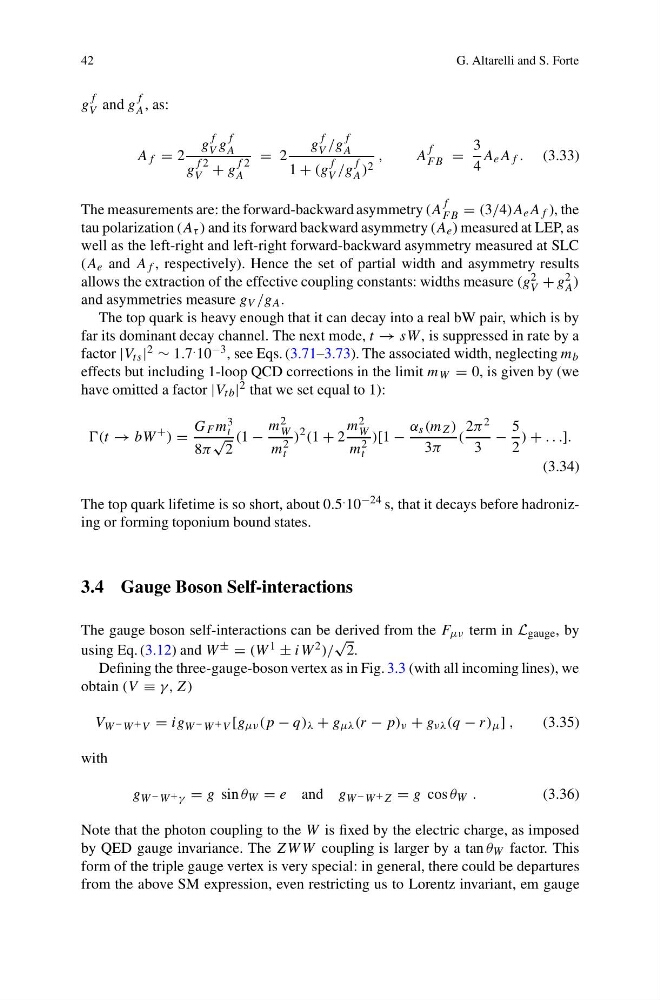
The measurements are: the forward-backward asymmetry (A
f
FB = (3/4)A e A f ), the
tau polarization (A τ ) and its forward backward asymmetry (A e ) measured at LEP, as
well as the left-right and left-right forward-backward asymmetry measured at SLC
(A e and A f , respectively). Hence the set of partial width and asymmetry results
allows the extraction of the effective coupling constants: widths measure (g 2
V + g 2
A )
and asymmetries measure g V /g A .
The top quark is heavy enough that it can decay into a real bW pair, which is by
far its dominant decay channel. The next mode, t → sW , is suppressed in rate by a
factor |V ts | 2 ∼ 1.7 . 10 −3 , see Eqs. (3.71–3.73). The associated width, neglecting m b
effects but including 1-loop QCD corrections in the limit m W = 0, is given by (we
have omitted a factor |V tb | 2 that we set equal to 1):
(t → bW
+ ) =
G F m 3
t
8π
√
2
(1 −
m 2
W
m 2
t
)
2 (1 + 2
m 2
W
m 2
t
)[1 −
α s (m Z )
3π
(
2π 2
3
−
5
2
) + . . .].
(3.34)
The top quark lifetime is so short, about 0.5 . 10 −24 s, that it decays before hadronizing or forming toponium bound states.
3.4 Gauge Boson Self-interactions
The gauge boson self-interactions can be derived from the F μν term in L gauge , by
using Eq. (3.12) and W ± = (W 1 ± iW 2 )/
√
2.
Defining the three-gauge-boson vertex as in Fig. 3.3 (with all incoming lines), we
obtain (V ≡ γ , Z)
V W − W + V = ig W − W + V [g μν (p − q) λ + g μλ (r − p) ν + g νλ (q − r) μ ] ,
(3.35)
with
g W − W + γ = g sin θ W = e and g W − W + Z = g cos θ W .
(3.36)
Note that the photon coupling to the W is fixed by the electric charge, as imposed
by QED gauge invariance. The ZW W coupling is larger by a tan θ W factor. This
form of the triple gauge vertex is very special: in general, there could be departures
from the above SM expression, even restricting us to Lorentz invariant, em gauge
G. Altarelli and S. Forte
g
f
V and g
f
A , as:
A f = 2
g
f
V g
f
A
g
f 2
V + g
f 2
A
= 2
g
f
V /g
f
A
1 + (g
f
V /g
f
A ) 2
,
A
f
FB =
3
4
A e A f . (3.33)
The measurements are: the forward-backward asymmetry (A
f
FB = (3/4)A e A f ), the
tau polarization (A τ ) and its forward backward asymmetry (A e ) measured at LEP, as
well as the left-right and left-right forward-backward asymmetry measured at SLC
(A e and A f , respectively). Hence the set of partial width and asymmetry results
allows the extraction of the effective coupling constants: widths measure (g 2
V + g 2
A )
and asymmetries measure g V /g A .
The top quark is heavy enough that it can decay into a real bW pair, which is by
far its dominant decay channel. The next mode, t → sW , is suppressed in rate by a
factor |V ts | 2 ∼ 1.7 . 10 −3 , see Eqs. (3.71–3.73). The associated width, neglecting m b
effects but including 1-loop QCD corrections in the limit m W = 0, is given by (we
have omitted a factor |V tb | 2 that we set equal to 1):
(t → bW
+ ) =
G F m 3
t
8π
√
2
(1 −
m 2
W
m 2
t
)
2 (1 + 2
m 2
W
m 2
t
)[1 −
α s (m Z )
3π
(
2π 2
3
−
5
2
) + . . .].
(3.34)
The top quark lifetime is so short, about 0.5 . 10 −24 s, that it decays before hadronizing or forming toponium bound states.
3.4 Gauge Boson Self-interactions
The gauge boson self-interactions can be derived from the F μν term in L gauge , by
using Eq. (3.12) and W ± = (W 1 ± iW 2 )/
√
2.
Defining the three-gauge-boson vertex as in Fig. 3.3 (with all incoming lines), we
obtain (V ≡ γ , Z)
V W − W + V = ig W − W + V [g μν (p − q) λ + g μλ (r − p) ν + g νλ (q − r) μ ] ,
(3.35)
with
g W − W + γ = g sin θ W = e and g W − W + Z = g cos θ W .
(3.36)
Note that the photon coupling to the W is fixed by the electric charge, as imposed
by QED gauge invariance. The ZW W coupling is larger by a tan θ W factor. This
form of the triple gauge vertex is very special: in general, there could be departures
from the above SM expression, even restricting us to Lorentz invariant, em gauge