

40
G. Altarelli and S. Forte
where
[. . .] ≡ t
3
L (1 − γ 5 ) + t
3
R (1 + γ 5 ) − 2Q sin
2 θ W
(3.23)
and
ρ 0 =
m 2
W
m 2
Z cos 2 θ W
.
(3.24)
All couplings given in this section are obtained at tree level and are modified in
higher orders of perturbation theory. In particular, the relations between m W and
sin θ W (Eqs. (3.20) and (3.21)) and the observed values of ρ (ρ = ρ 0 at tree level)
in different NC processes, are altered by computable EW radiative corrections, as
discussed in Sect. (3.11).
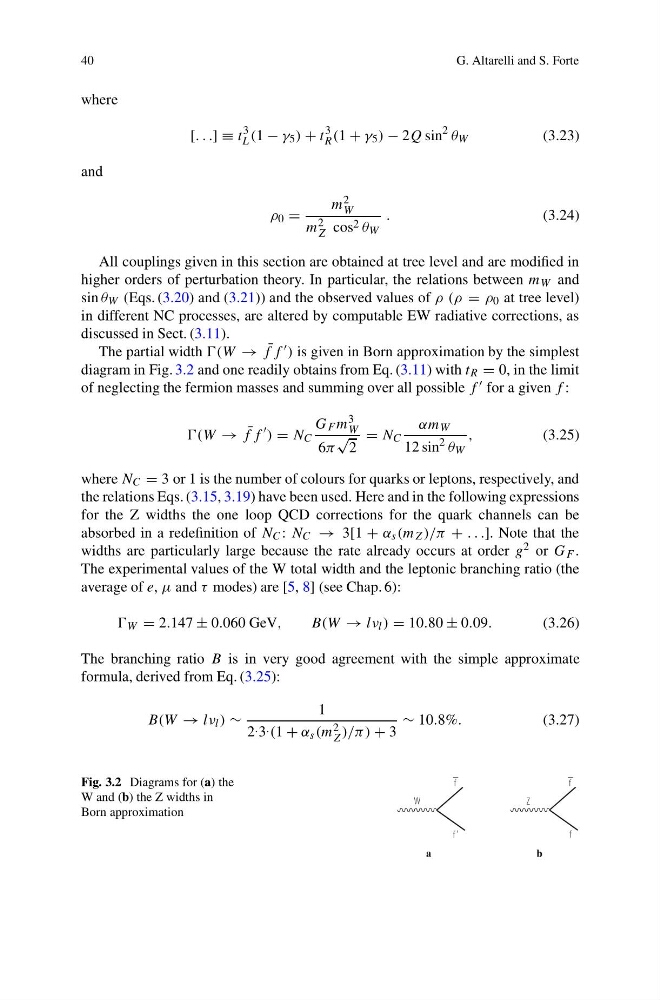
The partial width (W → ¯
f f ) is given in Born approximation by the simplest
diagram in Fig. 3.2 and one readily obtains from Eq. (3.11) with t R = 0, in the limit
of neglecting the fermion masses and summing over all possible f for a given f :
→ ¯
f f
) = N C
G F m
3
W
6π
√
2
= N C
αm W
12 sin
2 θ W
,
(3.25)
where N C = 3 or 1 is the number of colours for quarks or leptons, respectively, and
the relations Eqs. (3.15, 3.19) have been used. Here and in the following expressions
for the Z widths the one loop QCD corrections for the quark channels can be
absorbed in a redefinition of N C : N C → 3[1 + α s (m Z )/π + . . .]. Note that the
widths are particularly large because the rate already occurs at order g 2 or G F .
The experimental values of the W total width and the leptonic branching ratio (the
average of e, μ and τ modes) are [5, 8] (see Chap. 6):
W = 2.147 ± 0.060 GeV,
B(W → lν l ) = 10.80 ± 0.09.
(3.26)
The branching ratio B is in very good agreement with the simple approximate
formula, derived from Eq. (3.25):
B(W → lν l ) ∼
1
2 . 3 . (1 + α s (m 2
Z )/π) + 3
∼ 10.8%.
(3.27)
Fig. 3.2 Diagrams for (a) the
W and (b) the Z widths in
Born approximation
Z
a
W
b
f
f
f ’
f
G. Altarelli and S. Forte
where
[. . .] ≡ t
3
L (1 − γ 5 ) + t
3
R (1 + γ 5 ) − 2Q sin
2 θ W
(3.23)
and
ρ 0 =
m 2
W
m 2
Z cos 2 θ W
.
(3.24)
All couplings given in this section are obtained at tree level and are modified in
higher orders of perturbation theory. In particular, the relations between m W and
sin θ W (Eqs. (3.20) and (3.21)) and the observed values of ρ (ρ = ρ 0 at tree level)
in different NC processes, are altered by computable EW radiative corrections, as
discussed in Sect. (3.11).
The partial width (W → ¯
f f ) is given in Born approximation by the simplest
diagram in Fig. 3.2 and one readily obtains from Eq. (3.11) with t R = 0, in the limit
of neglecting the fermion masses and summing over all possible f for a given f :
→ ¯
f f
) = N C
G F m
3
W
6π
√
2
= N C
αm W
12 sin
2 θ W
,
(3.25)
where N C = 3 or 1 is the number of colours for quarks or leptons, respectively, and
the relations Eqs. (3.15, 3.19) have been used. Here and in the following expressions
for the Z widths the one loop QCD corrections for the quark channels can be
absorbed in a redefinition of N C : N C → 3[1 + α s (m Z )/π + . . .]. Note that the
widths are particularly large because the rate already occurs at order g 2 or G F .
The experimental values of the W total width and the leptonic branching ratio (the
average of e, μ and τ modes) are [5, 8] (see Chap. 6):
W = 2.147 ± 0.060 GeV,
B(W → lν l ) = 10.80 ± 0.09.
(3.26)
The branching ratio B is in very good agreement with the simple approximate
formula, derived from Eq. (3.25):
B(W → lν l ) ∼
1
2 . 3 . (1 + α s (m 2
Z )/π) + 3
∼ 10.8%.
(3.27)
Fig. 3.2 Diagrams for (a) the
W and (b) the Z widths in
Born approximation
Z
a
W
b
f
f
f ’
f