

3 The Standard Model of Electroweak Interactions
39
Once θ W has been fixed by the photon couplings, it is a simple matter of algebra to
derive the Z couplings, with the result
V ¯
ψψZ =
g
2 cos θ W
¯
ψγ μ [t
3
L (1 − γ 5 ) + t
3
R (1 + γ 5 ) − 2Q sin
2 θ W ]ψZ
μ ,
(3.17)
where V ¯
ψψZ is a notation for the vertex. Once again, recall that in the MSM, t 3
R = 0
and t 3
L = ±1/2.
In order to derive the effective four-fermion interactions that are equivalent, at
low energies, to the CC and NC couplings given in Eqs. (3.11) and (3.17), we
anticipate that large masses, as experimentally observed, are provided for W ± and
Z by L Higgs . For left–left CC couplings, when the momentum transfer squared can
be neglected, with respect to m 2
W , in the propagator of Born diagrams with single
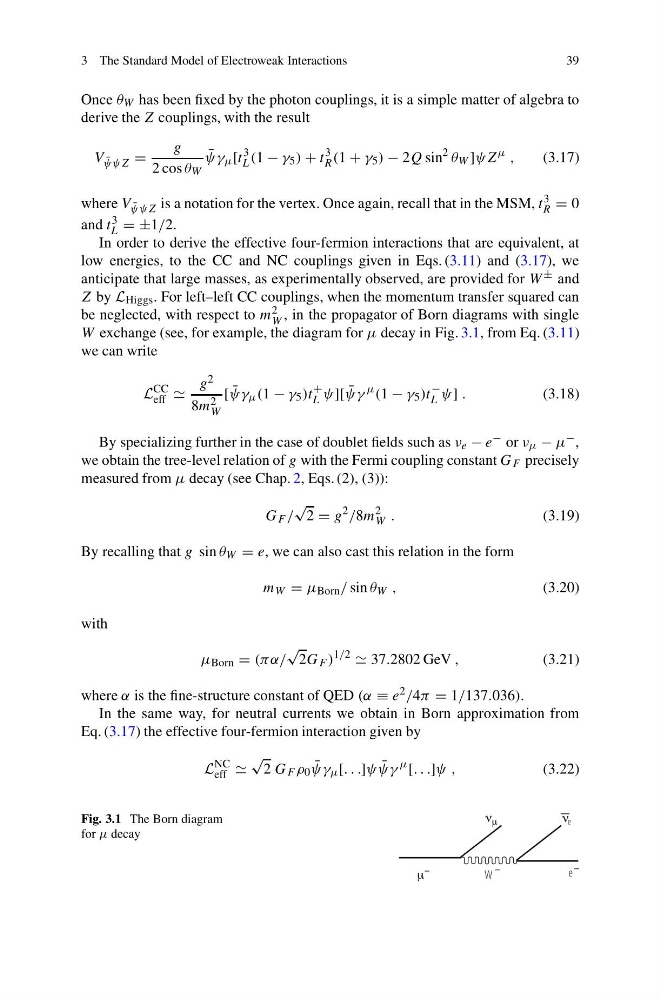
W exchange (see, for example, the diagram for μ decay in Fig. 3.1, from Eq. (3.11)
we can write
L
CC
eff
g 2
8m 2
W
[ ¯
ψγ μ (1 − γ 5 )t
+
L ψ][ ¯
ψγ
μ (1 − γ 5 )t
−
L ψ] .
(3.18)
By specializing further in the case of doublet fields such as ν e − e − or ν μ − μ − ,
we obtain the tree-level relation of g with the Fermi coupling constant G F precisely
measured from μ decay (see Chap. 2, Eqs. (2), (3)):
G F /
√
2 = g
2 /8m
2
W .
(3.19)
By recalling that g sin θ W = e, we can also cast this relation in the form
m W = μ Born / sin θ W ,
(3.20)
with
μ Born = (πα/
√
2G F )
1/2
37.2802 GeV ,
(3.21)
where α is the fine-structure constant of QED (α ≡ e 2 /4π = 1/137.036).
In the same way, for neutral currents we obtain in Born approximation from
Eq. (3.17) the effective four-fermion interaction given by
L
NC
eff
√
2 G F ρ 0 ¯
ψγ μ [. . .]ψ ¯
ψγ
μ
[. . .]ψ ,
(3.22)
Fig. 3.1 The Born diagram
for μ decay
W
e
e
39
Once θ W has been fixed by the photon couplings, it is a simple matter of algebra to
derive the Z couplings, with the result
V ¯
ψψZ =
g
2 cos θ W
¯
ψγ μ [t
3
L (1 − γ 5 ) + t
3
R (1 + γ 5 ) − 2Q sin
2 θ W ]ψZ
μ ,
(3.17)
where V ¯
ψψZ is a notation for the vertex. Once again, recall that in the MSM, t 3
R = 0
and t 3
L = ±1/2.
In order to derive the effective four-fermion interactions that are equivalent, at
low energies, to the CC and NC couplings given in Eqs. (3.11) and (3.17), we
anticipate that large masses, as experimentally observed, are provided for W ± and
Z by L Higgs . For left–left CC couplings, when the momentum transfer squared can
be neglected, with respect to m 2
W , in the propagator of Born diagrams with single
W exchange (see, for example, the diagram for μ decay in Fig. 3.1, from Eq. (3.11)
we can write
L
CC
eff
g 2
8m 2
W
[ ¯
ψγ μ (1 − γ 5 )t
+
L ψ][ ¯
ψγ
μ (1 − γ 5 )t
−
L ψ] .
(3.18)
By specializing further in the case of doublet fields such as ν e − e − or ν μ − μ − ,
we obtain the tree-level relation of g with the Fermi coupling constant G F precisely
measured from μ decay (see Chap. 2, Eqs. (2), (3)):
G F /
√
2 = g
2 /8m
2
W .
(3.19)
By recalling that g sin θ W = e, we can also cast this relation in the form
m W = μ Born / sin θ W ,
(3.20)
with
μ Born = (πα/
√
2G F )
1/2
37.2802 GeV ,
(3.21)
where α is the fine-structure constant of QED (α ≡ e 2 /4π = 1/137.036).
In the same way, for neutral currents we obtain in Born approximation from
Eq. (3.17) the effective four-fermion interaction given by
L
NC
eff
√
2 G F ρ 0 ¯
ψγ μ [. . .]ψ ¯
ψγ
μ
[. . .]ψ ,
(3.22)
Fig. 3.1 The Born diagram
for μ decay
W
e
e