

38
G. Altarelli and S. Forte
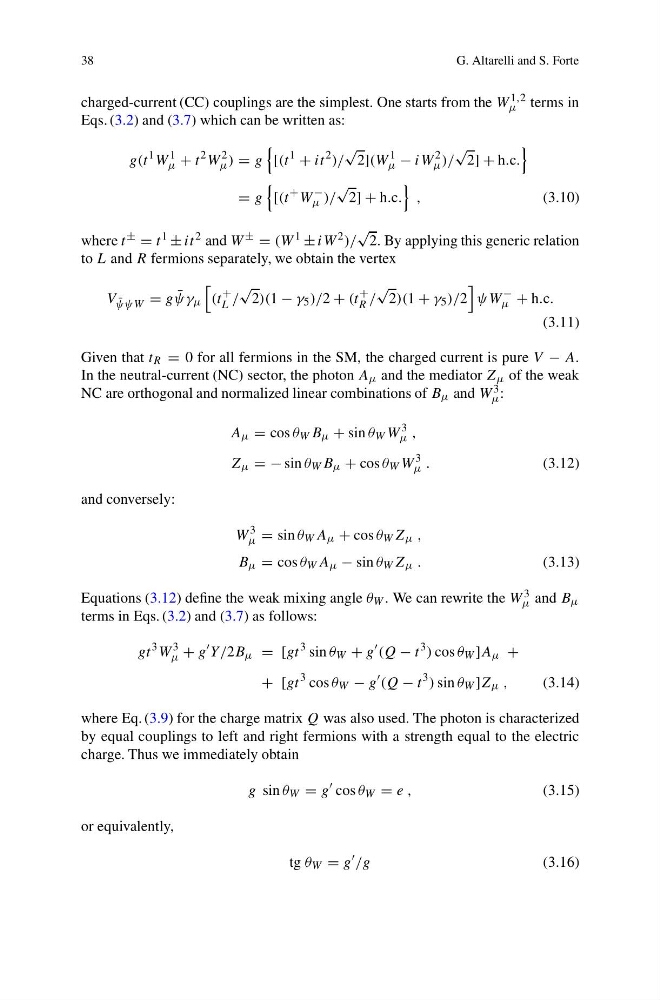
charged-current (CC) couplings are the simplest. One starts from the W 1,2
μ terms in
Eqs. (3.2) and (3.7) which can be written as:
g(t
1 W
1
μ + t
2 W
2
μ ) = g
[(t
1
+ it
2 )/
√
2](W
1
μ − iW
2
μ )/
√
2] + h.c.
= g
[(t
+ W
−
μ )/
√
2] + h.c.
,
(3.10)
where t ± = t 1 ± it 2 and W ± = (W 1 ± iW 2 )/
√
2. By applying this generic relation
to L and R fermions separately, we obtain the vertex
V ¯
ψψW = g ¯
ψγ μ
(t
+
L /
√
2)(1 − γ 5 )/2 + (t
+
R /
√
2)(1 + γ 5 )/2
ψW
−
μ + h.c.
(3.11)
Given that t R = 0 for all fermions in the SM, the charged current is pure V − A.
In the neutral-current (NC) sector, the photon A μ and the mediator Z μ of the weak
NC are orthogonal and normalized linear combinations of B μ and W 3
μ :
A μ = cos θ W B μ + sin θ W W
3
μ ,
Z μ = − sin θ W B μ + cos θ W W
3
μ .
(3.12)
and conversely:
W
3
μ = sin θ W A μ + cos θ W Z μ ,
B μ = cos θ W A μ − sin θ W Z μ .
(3.13)
Equations (3.12) define the weak mixing angle θ W . We can rewrite the W 3
μ and B μ
terms in Eqs. (3.2) and (3.7) as follows:
gt
3 W
3
μ + g
Y/2B μ = [gt
3 sin θ W + g
(Q − t
3 ) cos θ W ]A μ +
+ [gt
3 cos θ W − g
(Q − t
3 ) sin θ W ]Z μ ,
(3.14)
where Eq. (3.9) for the charge matrix Q was also used. The photon is characterized
by equal couplings to left and right fermions with a strength equal to the electric
charge. Thus we immediately obtain
g sin θ W = g
cos θ W = e ,
(3.15)
or equivalently,
tg θ W = g
/g
(3.16)
G. Altarelli and S. Forte
charged-current (CC) couplings are the simplest. One starts from the W 1,2
μ terms in
Eqs. (3.2) and (3.7) which can be written as:
g(t
1 W
1
μ + t
2 W
2
μ ) = g
[(t
1
+ it
2 )/
√
2](W
1
μ − iW
2
μ )/
√
2] + h.c.
= g
[(t
+ W
−
μ )/
√
2] + h.c.
,
(3.10)
where t ± = t 1 ± it 2 and W ± = (W 1 ± iW 2 )/
√
2. By applying this generic relation
to L and R fermions separately, we obtain the vertex
V ¯
ψψW = g ¯
ψγ μ
(t
+
L /
√
2)(1 − γ 5 )/2 + (t
+
R /
√
2)(1 + γ 5 )/2
ψW
−
μ + h.c.
(3.11)
Given that t R = 0 for all fermions in the SM, the charged current is pure V − A.
In the neutral-current (NC) sector, the photon A μ and the mediator Z μ of the weak
NC are orthogonal and normalized linear combinations of B μ and W 3
μ :
A μ = cos θ W B μ + sin θ W W
3
μ ,
Z μ = − sin θ W B μ + cos θ W W
3
μ .
(3.12)
and conversely:
W
3
μ = sin θ W A μ + cos θ W Z μ ,
B μ = cos θ W A μ − sin θ W Z μ .
(3.13)
Equations (3.12) define the weak mixing angle θ W . We can rewrite the W 3
μ and B μ
terms in Eqs. (3.2) and (3.7) as follows:
gt
3 W
3
μ + g
Y/2B μ = [gt
3 sin θ W + g
(Q − t
3 ) cos θ W ]A μ +
+ [gt
3 cos θ W − g
(Q − t
3 ) sin θ W ]Z μ ,
(3.14)
where Eq. (3.9) for the charge matrix Q was also used. The photon is characterized
by equal couplings to left and right fermions with a strength equal to the electric
charge. Thus we immediately obtain
g sin θ W = g
cos θ W = e ,
(3.15)
or equivalently,
tg θ W = g
/g
(3.16)