

3 The Standard Model of Electroweak Interactions
37
whilst for the γ 5 -odd,
¯
ψψ O ψ = ¯
ψ L O ψ L + ¯
ψ R O ψ R
(( O ≡ γ μ , γ μ γ 5 ) .
(3.6)
The standard EW theory is a chiral theory, in the sense that ψ L and ψ R behave
differently under the gauge group (so that parity and charge conjugation non
conservation are made possible in principle). Thus, mass terms for fermions (of
the form ¯
ψ L ψ R + h.c.) are forbidden in the symmetric limit. In particular, in the
Minimal Standard Model (MSM: i.e. the model that only includes all observed
particles plus a single Higgs doublet), all ψ L are SU (2) doublets while all ψ R
are singlets. But for the moment, by ψ L,R we mean column vectors, including
all fermion types in the theory that span generic reducible representations of
SU (2) ⊗ U(1).
In the absence of mass terms, there are only vector and axial vector interactions
in the lagrangian and those have the property of not mixing ψ L and ψ R . Fermion
masses will be introduced, together with W ± and Z masses, by the mechanism of
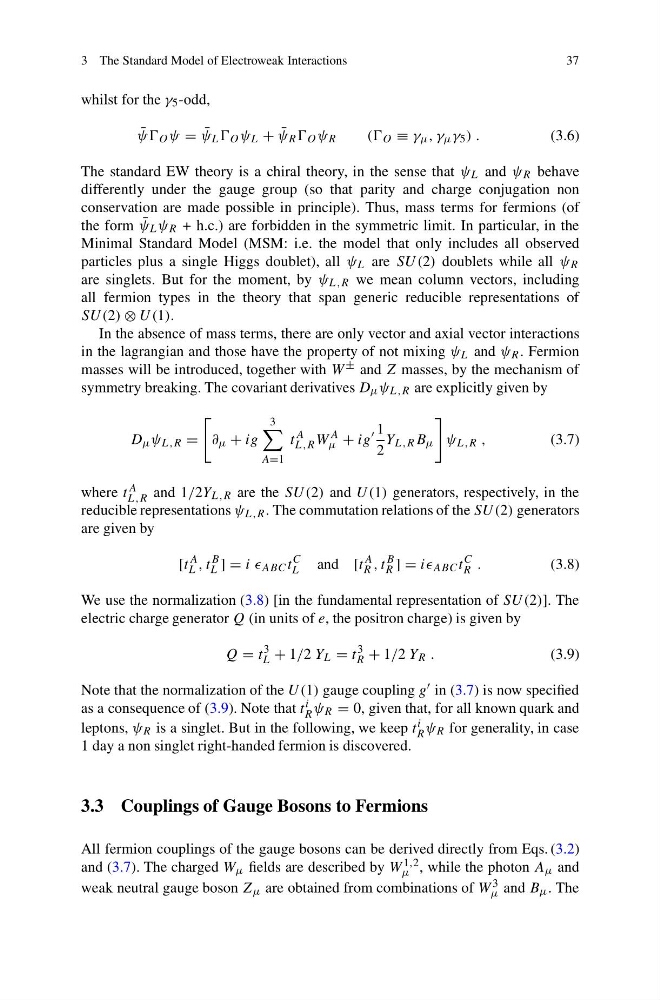
symmetry breaking. The covariant derivatives D μ ψ L,R are explicitly given by
D μ ψ L,R =
∂ μ + ig
3
A=1
t
A
L,R W
A
μ + ig
1
2
Y L,R B μ
ψ L,R ,
(3.7)
where t A
L,R and 1/2Y L,R are the SU (2) and U(1) generators, respectively, in the
reducible representations ψ L,R . The commutation relations of the SU (2) generators
are given by
[t
A
L , t
B
L ] = i i ABC t
C
L
and [t
A
R , t
B
R ] = ii ABC t
C
R .
(3.8)
We use the normalization (3.8) [in the fundamental representation of SU (2)]. The
electric charge generator Q (in units of e, the positron charge) is given by
Q = t
3
L + 1/2 Y L = t
3
R + 1/2 Y R .
(3.9)
Note that the normalization of the U(1) gauge coupling g in (3.7) is now specified
as a consequence of (3.9). Note that t
i
R ψ R = 0, given that, for all known quark and
leptons, ψ R is a singlet. But in the following, we keep t
i
R ψ R for generality, in case
1 day a non singlet right-handed fermion is discovered.
3.3 Couplings of Gauge Bosons to Fermions
All fermion couplings of the gauge bosons can be derived directly from Eqs. (3.2)
and (3.7). The charged W μ fields are described by W 1,2
μ , while the photon A μ and
weak neutral gauge boson Z μ are obtained from combinations of W 3
μ and B μ . The
37
whilst for the γ 5 -odd,
¯
ψψ O ψ = ¯
ψ L O ψ L + ¯
ψ R O ψ R
(( O ≡ γ μ , γ μ γ 5 ) .
(3.6)
The standard EW theory is a chiral theory, in the sense that ψ L and ψ R behave
differently under the gauge group (so that parity and charge conjugation non
conservation are made possible in principle). Thus, mass terms for fermions (of
the form ¯
ψ L ψ R + h.c.) are forbidden in the symmetric limit. In particular, in the
Minimal Standard Model (MSM: i.e. the model that only includes all observed
particles plus a single Higgs doublet), all ψ L are SU (2) doublets while all ψ R
are singlets. But for the moment, by ψ L,R we mean column vectors, including
all fermion types in the theory that span generic reducible representations of
SU (2) ⊗ U(1).
In the absence of mass terms, there are only vector and axial vector interactions
in the lagrangian and those have the property of not mixing ψ L and ψ R . Fermion
masses will be introduced, together with W ± and Z masses, by the mechanism of
symmetry breaking. The covariant derivatives D μ ψ L,R are explicitly given by
D μ ψ L,R =
∂ μ + ig
3
A=1
t
A
L,R W
A
μ + ig
1
2
Y L,R B μ
ψ L,R ,
(3.7)
where t A
L,R and 1/2Y L,R are the SU (2) and U(1) generators, respectively, in the
reducible representations ψ L,R . The commutation relations of the SU (2) generators
are given by
[t
A
L , t
B
L ] = i i ABC t
C
L
and [t
A
R , t
B
R ] = ii ABC t
C
R .
(3.8)
We use the normalization (3.8) [in the fundamental representation of SU (2)]. The
electric charge generator Q (in units of e, the positron charge) is given by
Q = t
3
L + 1/2 Y L = t
3
R + 1/2 Y R .
(3.9)
Note that the normalization of the U(1) gauge coupling g in (3.7) is now specified
as a consequence of (3.9). Note that t
i
R ψ R = 0, given that, for all known quark and
leptons, ψ R is a singlet. But in the following, we keep t
i
R ψ R for generality, in case
1 day a non singlet right-handed fermion is discovered.
3.3 Couplings of Gauge Bosons to Fermions
All fermion couplings of the gauge bosons can be derived directly from Eqs. (3.2)
and (3.7). The charged W μ fields are described by W 1,2
μ , while the photon A μ and
weak neutral gauge boson Z μ are obtained from combinations of W 3
μ and B μ . The