

36
G. Altarelli and S. Forte
spontaneous symmetry breaking responsible for the non vanishing vector boson and
fermion masses.
3.2 The Gauge Sector
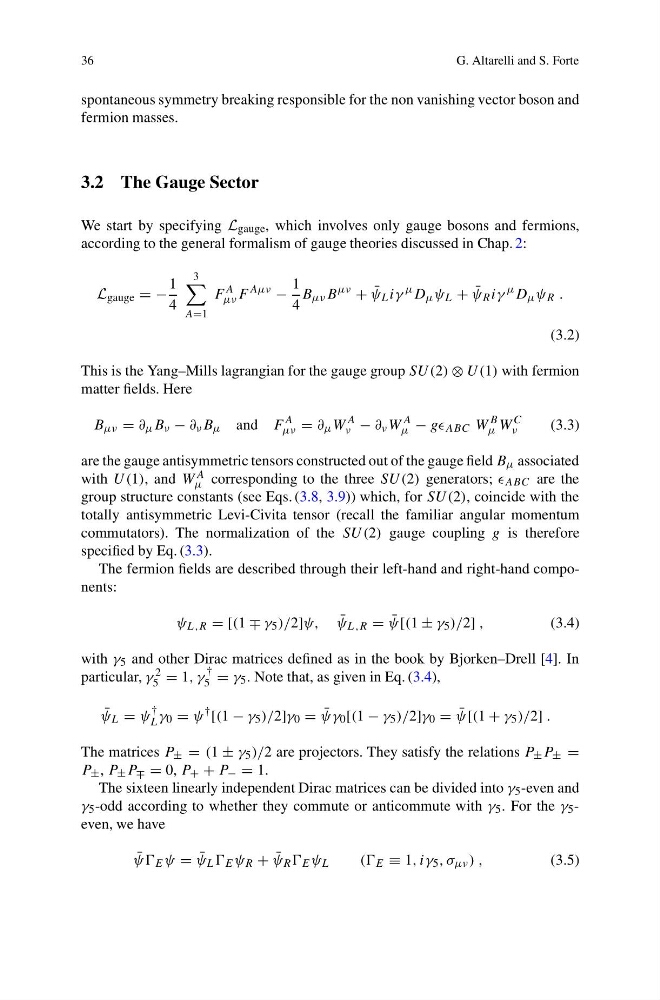
We start by specifying L gauge , which involves only gauge bosons and fermions,
according to the general formalism of gauge theories discussed in Chap. 2:
L gauge = −
1
4
3
A=1
F
A
μν F
Aμν
−
1
4
B μν B
μν
+ ¯
ψ L iγ
μ D μ ψ L + ¯
ψ R iγ
μ D μ ψ R .
(3.2)
This is the Yang–Mills lagrangian for the gauge group SU (2) ⊗ U(1) with fermion
matter fields. Here
B μν = ∂ μ B ν − ∂ ν B μ and F
A
μν = ∂ μ W
A
ν − ∂ ν W
A
μ − gg ABC W
B
μ W
C
ν
(3.3)
are the gauge antisymmetric tensors constructed out of the gauge field B μ associated
with U(1), and W A
μ corresponding to the three SU (2) generators; ABC are the
group structure constants (see Eqs. (3.8, 3.9)) which, for SU (2), coincide with the
totally antisymmetric Levi-Civita tensor (recall the familiar angular momentum
commutators). The normalization of the SU (2) gauge coupling g is therefore
specified by Eq. (3.3).
The fermion fields are described through their left-hand and right-hand components:
ψ L,R = [(1 ∓ γ 5 )/2]ψ, ¯
ψ L,R = ¯
ψ[(1 ± γ 5 )/2] ,
(3.4)
with γ 5 and other Dirac matrices defined as in the book by Bjorken–Drell [4]. In
particular, γ 2
5 = 1, γ
†
5 = γ 5 . Note that, as given in Eq. (3.4),
¯
ψ L = ψ
†
L γ 0 = ψ
†
[(1 − γ 5 )/2]γ 0 = ¯
ψγ 0 [(1 − γ 5 )/2]γ 0 = ¯
ψ[(1 + γ 5 )/2] .
The matrices P ± = (1 ± γ 5 )/2 are projectors. They satisfy the relations P ± P ± =
P ± , P ± P ∓ = 0, P + + P − = 1.
The sixteen linearly independent Dirac matrices can be divided into γ 5 -even and
γ 5 -odd according to whether they commute or anticommute with γ 5 . For the γ 5 -
even, we have
¯
ψψ E ψ = ¯
ψ L E ψ R + ¯
ψ R E ψ L
(( E ≡ 1, iγ 5 , σ μν ) ,
(3.5)
G. Altarelli and S. Forte
spontaneous symmetry breaking responsible for the non vanishing vector boson and
fermion masses.
3.2 The Gauge Sector
We start by specifying L gauge , which involves only gauge bosons and fermions,
according to the general formalism of gauge theories discussed in Chap. 2:
L gauge = −
1
4
3
A=1
F
A
μν F
Aμν
−
1
4
B μν B
μν
+ ¯
ψ L iγ
μ D μ ψ L + ¯
ψ R iγ
μ D μ ψ R .
(3.2)
This is the Yang–Mills lagrangian for the gauge group SU (2) ⊗ U(1) with fermion
matter fields. Here
B μν = ∂ μ B ν − ∂ ν B μ and F
A
μν = ∂ μ W
A
ν − ∂ ν W
A
μ − gg ABC W
B
μ W
C
ν
(3.3)
are the gauge antisymmetric tensors constructed out of the gauge field B μ associated
with U(1), and W A
μ corresponding to the three SU (2) generators; ABC are the
group structure constants (see Eqs. (3.8, 3.9)) which, for SU (2), coincide with the
totally antisymmetric Levi-Civita tensor (recall the familiar angular momentum
commutators). The normalization of the SU (2) gauge coupling g is therefore
specified by Eq. (3.3).
The fermion fields are described through their left-hand and right-hand components:
ψ L,R = [(1 ∓ γ 5 )/2]ψ, ¯
ψ L,R = ¯
ψ[(1 ± γ 5 )/2] ,
(3.4)
with γ 5 and other Dirac matrices defined as in the book by Bjorken–Drell [4]. In
particular, γ 2
5 = 1, γ
†
5 = γ 5 . Note that, as given in Eq. (3.4),
¯
ψ L = ψ
†
L γ 0 = ψ
†
[(1 − γ 5 )/2]γ 0 = ¯
ψγ 0 [(1 − γ 5 )/2]γ 0 = ¯
ψ[(1 + γ 5 )/2] .
The matrices P ± = (1 ± γ 5 )/2 are projectors. They satisfy the relations P ± P ± =
P ± , P ± P ∓ = 0, P + + P − = 1.
The sixteen linearly independent Dirac matrices can be divided into γ 5 -even and
γ 5 -odd according to whether they commute or anticommute with γ 5 . For the γ 5 -
even, we have
¯
ψψ E ψ = ¯
ψ L E ψ R + ¯
ψ R E ψ L
(( E ≡ 1, iγ 5 , σ μν ) ,
(3.5)