

8 Beyond the Standard Model
463
to construct explicitly supersymmetric Lagrangians. The integration formulas for
Grassmann variables are:
dθ α θ α =
∂
∂θ α
= 1,
dθ α = 0
(8.10)
Which results also in:
d
2 θd
2 θ L =
d
2 θ
∂ 2 L
∂θ 1 θ 2
(8.11)
The supercharges can be realized in superspace by generators of supertranslations:
Q α =
∂
∂θ α
− iσ
μ
α ˙
α θ
˙
α ∂ μ , Q ˙
α = −
∂
∂θ ˙
α
+ iθ
α σ
μ
α ˙
α ∂ μ .
(8.12)
To define the concept of (anti) chiral fields one defines a supercovariant
derivative:
D α =
∂
∂θ α
+ iσ
μ
α ˙
α θ
˙
α ∂ μ , D ˙
α = −
∂
∂θ ˙
α
− iθ
α σ
μ
α ˙
α ∂ μ .
(8.13)
A superfield is called “chiral” if:
D ˙
α Φ = 0.
(8.14)
Anti-chiral fields are defined by reversing the role of the θ and θ .
One introduces the variable,
y
μ
= x
μ
+ iθσ
μ θ
(8.15)
in terms of which the expansion of a chiral field is,
Φ(y) = A(y) +
√
2θψ(y) + θθF (y)
(8.16)
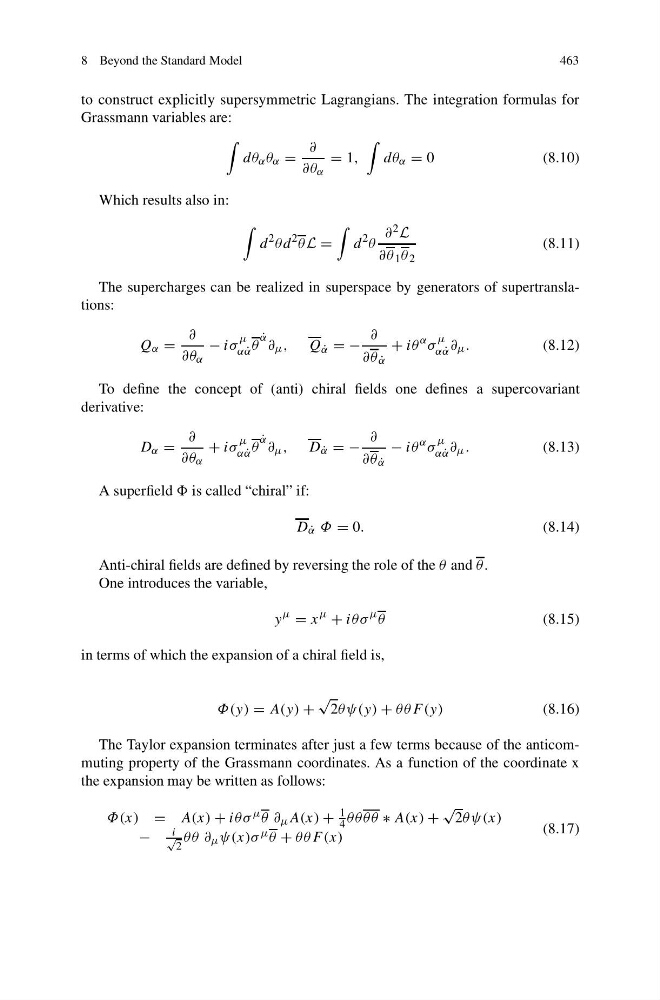
The Taylor expansion terminates after just a few terms because of the anticommuting property of the Grassmann coordinates. As a function of the coordinate x
the expansion may be written as follows:
Φ(x) = A(x) + iθσ μ θ ∂ μ A(x) +
1
4 θθθ θ ∗ A(x) +
√
2θψ(x)
−
i
√
2
θθ ∂ μ ψ(x)σ μ θ + θθF (x)
(8.17)
463
to construct explicitly supersymmetric Lagrangians. The integration formulas for
Grassmann variables are:
dθ α θ α =
∂
∂θ α
= 1,
dθ α = 0
(8.10)
Which results also in:
d
2 θd
2 θ L =
d
2 θ
∂ 2 L
∂θ 1 θ 2
(8.11)
The supercharges can be realized in superspace by generators of supertranslations:
Q α =
∂
∂θ α
− iσ
μ
α ˙
α θ
˙
α ∂ μ , Q ˙
α = −
∂
∂θ ˙
α
+ iθ
α σ
μ
α ˙
α ∂ μ .
(8.12)
To define the concept of (anti) chiral fields one defines a supercovariant
derivative:
D α =
∂
∂θ α
+ iσ
μ
α ˙
α θ
˙
α ∂ μ , D ˙
α = −
∂
∂θ ˙
α
− iθ
α σ
μ
α ˙
α ∂ μ .
(8.13)
A superfield is called “chiral” if:
D ˙
α Φ = 0.
(8.14)
Anti-chiral fields are defined by reversing the role of the θ and θ .
One introduces the variable,
y
μ
= x
μ
+ iθσ
μ θ
(8.15)
in terms of which the expansion of a chiral field is,
Φ(y) = A(y) +
√
2θψ(y) + θθF (y)
(8.16)
The Taylor expansion terminates after just a few terms because of the anticommuting property of the Grassmann coordinates. As a function of the coordinate x
the expansion may be written as follows:
Φ(x) = A(x) + iθσ μ θ ∂ μ A(x) +
1
4 θθθ θ ∗ A(x) +
√
2θψ(x)
−
i
√
2
θθ ∂ μ ψ(x)σ μ θ + θθF (x)
(8.17)