

464
E. Rabinovici
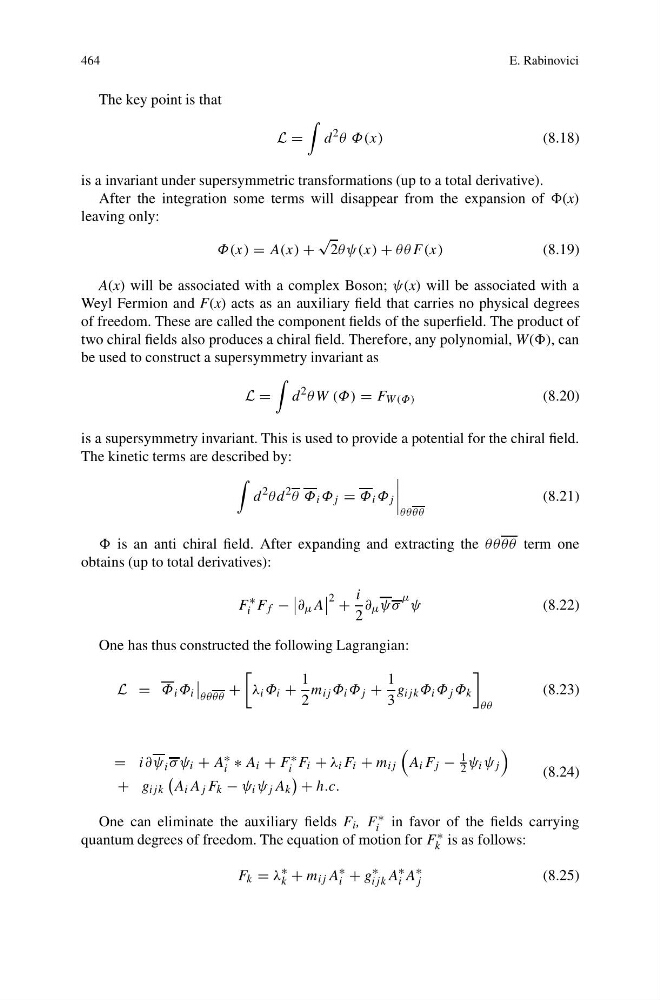
The key point is that
L =
d
2 θ Φ(x)
(8.18)
is a invariant under supersymmetric transformations (up to a total derivative).
After the integration some terms will disappear from the expansion of
leaving only:
Φ(x) = A(x) +
√
2θψ(x) + θθF (x)
(8.19)
A(x) will be associated with a complex Boson; ψ(x) will be associated with a
Weyl Fermion and F(x) acts as an auxiliary field that carries no physical degrees
of freedom. These are called the component fields of the superfield. The product of
two chiral fields also produces a chiral field. Therefore, any polynomial, W(), can
be used to construct a supersymmetry invariant as
L =
d
2 θW (Φ) = F W (Φ)
(8.20)
is a supersymmetry invariant. This is used to provide a potential for the chiral field.
The kinetic terms are described by:
d
2 θd
2 θ Φ i Φ j = Φ i Φ j
θθθ θ
(8.21)
is an anti chiral field. After expanding and extracting the θθθθ term one
obtains (up to total derivatives):
F
∗
i F f −
∂ μ A
2 +
i
2
∂ μ ψσ
μ ψ
(8.22)
One has thus constructed the following Lagrangian:
L = Φ i Φ i
θθθθ
+
λ i Φ i +
1
2
m ij Φ i Φ j +
1
3
g ij k Φ i Φ j Φ k
θθ
(8.23)
= i∂ψ i σ ψ i + A ∗
i ∗ A i + F ∗
i F i + λ i F i + m ij
A i F j −
1
2 ψ i ψ j
+ g ij k
A i A j F k − ψ i ψ j A k
+ h.c.
(8.24)
One can eliminate the auxiliary fields F i , F ∗
i in favor of the fields carrying
quantum degrees of freedom. The equation of motion for F ∗
k is as follows:
F k = λ
∗
k + m ij A
∗
i + g
∗
ij k A
∗
i A
∗
j
(8.25)
E. Rabinovici
The key point is that
L =
d
2 θ Φ(x)
(8.18)
is a invariant under supersymmetric transformations (up to a total derivative).
After the integration some terms will disappear from the expansion of
leaving only:
Φ(x) = A(x) +
√
2θψ(x) + θθF (x)
(8.19)
A(x) will be associated with a complex Boson; ψ(x) will be associated with a
Weyl Fermion and F(x) acts as an auxiliary field that carries no physical degrees
of freedom. These are called the component fields of the superfield. The product of
two chiral fields also produces a chiral field. Therefore, any polynomial, W(), can
be used to construct a supersymmetry invariant as
L =
d
2 θW (Φ) = F W (Φ)
(8.20)
is a supersymmetry invariant. This is used to provide a potential for the chiral field.
The kinetic terms are described by:
d
2 θd
2 θ Φ i Φ j = Φ i Φ j
θθθ θ
(8.21)
is an anti chiral field. After expanding and extracting the θθθθ term one
obtains (up to total derivatives):
F
∗
i F f −
∂ μ A
2 +
i
2
∂ μ ψσ
μ ψ
(8.22)
One has thus constructed the following Lagrangian:
L = Φ i Φ i
θθθθ
+
λ i Φ i +
1
2
m ij Φ i Φ j +
1
3
g ij k Φ i Φ j Φ k
θθ
(8.23)
= i∂ψ i σ ψ i + A ∗
i ∗ A i + F ∗
i F i + λ i F i + m ij
A i F j −
1
2 ψ i ψ j
+ g ij k
A i A j F k − ψ i ψ j A k
+ h.c.
(8.24)
One can eliminate the auxiliary fields F i , F ∗
i in favor of the fields carrying
quantum degrees of freedom. The equation of motion for F ∗
k is as follows:
F k = λ
∗
k + m ij A
∗
i + g
∗
ij k A
∗
i A
∗
j
(8.25)