

462
E. Rabinovici
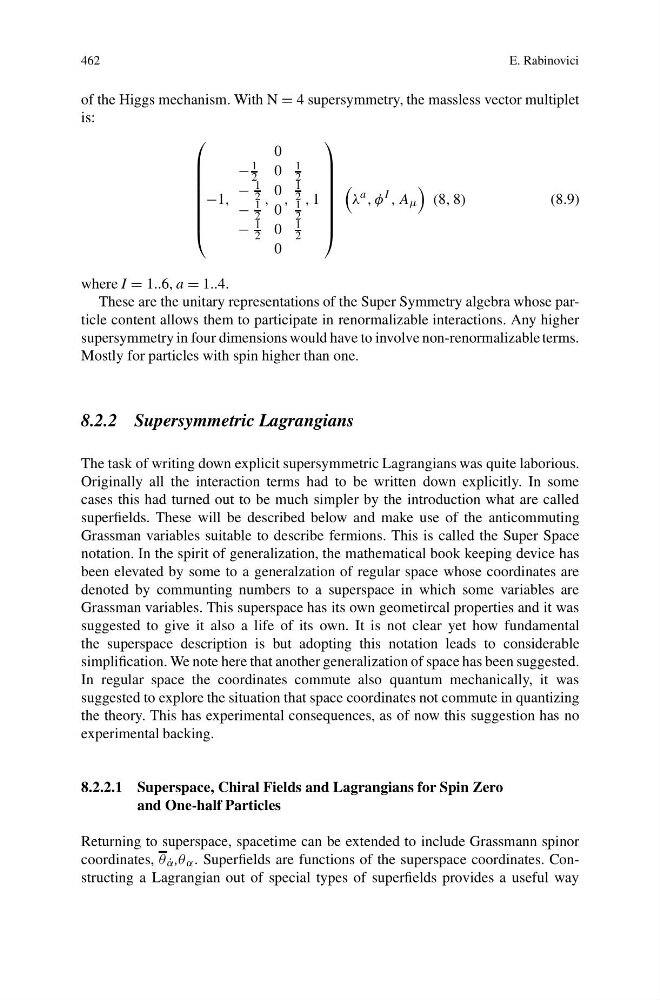
of the Higgs mechanism. With N = 4 supersymmetry, the massless vector multiplet
is:
⎛
⎜
⎜
⎜
⎜
⎜
⎜
⎜
⎝
−1,
−
1
2
−
1
2
−
1
2
−
1
2
,
0
0
0
0
0
0
,
1
2
1
2
1
2
1
2
, 1
⎞
⎟
⎟
⎟
⎟
⎟
⎟
⎟
⎠
λ
a , φ
I , A μ
(8, 8)
(8.9)
where I = 1..6, a = 1..4.
These are the unitary representations of the Super Symmetry algebra whose particle content allows them to participate in renormalizable interactions. Any higher
supersymmetry in four dimensions would have to involve non-renormalizable terms.
Mostly for particles with spin higher than one.
8.2.2 Supersymmetric Lagrangians
The task of writing down explicit supersymmetric Lagrangians was quite laborious.
Originally all the interaction terms had to be written down explicitly. In some
cases this had turned out to be much simpler by the introduction what are called
superfields. These will be described below and make use of the anticommuting
Grassman variables suitable to describe fermions. This is called the Super Space
notation. In the spirit of generalization, the mathematical book keeping device has
been elevated by some to a generalzation of regular space whose coordinates are
denoted by communting numbers to a superspace in which some variables are
Grassman variables. This superspace has its own geometircal properties and it was
suggested to give it also a life of its own. It is not clear yet how fundamental
the superspace description is but adopting this notation leads to considerable
simplification. We note here that another generalization of space has been suggested.
In regular space the coordinates commute also quantum mechanically, it was
suggested to explore the situation that space coordinates not commute in quantizing
the theory. This has experimental consequences, as of now this suggestion has no
experimental backing.
8.2.2.1 Superspace, Chiral Fields and Lagrangians for Spin Zero
and One-half Particles
Returning to superspace, spacetime can be extended to include Grassmann spinor
coordinates, θ ˙
α ,θ α . Superfields are functions of the superspace coordinates. Constructing a Lagrangian out of special types of superfields provides a useful way
E. Rabinovici
of the Higgs mechanism. With N = 4 supersymmetry, the massless vector multiplet
is:
⎛
⎜
⎜
⎜
⎜
⎜
⎜
⎜
⎝
−1,
−
1
2
−
1
2
−
1
2
−
1
2
,
0
0
0
0
0
0
,
1
2
1
2
1
2
1
2
, 1
⎞
⎟
⎟
⎟
⎟
⎟
⎟
⎟
⎠
λ
a , φ
I , A μ
(8, 8)
(8.9)
where I = 1..6, a = 1..4.
These are the unitary representations of the Super Symmetry algebra whose particle content allows them to participate in renormalizable interactions. Any higher
supersymmetry in four dimensions would have to involve non-renormalizable terms.
Mostly for particles with spin higher than one.
8.2.2 Supersymmetric Lagrangians
The task of writing down explicit supersymmetric Lagrangians was quite laborious.
Originally all the interaction terms had to be written down explicitly. In some
cases this had turned out to be much simpler by the introduction what are called
superfields. These will be described below and make use of the anticommuting
Grassman variables suitable to describe fermions. This is called the Super Space
notation. In the spirit of generalization, the mathematical book keeping device has
been elevated by some to a generalzation of regular space whose coordinates are
denoted by communting numbers to a superspace in which some variables are
Grassman variables. This superspace has its own geometircal properties and it was
suggested to give it also a life of its own. It is not clear yet how fundamental
the superspace description is but adopting this notation leads to considerable
simplification. We note here that another generalization of space has been suggested.
In regular space the coordinates commute also quantum mechanically, it was
suggested to explore the situation that space coordinates not commute in quantizing
the theory. This has experimental consequences, as of now this suggestion has no
experimental backing.
8.2.2.1 Superspace, Chiral Fields and Lagrangians for Spin Zero
and One-half Particles
Returning to superspace, spacetime can be extended to include Grassmann spinor
coordinates, θ ˙
α ,θ α . Superfields are functions of the superspace coordinates. Constructing a Lagrangian out of special types of superfields provides a useful way