

8 Beyond the Standard Model
461
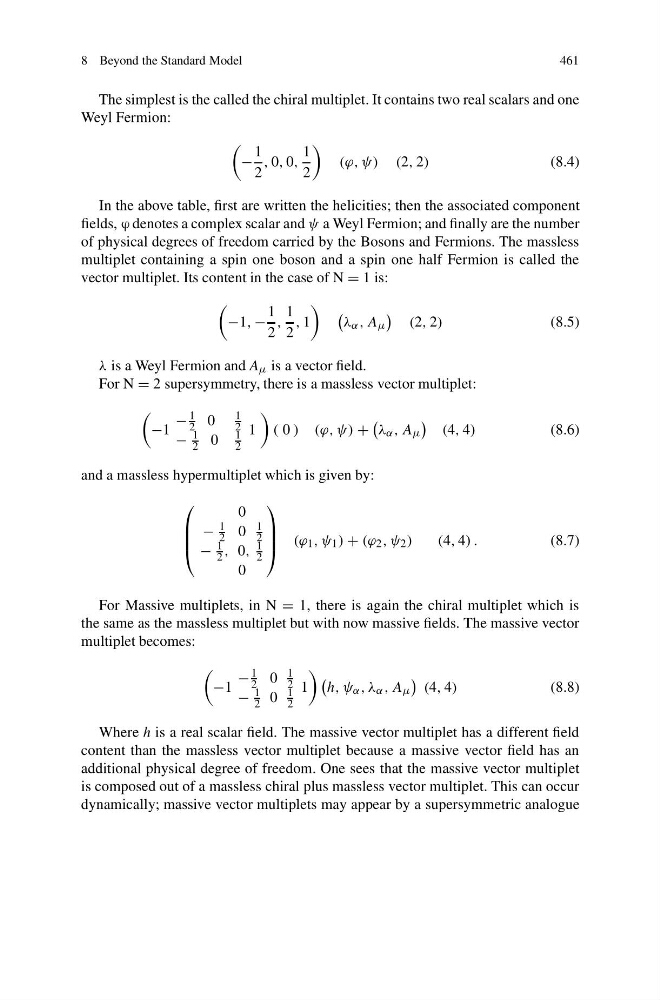
The simplest is the called the chiral multiplet. It contains two real scalars and one
Weyl Fermion:
−
1
2
, 0, 0,
1
2
(ϕ, ψ) (2, 2)
(8.4)
In the above table, first are written the helicities; then the associated component
fields, ϕ denotes a complex scalar and ψ a Weyl Fermion; and finally are the number
of physical degrees of freedom carried by the Bosons and Fermions. The massless
multiplet containing a spin one boson and a spin one half Fermion is called the
vector multiplet. Its content in the case of N = 1 is:
−1, −
1
2
,
1
2
, 1
λ α , A μ
(2, 2)
(8.5)
λ is a Weyl Fermion and A μ is a vector field.
For N = 2 supersymmetry, there is a massless vector multiplet:
−1
−
1
2 0
−
1
2 0
1
2
1
2
1
( 0 ) (ϕ, ψ) +
λ α , A μ
(4, 4)
(8.6)
and a massless hypermultiplet which is given by:
⎛
⎜
⎜
⎝
0
−
1
2 0
1
2
−
1
2 , 0,
1
2
0
⎞
⎟
⎟
⎠ (ϕ 1 , ψ 1 ) + (ϕ 2 , ψ 2 )
(4, 4) .
(8.7)
For Massive multiplets, in N = 1, there is again the chiral multiplet which is
the same as the massless multiplet but with now massive fields. The massive vector
multiplet becomes:
−1
−
1
2
−
1
2
0
0
1
2
1
2
1
h, ψ α , λ α , A μ
(4, 4)
(8.8)
Where h is a real scalar field. The massive vector multiplet has a different field
content than the massless vector multiplet because a massive vector field has an
additional physical degree of freedom. One sees that the massive vector multiplet
is composed out of a massless chiral plus massless vector multiplet. This can occur
dynamically; massive vector multiplets may appear by a supersymmetric analogue
461
The simplest is the called the chiral multiplet. It contains two real scalars and one
Weyl Fermion:
−
1
2
, 0, 0,
1
2
(ϕ, ψ) (2, 2)
(8.4)
In the above table, first are written the helicities; then the associated component
fields, ϕ denotes a complex scalar and ψ a Weyl Fermion; and finally are the number
of physical degrees of freedom carried by the Bosons and Fermions. The massless
multiplet containing a spin one boson and a spin one half Fermion is called the
vector multiplet. Its content in the case of N = 1 is:
−1, −
1
2
,
1
2
, 1
λ α , A μ
(2, 2)
(8.5)
λ is a Weyl Fermion and A μ is a vector field.
For N = 2 supersymmetry, there is a massless vector multiplet:
−1
−
1
2 0
−
1
2 0
1
2
1
2
1
( 0 ) (ϕ, ψ) +
λ α , A μ
(4, 4)
(8.6)
and a massless hypermultiplet which is given by:
⎛
⎜
⎜
⎝
0
−
1
2 0
1
2
−
1
2 , 0,
1
2
0
⎞
⎟
⎟
⎠ (ϕ 1 , ψ 1 ) + (ϕ 2 , ψ 2 )
(4, 4) .
(8.7)
For Massive multiplets, in N = 1, there is again the chiral multiplet which is
the same as the massless multiplet but with now massive fields. The massive vector
multiplet becomes:
−1
−
1
2
−
1
2
0
0
1
2
1
2
1
h, ψ α , λ α , A μ
(4, 4)
(8.8)
Where h is a real scalar field. The massive vector multiplet has a different field
content than the massless vector multiplet because a massive vector field has an
additional physical degree of freedom. One sees that the massive vector multiplet
is composed out of a massless chiral plus massless vector multiplet. This can occur
dynamically; massive vector multiplets may appear by a supersymmetric analogue