

460
E. Rabinovici
8.2.1 Elementary Particles in SUSY Models: Algebraic
Structure
Many successes resulted from the application of symmetry principles to systems
such as atoms, nuclei and elementary particles. They have been obtained even in
the face of a rather incomplete understanding of the dynamics of these systems.
Consequentially evermore higher symmetries were searched for, and in particular
unifying ones. Such was the search for a symmetry that would contain in a
non-trivial way both the Poincar’e space time symmetry and internal symmetries
such as Isospin and flavor SU(3). It was shown that that was impossible, only
a trivial product symmetry is allowed. Theorems are proved under assumptions,
time and again new important directions emerge once significant loop holes in the
assumptions are uncovered. Such was the case for obtaining consistently massive
spin one particles and such was the case here. Allowing the algebra of the symmetry
generators to be graded, i.e. to include both commutators and anti commutators a
new structure containing both Poincar’e and internal symmetries was discovered.
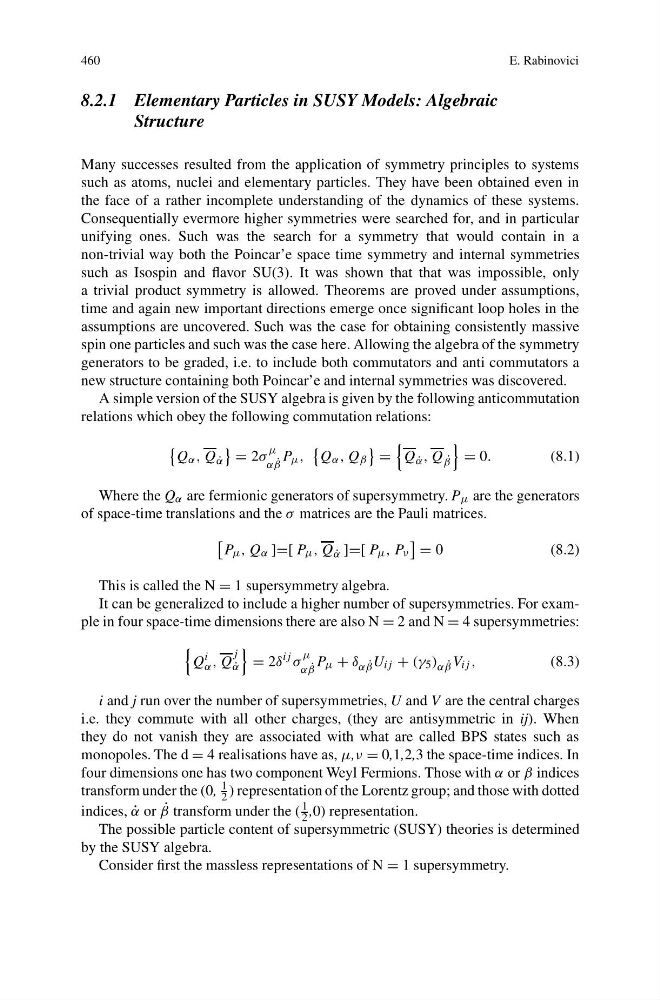
A simple version of the SUSY algebra is given by the following anticommutation
relations which obey the following commutation relations:
Q α , Q ˙
α
= 2σ
μ
α ˙
β
P μ ,
Q α , Q β
=
Q ˙
α , Q ˙
β
= 0.
(8.1)
Where the Q α are fermionic generators of supersymmetry. P μ are the generators
of space-time translations and the σ matrices are the Pauli matrices.
P μ , Q α ]=[ P μ , Q ˙
α ]=[ P μ , P ν
= 0
(8.2)
This is called the N = 1 supersymmetry algebra.
It can be generalized to include a higher number of supersymmetries. For example in four space-time dimensions there are also N = 2 and N = 4 supersymmetries:
Q
i
α , Q
j
˙
α
= 2δ
ij σ
μ
α ˙
β
P μ + δ α ˙
β U ij + (γ 5 ) α ˙
β V ij ,
(8.3)
i and j run over the number of supersymmetries, U and V are the central charges
i.e. they commute with all other charges, (they are antisymmetric in ij). When
they do not vanish they are associated with what are called BPS states such as
monopoles. The d = 4 realisations have as, μ,ν = 0,1,2,3 the space-time indices. In
four dimensions one has two component Weyl Fermions. Those with α or β indices
transform under the (0,
1
2 ) representation of the Lorentz group; and those with dotted
indices, ˙
α or ˙
β transform under the (
1
2 ,0) representation.
The possible particle content of supersymmetric (SUSY) theories is determined
by the SUSY algebra.
Consider first the massless representations of N = 1 supersymmetry.
E. Rabinovici
8.2.1 Elementary Particles in SUSY Models: Algebraic
Structure
Many successes resulted from the application of symmetry principles to systems
such as atoms, nuclei and elementary particles. They have been obtained even in
the face of a rather incomplete understanding of the dynamics of these systems.
Consequentially evermore higher symmetries were searched for, and in particular
unifying ones. Such was the search for a symmetry that would contain in a
non-trivial way both the Poincar’e space time symmetry and internal symmetries
such as Isospin and flavor SU(3). It was shown that that was impossible, only
a trivial product symmetry is allowed. Theorems are proved under assumptions,
time and again new important directions emerge once significant loop holes in the
assumptions are uncovered. Such was the case for obtaining consistently massive
spin one particles and such was the case here. Allowing the algebra of the symmetry
generators to be graded, i.e. to include both commutators and anti commutators a
new structure containing both Poincar’e and internal symmetries was discovered.
A simple version of the SUSY algebra is given by the following anticommutation
relations which obey the following commutation relations:
Q α , Q ˙
α
= 2σ
μ
α ˙
β
P μ ,
Q α , Q β
=
Q ˙
α , Q ˙
β
= 0.
(8.1)
Where the Q α are fermionic generators of supersymmetry. P μ are the generators
of space-time translations and the σ matrices are the Pauli matrices.
P μ , Q α ]=[ P μ , Q ˙
α ]=[ P μ , P ν
= 0
(8.2)
This is called the N = 1 supersymmetry algebra.
It can be generalized to include a higher number of supersymmetries. For example in four space-time dimensions there are also N = 2 and N = 4 supersymmetries:
Q
i
α , Q
j
˙
α
= 2δ
ij σ
μ
α ˙
β
P μ + δ α ˙
β U ij + (γ 5 ) α ˙
β V ij ,
(8.3)
i and j run over the number of supersymmetries, U and V are the central charges
i.e. they commute with all other charges, (they are antisymmetric in ij). When
they do not vanish they are associated with what are called BPS states such as
monopoles. The d = 4 realisations have as, μ,ν = 0,1,2,3 the space-time indices. In
four dimensions one has two component Weyl Fermions. Those with α or β indices
transform under the (0,
1
2 ) representation of the Lorentz group; and those with dotted
indices, ˙
α or ˙
β transform under the (
1
2 ,0) representation.
The possible particle content of supersymmetric (SUSY) theories is determined
by the SUSY algebra.
Consider first the massless representations of N = 1 supersymmetry.