

440
R. Stock
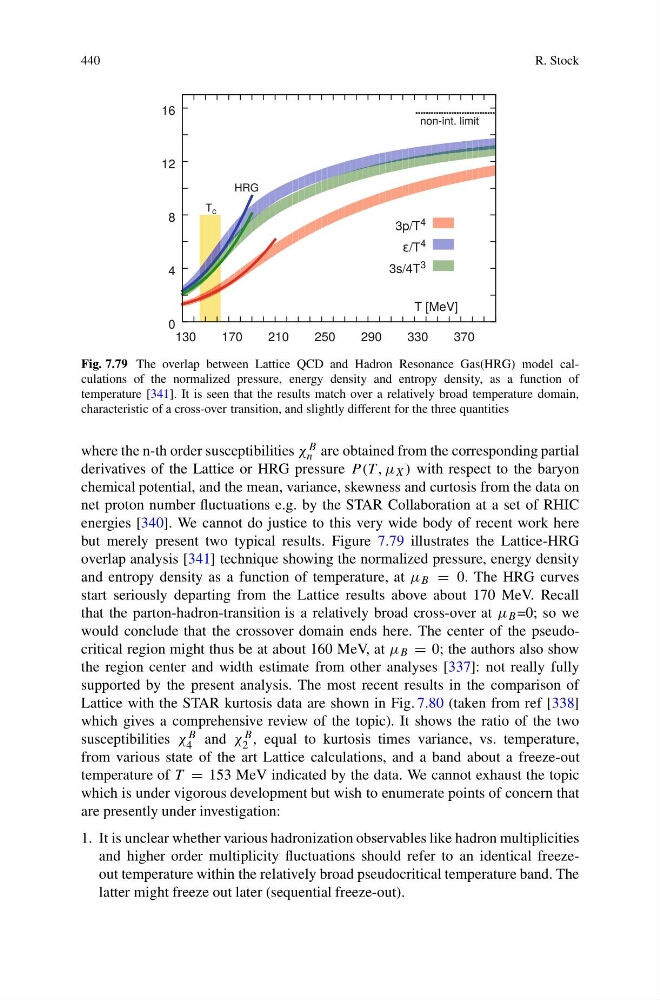
Fig. 7.79 The overlap between Lattice QCD and Hadron Resonance Gas(HRG) model calculations of the normalized pressure, energy density and entropy density, as a function of
temperature [341]. It is seen that the results match over a relatively broad temperature domain,
characteristic of a cross-over transition, and slightly different for the three quantities
where the n-th order susceptibilities χ B
n are obtained from the corresponding partial
derivatives of the Lattice or HRG pressure P (T , μ X ) with respect to the baryon
chemical potential, and the mean, variance, skewness and curtosis from the data on
net proton number fluctuations e.g. by the STAR Collaboration at a set of RHIC
energies [340]. We cannot do justice to this very wide body of recent work here
but merely present two typical results. Figure 7.79 illustrates the Lattice-HRG
overlap analysis [341] technique showing the normalized pressure, energy density
and entropy density as a function of temperature, at μ B = 0. The HRG curves
start seriously departing from the Lattice results above about 170 MeV. Recall
that the parton-hadron-transition is a relatively broad cross-over at μ B =0; so we
would conclude that the crossover domain ends here. The center of the pseudocritical region might thus be at about 160 MeV, at μ B = 0; the authors also show
the region center and width estimate from other analyses [337]: not really fully
supported by the present analysis. The most recent results in the comparison of
Lattice with the STAR kurtosis data are shown in Fig. 7.80 (taken from ref [338]
which gives a comprehensive review of the topic). It shows the ratio of the two
susceptibilities χ B
4 and χ B
2 , equal to kurtosis times variance, vs. temperature,
from various state of the art Lattice calculations, and a band about a freeze-out
temperature of T = 153 MeV indicated by the data. We cannot exhaust the topic
which is under vigorous development but wish to enumerate points of concern that
are presently under investigation:
1. It is unclear whether various hadronization observables like hadron multiplicities
and higher order multiplicity fluctuations should refer to an identical freezeout temperature within the relatively broad pseudocritical temperature band. The
latter might freeze out later (sequential freeze-out).
R. Stock
Fig. 7.79 The overlap between Lattice QCD and Hadron Resonance Gas(HRG) model calculations of the normalized pressure, energy density and entropy density, as a function of
temperature [341]. It is seen that the results match over a relatively broad temperature domain,
characteristic of a cross-over transition, and slightly different for the three quantities
where the n-th order susceptibilities χ B
n are obtained from the corresponding partial
derivatives of the Lattice or HRG pressure P (T , μ X ) with respect to the baryon
chemical potential, and the mean, variance, skewness and curtosis from the data on
net proton number fluctuations e.g. by the STAR Collaboration at a set of RHIC
energies [340]. We cannot do justice to this very wide body of recent work here
but merely present two typical results. Figure 7.79 illustrates the Lattice-HRG
overlap analysis [341] technique showing the normalized pressure, energy density
and entropy density as a function of temperature, at μ B = 0. The HRG curves
start seriously departing from the Lattice results above about 170 MeV. Recall
that the parton-hadron-transition is a relatively broad cross-over at μ B =0; so we
would conclude that the crossover domain ends here. The center of the pseudocritical region might thus be at about 160 MeV, at μ B = 0; the authors also show
the region center and width estimate from other analyses [337]: not really fully
supported by the present analysis. The most recent results in the comparison of
Lattice with the STAR kurtosis data are shown in Fig. 7.80 (taken from ref [338]
which gives a comprehensive review of the topic). It shows the ratio of the two
susceptibilities χ B
4 and χ B
2 , equal to kurtosis times variance, vs. temperature,
from various state of the art Lattice calculations, and a band about a freeze-out
temperature of T = 153 MeV indicated by the data. We cannot exhaust the topic
which is under vigorous development but wish to enumerate points of concern that
are presently under investigation:
1. It is unclear whether various hadronization observables like hadron multiplicities
and higher order multiplicity fluctuations should refer to an identical freezeout temperature within the relatively broad pseudocritical temperature band. The
latter might freeze out later (sequential freeze-out).