

7 Relativistic Nucleus-Nucleus Collisions and the QCD Matter Phase Diagram
439
NA49 at the SPS has employed a formidable correction simulation to determine the
feeddown fractions, of order 50%. Once all this dust settles, one can still expect
an interesting freeze-out curve [323], which should reflect influences of a critical
point, perhaps even adjacent to a new, further form of QCD phase transition, from
quarkyonic [337] to hadronic matter, that interpolates between the partonic and the
hadronic phases at high μ B [323]. This region in the QCD phase diagram will
receive the necessary attention by NA61(SPS) and by the FAIR and NICA projects.
We turn to a second, very much elaborated source of information about the
parton-hadron phase boundary, which was made possible by recent developments
of Lattice QCD. In a way, this progress was a generalization of the attempt to
extend Lattice QCD from μ B =0 to finite baryochemical potential [336], by a Taylor
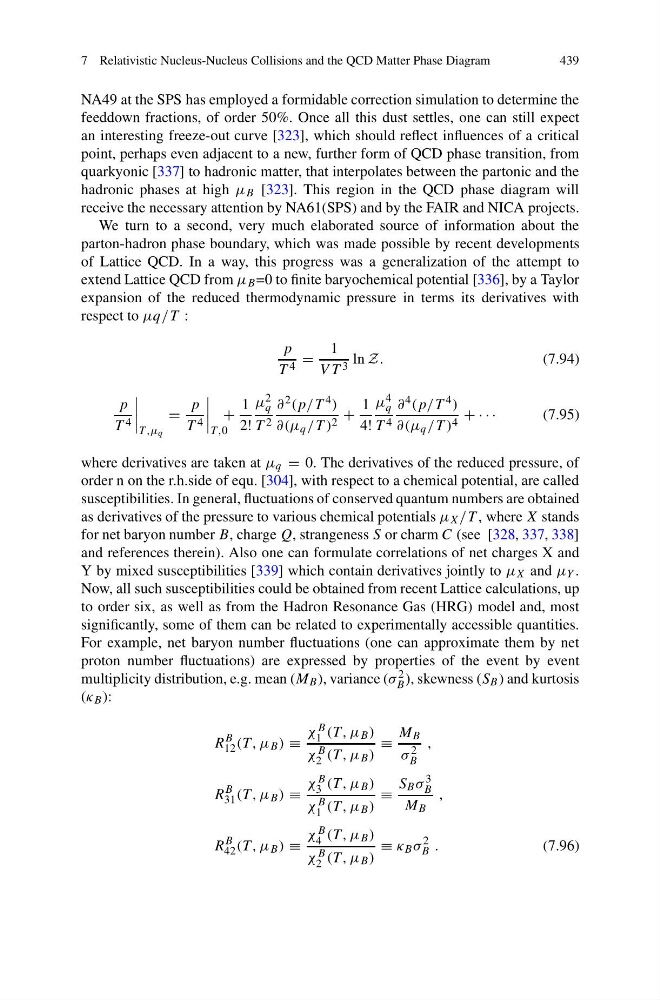
expansion of the reduced thermodynamic pressure in terms its derivatives with
respect to μq/T :
p
T 4 =
1
V T 3 ln Z.
(7.94)
p
T 4
T ,μ q
=
p
T 4
T ,0
+
1
2!
μ 2
q
T 2
∂ 2 (p/T 4 )
∂(μ q /T ) 2 +
1
4!
μ 4
q
T 4
∂ 4 (p/T 4 )
∂(μ q /T ) 4 + · · ·
(7.95)
where derivatives are taken at μ q = 0. The derivatives of the reduced pressure, of
order n on the r.h.side of equ. [304], with respect to a chemical potential, are called
susceptibilities. In general, fluctuations of conserved quantum numbers are obtained
as derivatives of the pressure to various chemical potentials μ X /T , where X stands
for net baryon number B, charge Q, strangeness S or charm C (see [328, 337, 338]
and references therein). Also one can formulate correlations of net charges X and
Y by mixed susceptibilities [339] which contain derivatives jointly to μ X and μ Y .
Now, all such susceptibilities could be obtained from recent Lattice calculations, up
to order six, as well as from the Hadron Resonance Gas (HRG) model and, most
significantly, some of them can be related to experimentally accessible quantities.
For example, net baryon number fluctuations (one can approximate them by net
proton number fluctuations) are expressed by properties of the event by event
multiplicity distribution, e.g. mean (M B ), variance (σ 2
B ), skewness (S B ) and kurtosis
(κ B ):
R
B
12 (T , μ B ) ≡
χ B
1 (T , μ B )
χ B
2 (T , μ B )
≡
M B
σ 2
B
,
R
B
31 (T , μ B ) ≡
χ B
3 (T , μ B )
χ B
1 (T , μ B )
≡
S B σ
3
B
M B
,
R
B
42 (T , μ B ) ≡
χ B
4 (T , μ B )
χ B
2 (T , μ B )
≡ κ B σ
2
B .
(7.96)
439
NA49 at the SPS has employed a formidable correction simulation to determine the
feeddown fractions, of order 50%. Once all this dust settles, one can still expect
an interesting freeze-out curve [323], which should reflect influences of a critical
point, perhaps even adjacent to a new, further form of QCD phase transition, from
quarkyonic [337] to hadronic matter, that interpolates between the partonic and the
hadronic phases at high μ B [323]. This region in the QCD phase diagram will
receive the necessary attention by NA61(SPS) and by the FAIR and NICA projects.
We turn to a second, very much elaborated source of information about the
parton-hadron phase boundary, which was made possible by recent developments
of Lattice QCD. In a way, this progress was a generalization of the attempt to
extend Lattice QCD from μ B =0 to finite baryochemical potential [336], by a Taylor
expansion of the reduced thermodynamic pressure in terms its derivatives with
respect to μq/T :
p
T 4 =
1
V T 3 ln Z.
(7.94)
p
T 4
T ,μ q
=
p
T 4
T ,0
+
1
2!
μ 2
q
T 2
∂ 2 (p/T 4 )
∂(μ q /T ) 2 +
1
4!
μ 4
q
T 4
∂ 4 (p/T 4 )
∂(μ q /T ) 4 + · · ·
(7.95)
where derivatives are taken at μ q = 0. The derivatives of the reduced pressure, of
order n on the r.h.side of equ. [304], with respect to a chemical potential, are called
susceptibilities. In general, fluctuations of conserved quantum numbers are obtained
as derivatives of the pressure to various chemical potentials μ X /T , where X stands
for net baryon number B, charge Q, strangeness S or charm C (see [328, 337, 338]
and references therein). Also one can formulate correlations of net charges X and
Y by mixed susceptibilities [339] which contain derivatives jointly to μ X and μ Y .
Now, all such susceptibilities could be obtained from recent Lattice calculations, up
to order six, as well as from the Hadron Resonance Gas (HRG) model and, most
significantly, some of them can be related to experimentally accessible quantities.
For example, net baryon number fluctuations (one can approximate them by net
proton number fluctuations) are expressed by properties of the event by event
multiplicity distribution, e.g. mean (M B ), variance (σ 2
B ), skewness (S B ) and kurtosis
(κ B ):
R
B
12 (T , μ B ) ≡
χ B
1 (T , μ B )
χ B
2 (T , μ B )
≡
M B
σ 2
B
,
R
B
31 (T , μ B ) ≡
χ B
3 (T , μ B )
χ B
1 (T , μ B )
≡
S B σ
3
B
M B
,
R
B
42 (T , μ B ) ≡
χ B
4 (T , μ B )
χ B
2 (T , μ B )
≡ κ B σ
2
B .
(7.96)