

438
R. Stock
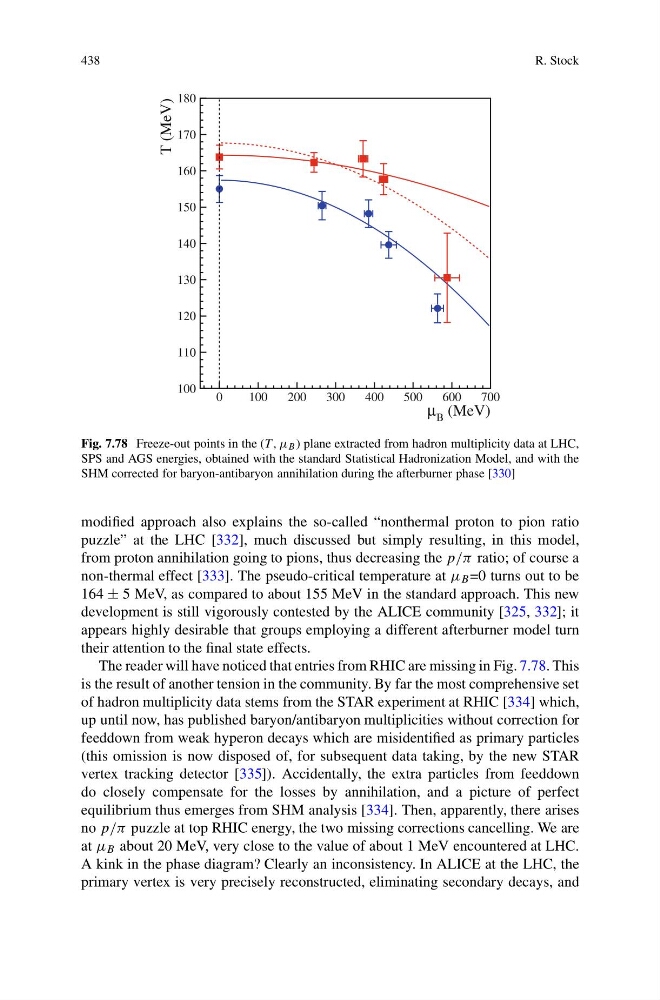
Fig. 7.78 Freeze-out points in the (T , μ B ) plane extracted from hadron multiplicity data at LHC,
SPS and AGS energies, obtained with the standard Statistical Hadronization Model, and with the
SHM corrected for baryon-antibaryon annihilation during the afterburner phase [330]
modified approach also explains the so-called “nonthermal proton to pion ratio
puzzle” at the LHC [332], much discussed but simply resulting, in this model,
from proton annihilation going to pions, thus decreasing the p/π ratio; of course a
non-thermal effect [333]. The pseudo-critical temperature at μ B =0 turns out to be
164 ± 5 MeV, as compared to about 155 MeV in the standard approach. This new
development is still vigorously contested by the ALICE community [325, 332]; it
appears highly desirable that groups employing a different afterburner model turn
their attention to the final state effects.
The reader will have noticed that entries from RHIC are missing in Fig. 7.78. This
is the result of another tension in the community. By far the most comprehensive set
of hadron multiplicity data stems from the STAR experiment at RHIC [334] which,
up until now, has published baryon/antibaryon multiplicities without correction for
feeddown from weak hyperon decays which are misidentified as primary particles
(this omission is now disposed of, for subsequent data taking, by the new STAR
vertex tracking detector [335]). Accidentally, the extra particles from feeddown
do closely compensate for the losses by annihilation, and a picture of perfect
equilibrium thus emerges from SHM analysis [334]. Then, apparently, there arises
no p/π puzzle at top RHIC energy, the two missing corrections cancelling. We are
at μ B about 20 MeV, very close to the value of about 1 MeV encountered at LHC.
A kink in the phase diagram? Clearly an inconsistency. In ALICE at the LHC, the
primary vertex is very precisely reconstructed, eliminating secondary decays, and
R. Stock
Fig. 7.78 Freeze-out points in the (T , μ B ) plane extracted from hadron multiplicity data at LHC,
SPS and AGS energies, obtained with the standard Statistical Hadronization Model, and with the
SHM corrected for baryon-antibaryon annihilation during the afterburner phase [330]
modified approach also explains the so-called “nonthermal proton to pion ratio
puzzle” at the LHC [332], much discussed but simply resulting, in this model,
from proton annihilation going to pions, thus decreasing the p/π ratio; of course a
non-thermal effect [333]. The pseudo-critical temperature at μ B =0 turns out to be
164 ± 5 MeV, as compared to about 155 MeV in the standard approach. This new
development is still vigorously contested by the ALICE community [325, 332]; it
appears highly desirable that groups employing a different afterburner model turn
their attention to the final state effects.
The reader will have noticed that entries from RHIC are missing in Fig. 7.78. This
is the result of another tension in the community. By far the most comprehensive set
of hadron multiplicity data stems from the STAR experiment at RHIC [334] which,
up until now, has published baryon/antibaryon multiplicities without correction for
feeddown from weak hyperon decays which are misidentified as primary particles
(this omission is now disposed of, for subsequent data taking, by the new STAR
vertex tracking detector [335]). Accidentally, the extra particles from feeddown
do closely compensate for the losses by annihilation, and a picture of perfect
equilibrium thus emerges from SHM analysis [334]. Then, apparently, there arises
no p/π puzzle at top RHIC energy, the two missing corrections cancelling. We are
at μ B about 20 MeV, very close to the value of about 1 MeV encountered at LHC.
A kink in the phase diagram? Clearly an inconsistency. In ALICE at the LHC, the
primary vertex is very precisely reconstructed, eliminating secondary decays, and