

434
R. Stock
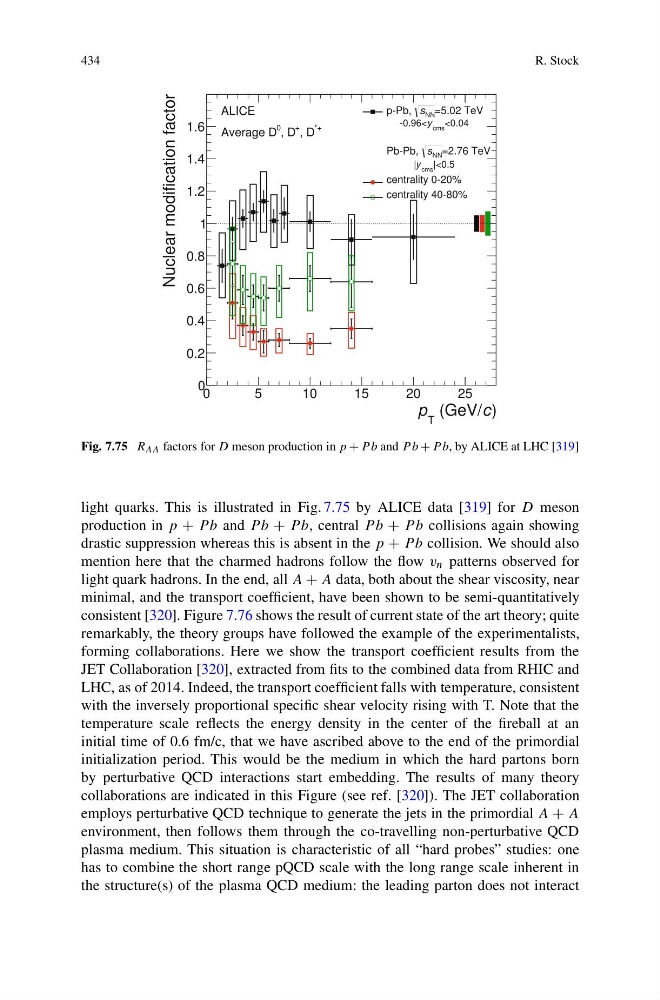
Fig. 7.75 R AA factors for D meson production in p + P b and P b + P b, by ALICE at LHC [319]
light quarks. This is illustrated in Fig. 7.75 by ALICE data [319] for D meson
production in p + P b and P b + P b, central P b + P b collisions again showing
drastic suppression whereas this is absent in the p + P b collision. We should also
mention here that the charmed hadrons follow the flow v n patterns observed for
light quark hadrons. In the end, all A + A data, both about the shear viscosity, near
minimal, and the transport coefficient, have been shown to be semi-quantitatively
consistent [320]. Figure 7.76 shows the result of current state of the art theory; quite
remarkably, the theory groups have followed the example of the experimentalists,
forming collaborations. Here we show the transport coefficient results from the
JET Collaboration [320], extracted from fits to the combined data from RHIC and
LHC, as of 2014. Indeed, the transport coefficient falls with temperature, consistent
with the inversely proportional specific shear velocity rising with T. Note that the
temperature scale reflects the energy density in the center of the fireball at an
initial time of 0.6 fm/c, that we have ascribed above to the end of the primordial
initialization period. This would be the medium in which the hard partons born
by perturbative QCD interactions start embedding. The results of many theory
collaborations are indicated in this Figure (see ref. [320]). The JET collaboration
employs perturbative QCD technique to generate the jets in the primordial A + A
environment, then follows them through the co-travelling non-perturbative QCD
plasma medium. This situation is characteristic of all “hard probes” studies: one
has to combine the short range pQCD scale with the long range scale inherent in
the structure(s) of the plasma QCD medium: the leading parton does not interact
R. Stock
Fig. 7.75 R AA factors for D meson production in p + P b and P b + P b, by ALICE at LHC [319]
light quarks. This is illustrated in Fig. 7.75 by ALICE data [319] for D meson
production in p + P b and P b + P b, central P b + P b collisions again showing
drastic suppression whereas this is absent in the p + P b collision. We should also
mention here that the charmed hadrons follow the flow v n patterns observed for
light quark hadrons. In the end, all A + A data, both about the shear viscosity, near
minimal, and the transport coefficient, have been shown to be semi-quantitatively
consistent [320]. Figure 7.76 shows the result of current state of the art theory; quite
remarkably, the theory groups have followed the example of the experimentalists,
forming collaborations. Here we show the transport coefficient results from the
JET Collaboration [320], extracted from fits to the combined data from RHIC and
LHC, as of 2014. Indeed, the transport coefficient falls with temperature, consistent
with the inversely proportional specific shear velocity rising with T. Note that the
temperature scale reflects the energy density in the center of the fireball at an
initial time of 0.6 fm/c, that we have ascribed above to the end of the primordial
initialization period. This would be the medium in which the hard partons born
by perturbative QCD interactions start embedding. The results of many theory
collaborations are indicated in this Figure (see ref. [320]). The JET collaboration
employs perturbative QCD technique to generate the jets in the primordial A + A
environment, then follows them through the co-travelling non-perturbative QCD
plasma medium. This situation is characteristic of all “hard probes” studies: one
has to combine the short range pQCD scale with the long range scale inherent in
the structure(s) of the plasma QCD medium: the leading parton does not interact