

7 Relativistic Nucleus-Nucleus Collisions and the QCD Matter Phase Diagram
433
ingredient in a theoretical description will be the parton transport parameter ˆ
q that
we introduced in Sects. 7.5.2 and 7.5.3. We recall that it represents the average
transverse momentum broadening square per unit pathlength, p 2
T /λ (cf. [359–
362, 366]). It is proportional to the local gluon number density. Recall further that
the average in-medium energy loss is proportional to ˆ
q [363]. This parameter can
be systematically deduced from identified hadron p T spectra in A + A collisions as
compared to the same spectra in minimum bias p + p at similar energy, resulting in
the nuclear modification factor R AA as defined in Sect. 7.5.1. For jets the standard
method is to estimate the jet energy loss by comparing the leading hadron (or fully
reconstructed jet) energy on the trigger side with that of the away-side jet, where
geometry has made sure that the trajectory traversed the QGP medium. Note, by
the way, that ˆ
q is inversely proportional to η/s from Eq. (7.93) (from old article!).
Thus if the latter is in a sense “near-minimal” the transport coefficient has to be
near-maximal. So the medium opaqueness might completely wipe out the jet at
lower energies, as was indeed observed at RHIC (see Figs. 7.50 and 7.53): the
black interior situation. At the LHC jet energies are always sufficient to observe
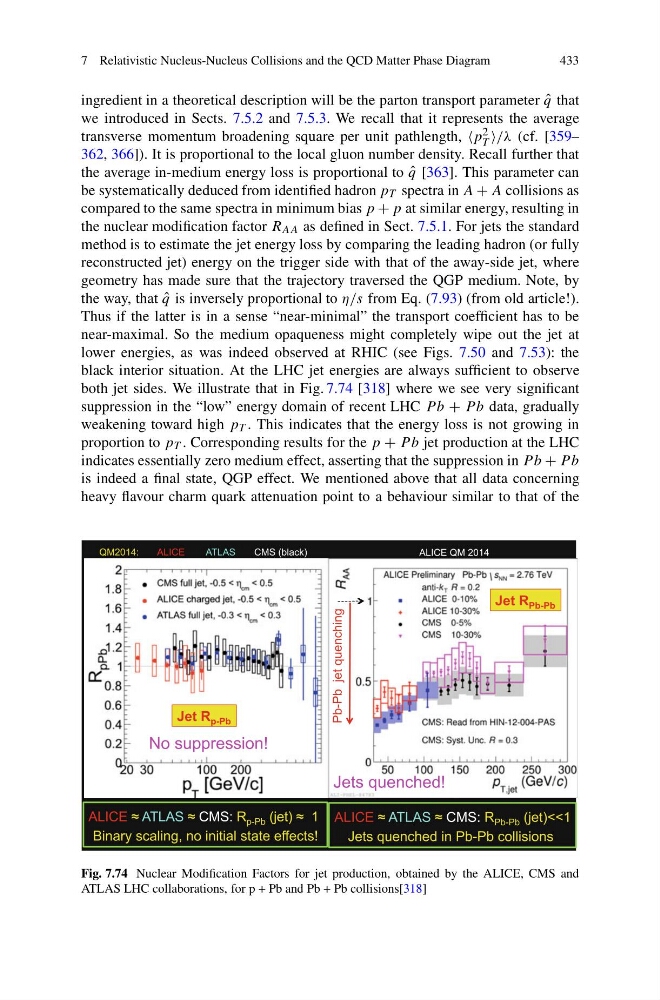
both jet sides. We illustrate that in Fig. 7.74 [318] where we see very significant
suppression in the “low” energy domain of recent LHC P b + P b data, gradually
weakening toward high p T . This indicates that the energy loss is not growing in
proportion to p T . Corresponding results for the p + P b jet production at the LHC
indicates essentially zero medium effect, asserting that the suppression in P b + P b
is indeed a final state, QGP effect. We mentioned above that all data concerning
heavy flavour charm quark attenuation point to a behaviour similar to that of the
Fig. 7.74 Nuclear Modification Factors for jet production, obtained by the ALICE, CMS and
ATLAS LHC collaborations, for p + Pb and Pb + Pb collisions[318]
433
ingredient in a theoretical description will be the parton transport parameter ˆ
q that
we introduced in Sects. 7.5.2 and 7.5.3. We recall that it represents the average
transverse momentum broadening square per unit pathlength, p 2
T /λ (cf. [359–
362, 366]). It is proportional to the local gluon number density. Recall further that
the average in-medium energy loss is proportional to ˆ
q [363]. This parameter can
be systematically deduced from identified hadron p T spectra in A + A collisions as
compared to the same spectra in minimum bias p + p at similar energy, resulting in
the nuclear modification factor R AA as defined in Sect. 7.5.1. For jets the standard
method is to estimate the jet energy loss by comparing the leading hadron (or fully
reconstructed jet) energy on the trigger side with that of the away-side jet, where
geometry has made sure that the trajectory traversed the QGP medium. Note, by
the way, that ˆ
q is inversely proportional to η/s from Eq. (7.93) (from old article!).
Thus if the latter is in a sense “near-minimal” the transport coefficient has to be
near-maximal. So the medium opaqueness might completely wipe out the jet at
lower energies, as was indeed observed at RHIC (see Figs. 7.50 and 7.53): the
black interior situation. At the LHC jet energies are always sufficient to observe
both jet sides. We illustrate that in Fig. 7.74 [318] where we see very significant
suppression in the “low” energy domain of recent LHC P b + P b data, gradually
weakening toward high p T . This indicates that the energy loss is not growing in
proportion to p T . Corresponding results for the p + P b jet production at the LHC
indicates essentially zero medium effect, asserting that the suppression in P b + P b
is indeed a final state, QGP effect. We mentioned above that all data concerning
heavy flavour charm quark attenuation point to a behaviour similar to that of the
Fig. 7.74 Nuclear Modification Factors for jet production, obtained by the ALICE, CMS and
ATLAS LHC collaborations, for p + Pb and Pb + Pb collisions[318]