

432
R. Stock
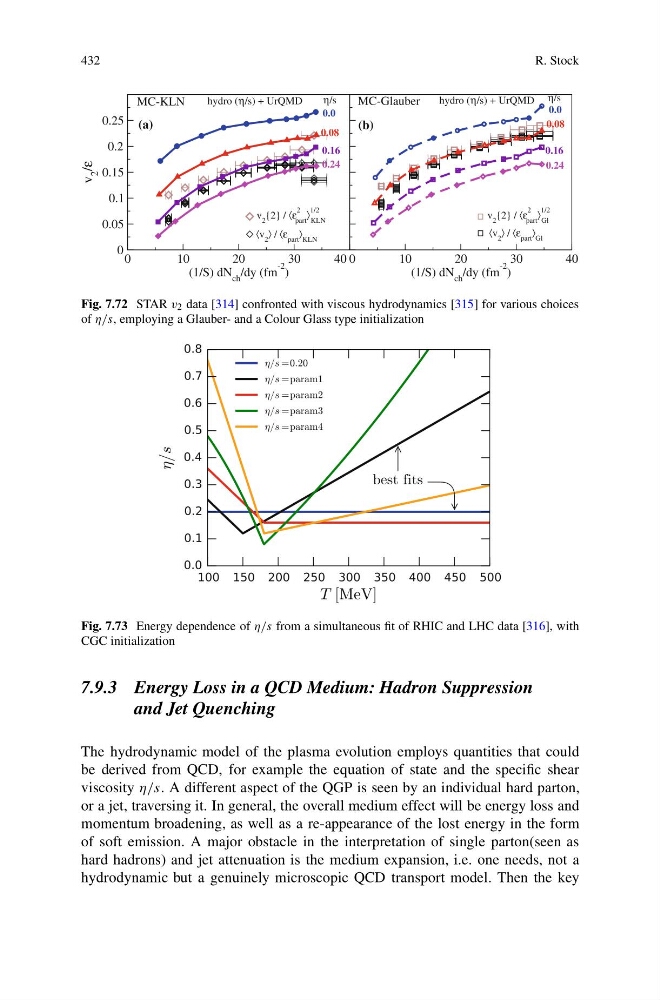
Fig. 7.72 STAR v 2 data [314] confronted with viscous hydrodynamics [315] for various choices
of η/s, employing a Glauber- and a Colour Glass type initialization
Fig. 7.73 Energy dependence of η/s from a simultaneous fit of RHIC and LHC data [316], with
CGC initialization
7.9.3 Energy Loss in a QCD Medium: Hadron Suppression
and Jet Quenching
The hydrodynamic model of the plasma evolution employs quantities that could
be derived from QCD, for example the equation of state and the specific shear
viscosity η/s. A different aspect of the QGP is seen by an individual hard parton,
or a jet, traversing it. In general, the overall medium effect will be energy loss and
momentum broadening, as well as a re-appearance of the lost energy in the form
of soft emission. A major obstacle in the interpretation of single parton(seen as
hard hadrons) and jet attenuation is the medium expansion, i.e. one needs, not a
hydrodynamic but a genuinely microscopic QCD transport model. Then the key
R. Stock
Fig. 7.72 STAR v 2 data [314] confronted with viscous hydrodynamics [315] for various choices
of η/s, employing a Glauber- and a Colour Glass type initialization
Fig. 7.73 Energy dependence of η/s from a simultaneous fit of RHIC and LHC data [316], with
CGC initialization
7.9.3 Energy Loss in a QCD Medium: Hadron Suppression
and Jet Quenching
The hydrodynamic model of the plasma evolution employs quantities that could
be derived from QCD, for example the equation of state and the specific shear
viscosity η/s. A different aspect of the QGP is seen by an individual hard parton,
or a jet, traversing it. In general, the overall medium effect will be energy loss and
momentum broadening, as well as a re-appearance of the lost energy in the form
of soft emission. A major obstacle in the interpretation of single parton(seen as
hard hadrons) and jet attenuation is the medium expansion, i.e. one needs, not a
hydrodynamic but a genuinely microscopic QCD transport model. Then the key