

7 Relativistic Nucleus-Nucleus Collisions and the QCD Matter Phase Diagram
421
the dependence on the charged particle rapidity density dN ch /dy which one might
intuitively expect to be related to the freeze-out volume [295]. We see, firstly, that
the plot vs.
√
s exhibits a non-monotonous pattern at the transition from AGS to
SPS energies [287, 295], whereas the plot vs. dN/dy rather features a rise toward a
plateau that ends in a steep increase at RHIC energies. Second, the tenfold increase
in charged particle rapidity density is reflected in only a doubling of the “volume”
V f .
The latter observation reminds us of the fact that the geometrical parameters
obtained via the above analysis do not refer to the global source volume if that
volume undergoes a collective Hubble expansion [96, 287]. A pion pair emitted with
small relative momentum into the azimuthal direction
K T is likely to stem (only)
from the fraction of the expanding source that also moves into this direction. This
coupling between position and momentum in the source becomes more pronounced,
both, with increasing K T and increasing sources transverse velocity β T from radial
expansion. We have seen in Fig. 7.24 that the latter increases dramatically with
√
s, such that the coherence volume V f comprises a decreasing fraction of the total
fireball. It should thus rise much more slowly than proportional to the global dN/dy
[96, 287].
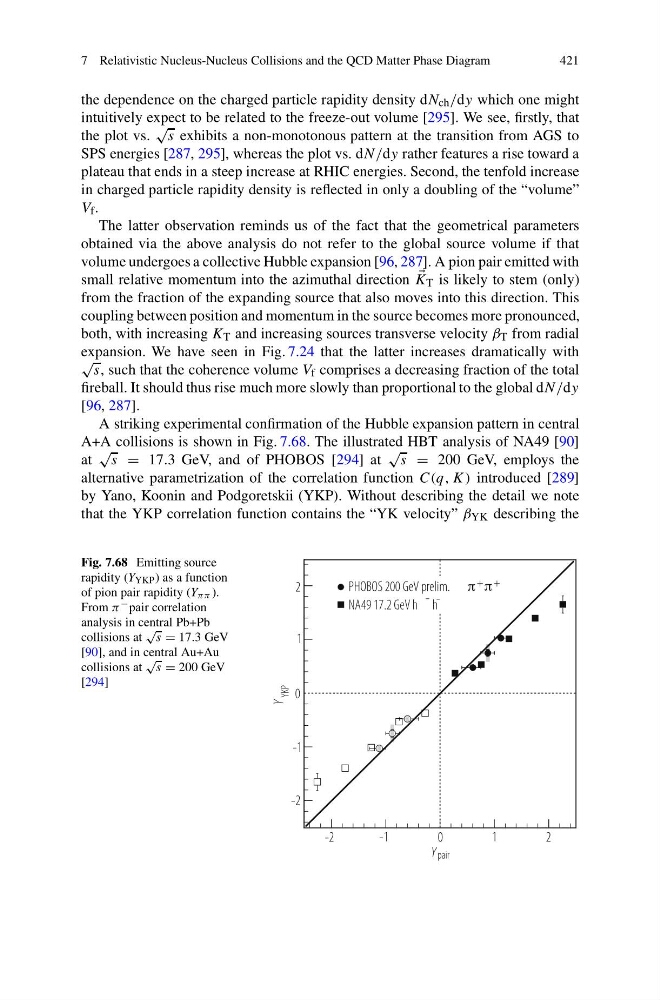
A striking experimental confirmation of the Hubble expansion pattern in central
A+A collisions is shown in Fig. 7.68. The illustrated HBT analysis of NA49 [90]
at
√
s = 17.3 GeV, and of PHOBOS [294] at
√
s = 200 GeV, employs the
alternative parametrization of the correlation function C(q, K) introduced [289]
by Yano, Koonin and Podgoretskii (YKP). Without describing the detail we note
that the YKP correlation function contains the “YK velocity” β YK describing the
Fig. 7.68 Emitting source
rapidity (Y YKP ) as a function
of pion pair rapidity (Y ππ ).
From π − pair correlation
analysis in central Pb+Pb
collisions at
√
s = 17.3 GeV
[90], and in central Au+Au
collisions at
√
s = 200 GeV
[294]
pair
Y
-2
-1
0
1
2
P
K
Y
Y
-2
-1
0
1
2
+
+
PHOBOS 200 GeV prelim.
-
h
-
NA49 17.2 GeV h
421
the dependence on the charged particle rapidity density dN ch /dy which one might
intuitively expect to be related to the freeze-out volume [295]. We see, firstly, that
the plot vs.
√
s exhibits a non-monotonous pattern at the transition from AGS to
SPS energies [287, 295], whereas the plot vs. dN/dy rather features a rise toward a
plateau that ends in a steep increase at RHIC energies. Second, the tenfold increase
in charged particle rapidity density is reflected in only a doubling of the “volume”
V f .
The latter observation reminds us of the fact that the geometrical parameters
obtained via the above analysis do not refer to the global source volume if that
volume undergoes a collective Hubble expansion [96, 287]. A pion pair emitted with
small relative momentum into the azimuthal direction
K T is likely to stem (only)
from the fraction of the expanding source that also moves into this direction. This
coupling between position and momentum in the source becomes more pronounced,
both, with increasing K T and increasing sources transverse velocity β T from radial
expansion. We have seen in Fig. 7.24 that the latter increases dramatically with
√
s, such that the coherence volume V f comprises a decreasing fraction of the total
fireball. It should thus rise much more slowly than proportional to the global dN/dy
[96, 287].
A striking experimental confirmation of the Hubble expansion pattern in central
A+A collisions is shown in Fig. 7.68. The illustrated HBT analysis of NA49 [90]
at
√
s = 17.3 GeV, and of PHOBOS [294] at
√
s = 200 GeV, employs the
alternative parametrization of the correlation function C(q, K) introduced [289]
by Yano, Koonin and Podgoretskii (YKP). Without describing the detail we note
that the YKP correlation function contains the “YK velocity” β YK describing the
Fig. 7.68 Emitting source
rapidity (Y YKP ) as a function
of pion pair rapidity (Y ππ ).
From π − pair correlation
analysis in central Pb+Pb
collisions at
√
s = 17.3 GeV
[90], and in central Au+Au
collisions at
√
s = 200 GeV
[294]
pair
Y
-2
-1
0
1
2
P
K
Y
Y
-2
-1
0
1
2
+
+
PHOBOS 200 GeV prelim.
-
h
-
NA49 17.2 GeV h