

422
R. Stock
source’s longitudinal collective motion in each interval of pion pair rapidity,
Y ππ =
1
2
ln
E 1 + E 2 + p z1 + p z2
E 1 + E 2 − p z1 − p z2
.
(7.91)
Defining the “YKP rapidity” corresponding to β YK by
Y YKP =
1
2
ln
1 + β YK
1 − β YK
+ y cm
(7.92)
leads to the results in Fig. 7.68, indicating a strong correlation of the collective
longitudinal source rapidity Y YKP with the position of the pion pair in rapidity space.
We are interested in a possible non-monotonous
√
s dependence of freeze-out
parameters such as V f because of recent predictions of the relativistic hydrodynamic
model that a QCD critical point should act as an attractor of the isentropic expansion
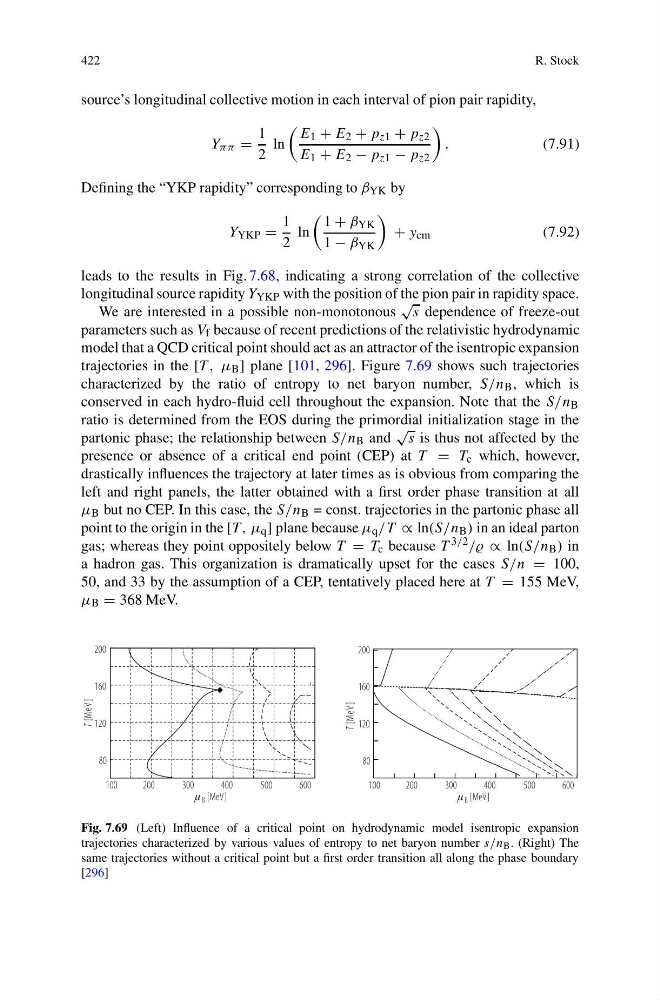
trajectories in the [T , μ B ] plane [101, 296]. Figure 7.69 shows such trajectories
characterized by the ratio of entropy to net baryon number, S/n B , which is
conserved in each hydro-fluid cell throughout the expansion. Note that the S/n B
ratio is determined from the EOS during the primordial initialization stage in the
partonic phase; the relationship between S/n B and
√
s is thus not affected by the
presence or absence of a critical end point (CEP) at T = T c which, however,
drastically influences the trajectory at later times as is obvious from comparing the
left and right panels, the latter obtained with a first order phase transition at all
μ B but no CEP. In this case, the S/n B = const. trajectories in the partonic phase all
point to the origin in the [T , μ q ] plane because μ q /T ∝ ln(S/n B ) in an ideal parton
gas; whereas they point oppositely below T = T c because T 3/2 // ∝ ln(S/n B ) in
a hadron gas. This organization is dramatically upset for the cases S/n = 100,
50, and 33 by the assumption of a CEP, tentatively placed here at T = 155 MeV,
μ B = 368 MeV.
200
160
120
80
100
200
300
400
500
600
B [MeV]
T ]
V
e
M
[
200
160
120
80
100
200
300
400
500
600
B [MeV]
T ]
V
e
M
[
Fig. 7.69 (Left) Influence of a critical point on hydrodynamic model isentropic expansion
trajectories characterized by various values of entropy to net baryon number s/n B . (Right) The
same trajectories without a critical point but a first order transition all along the phase boundary
[296]
R. Stock
source’s longitudinal collective motion in each interval of pion pair rapidity,
Y ππ =
1
2
ln
E 1 + E 2 + p z1 + p z2
E 1 + E 2 − p z1 − p z2
.
(7.91)
Defining the “YKP rapidity” corresponding to β YK by
Y YKP =
1
2
ln
1 + β YK
1 − β YK
+ y cm
(7.92)
leads to the results in Fig. 7.68, indicating a strong correlation of the collective
longitudinal source rapidity Y YKP with the position of the pion pair in rapidity space.
We are interested in a possible non-monotonous
√
s dependence of freeze-out
parameters such as V f because of recent predictions of the relativistic hydrodynamic
model that a QCD critical point should act as an attractor of the isentropic expansion
trajectories in the [T , μ B ] plane [101, 296]. Figure 7.69 shows such trajectories
characterized by the ratio of entropy to net baryon number, S/n B , which is
conserved in each hydro-fluid cell throughout the expansion. Note that the S/n B
ratio is determined from the EOS during the primordial initialization stage in the
partonic phase; the relationship between S/n B and
√
s is thus not affected by the
presence or absence of a critical end point (CEP) at T = T c which, however,
drastically influences the trajectory at later times as is obvious from comparing the
left and right panels, the latter obtained with a first order phase transition at all
μ B but no CEP. In this case, the S/n B = const. trajectories in the partonic phase all
point to the origin in the [T , μ q ] plane because μ q /T ∝ ln(S/n B ) in an ideal parton
gas; whereas they point oppositely below T = T c because T 3/2 // ∝ ln(S/n B ) in
a hadron gas. This organization is dramatically upset for the cases S/n = 100,
50, and 33 by the assumption of a CEP, tentatively placed here at T = 155 MeV,
μ B = 368 MeV.
200
160
120
80
100
200
300
400
500
600
B [MeV]
T ]
V
e
M
[
200
160
120
80
100
200
300
400
500
600
B [MeV]
T ]
V
e
M
[
Fig. 7.69 (Left) Influence of a critical point on hydrodynamic model isentropic expansion
trajectories characterized by various values of entropy to net baryon number s/n B . (Right) The
same trajectories without a critical point but a first order transition all along the phase boundary
[296]