

420
R. Stock
which is fitted to the experimental correlation function (Eq. (7.82)). The experiment
thus determines the variances R out , R side andR long . In the so-called “local co-moving
system” (LCMS), defined as the frame in which p z,1 = −p z,2 , i.e. β long = 0, we
obtain in addition to Eq. (7.87)
R out (K)
2
=
( ˜
x(K) − β T ˜
t(K))
2
R
2
long (K) =
˜
z(K)
2
(7.89)
and finally, for azimuthal symmetry in central collisions with
˜
x 2 ≈
˜
y 2
we find
the “duration of emission” parameter illustrated in Fig. 7.19 [90]:
˜
t
2
≈
1
β T
R
2
out − R
2
side
.
(7.90)
The resulting reduction of the initial 8 coordinates of the meson pair stems,
in summary, from the on-shell requirement, from azimuthal symmetry and from
approximate Bjorken invariance in the LCMS system [287, 288]. One has to
be aware of the latter idealizations. Note that in an expanding source all HBT
parameters depend on K, the pair mean momentum (see below).
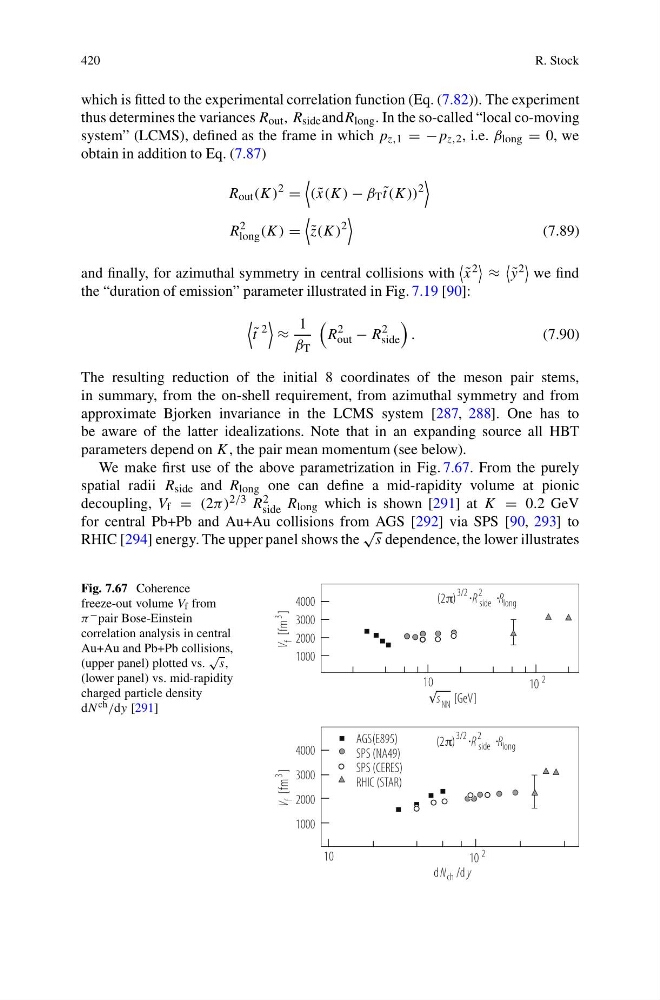
We make first use of the above parametrization in Fig. 7.67. From the purely
spatial radii R side and R long one can define a mid-rapidity volume at pionic
decoupling, V f = (2π) 2/3 R 2
side R long which is shown [291] at K = 0.2 GeV
for central Pb+Pb and Au+Au collisions from AGS [292] via SPS [90, 293] to
RHIC [294] energy. The upper panel shows the
√
s dependence, the lower illustrates
Fig. 7.67 Coherence
freeze-out volume V f from
π − pair Bose-Einstein
correlation analysis in central
Au+Au and Pb+Pb collisions,
(upper panel) plotted vs.
√
s,
(lower panel) vs. mid-rapidity
charged particle density
dN ch /dy [291]
s NN [GeV]
10
10
10
2
10
2
4000
3000
2000
1000
4000
3000
2000
1000
d /d
N
y
ch
V f
3
]
m
f
[
V f
3
]
m
f
[
AGS(E895)
SPS (NA49)
SPS (CERES)
RHIC (STAR)
(2 )
3/2 2
side long
R
R
(2 )
3/2 2
side long
R
R
R. Stock
which is fitted to the experimental correlation function (Eq. (7.82)). The experiment
thus determines the variances R out , R side andR long . In the so-called “local co-moving
system” (LCMS), defined as the frame in which p z,1 = −p z,2 , i.e. β long = 0, we
obtain in addition to Eq. (7.87)
R out (K)
2
=
( ˜
x(K) − β T ˜
t(K))
2
R
2
long (K) =
˜
z(K)
2
(7.89)
and finally, for azimuthal symmetry in central collisions with
˜
x 2 ≈
˜
y 2
we find
the “duration of emission” parameter illustrated in Fig. 7.19 [90]:
˜
t
2
≈
1
β T
R
2
out − R
2
side
.
(7.90)
The resulting reduction of the initial 8 coordinates of the meson pair stems,
in summary, from the on-shell requirement, from azimuthal symmetry and from
approximate Bjorken invariance in the LCMS system [287, 288]. One has to
be aware of the latter idealizations. Note that in an expanding source all HBT
parameters depend on K, the pair mean momentum (see below).
We make first use of the above parametrization in Fig. 7.67. From the purely
spatial radii R side and R long one can define a mid-rapidity volume at pionic
decoupling, V f = (2π) 2/3 R 2
side R long which is shown [291] at K = 0.2 GeV
for central Pb+Pb and Au+Au collisions from AGS [292] via SPS [90, 293] to
RHIC [294] energy. The upper panel shows the
√
s dependence, the lower illustrates
Fig. 7.67 Coherence
freeze-out volume V f from
π − pair Bose-Einstein
correlation analysis in central
Au+Au and Pb+Pb collisions,
(upper panel) plotted vs.
√
s,
(lower panel) vs. mid-rapidity
charged particle density
dN ch /dy [291]
s NN [GeV]
10
10
10
2
10
2
4000
3000
2000
1000
4000
3000
2000
1000
d /d
N
y
ch
V f
3
]
m
f
[
V f
3
]
m
f
[
AGS(E895)
SPS (NA49)
SPS (CERES)
RHIC (STAR)
(2 )
3/2 2
side long
R
R
(2 )
3/2 2
side long
R
R