

376
R. Stock
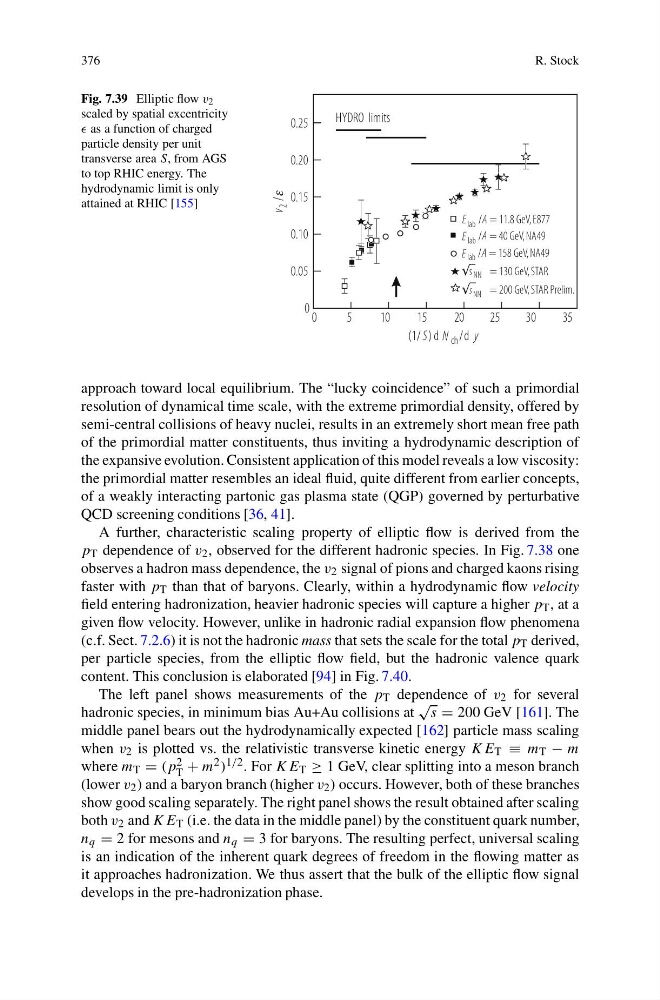
Fig. 7.39 Elliptic flow v 2
scaled by spatial excentricity
as a function of charged
particle density per unit
transverse area S, from AGS
to top RHIC energy. The
hydrodynamic limit is only
attained at RHIC [155]
HYDRO limits
0.25
0.20
0.15
0.10
0.05
0 0
5
10
15
20
25
30
35
(1/ ) d /d
S N
y
ch
v 2
/
/ = 11.8 GeV, E877
A
lab
lab
E
/ = 40 GeV, NA49
A
E
E / = 158 GeV, NA49
A
lab
= 130 GeV, STAR
NN
NN
s
s
= 200 GeV, STAR Prelim.
approach toward local equilibrium. The “lucky coincidence” of such a primordial
resolution of dynamical time scale, with the extreme primordial density, offered by
semi-central collisions of heavy nuclei, results in an extremely short mean free path
of the primordial matter constituents, thus inviting a hydrodynamic description of
the expansive evolution. Consistent application of this model reveals a low viscosity:
the primordial matter resembles an ideal fluid, quite different from earlier concepts,
of a weakly interacting partonic gas plasma state (QGP) governed by perturbative
QCD screening conditions [36, 41].
A further, characteristic scaling property of elliptic flow is derived from the
p T dependence of v 2 , observed for the different hadronic species. In Fig. 7.38 one
observes a hadron mass dependence, the v 2 signal of pions and charged kaons rising
faster with p T than that of baryons. Clearly, within a hydrodynamic flow velocity
field entering hadronization, heavier hadronic species will capture a higher p T , at a
given flow velocity. However, unlike in hadronic radial expansion flow phenomena
(c.f. Sect. 7.2.6) it is not the hadronic mass that sets the scale for the total p T derived,
per particle species, from the elliptic flow field, but the hadronic valence quark
content. This conclusion is elaborated [94] in Fig. 7.40.
The left panel shows measurements of the p T dependence of v 2 for several
hadronic species, in minimum bias Au+Au collisions at
√
s = 200 GeV [161]. The
middle panel bears out the hydrodynamically expected [162] particle mass scaling
when v 2 is plotted vs. the relativistic transverse kinetic energy KE T ≡ m T − m
where m T = (p 2
T + m 2 ) 1/2 . For KE T ≥ 1 GeV, clear splitting into a meson branch
(lower v 2 ) and a baryon branch (higher v 2 ) occurs. However, both of these branches
show good scaling separately. The right panel shows the result obtained after scaling
both v 2 and KE T (i.e. the data in the middle panel) by the constituent quark number,
n q = 2 for mesons and n q = 3 for baryons. The resulting perfect, universal scaling
is an indication of the inherent quark degrees of freedom in the flowing matter as
it approaches hadronization. We thus assert that the bulk of the elliptic flow signal
develops in the pre-hadronization phase.
R. Stock
Fig. 7.39 Elliptic flow v 2
scaled by spatial excentricity
as a function of charged
particle density per unit
transverse area S, from AGS
to top RHIC energy. The
hydrodynamic limit is only
attained at RHIC [155]
HYDRO limits
0.25
0.20
0.15
0.10
0.05
0 0
5
10
15
20
25
30
35
(1/ ) d /d
S N
y
ch
v 2
/
/ = 11.8 GeV, E877
A
lab
lab
E
/ = 40 GeV, NA49
A
E
E / = 158 GeV, NA49
A
lab
= 130 GeV, STAR
NN
NN
s
s
= 200 GeV, STAR Prelim.
approach toward local equilibrium. The “lucky coincidence” of such a primordial
resolution of dynamical time scale, with the extreme primordial density, offered by
semi-central collisions of heavy nuclei, results in an extremely short mean free path
of the primordial matter constituents, thus inviting a hydrodynamic description of
the expansive evolution. Consistent application of this model reveals a low viscosity:
the primordial matter resembles an ideal fluid, quite different from earlier concepts,
of a weakly interacting partonic gas plasma state (QGP) governed by perturbative
QCD screening conditions [36, 41].
A further, characteristic scaling property of elliptic flow is derived from the
p T dependence of v 2 , observed for the different hadronic species. In Fig. 7.38 one
observes a hadron mass dependence, the v 2 signal of pions and charged kaons rising
faster with p T than that of baryons. Clearly, within a hydrodynamic flow velocity
field entering hadronization, heavier hadronic species will capture a higher p T , at a
given flow velocity. However, unlike in hadronic radial expansion flow phenomena
(c.f. Sect. 7.2.6) it is not the hadronic mass that sets the scale for the total p T derived,
per particle species, from the elliptic flow field, but the hadronic valence quark
content. This conclusion is elaborated [94] in Fig. 7.40.
The left panel shows measurements of the p T dependence of v 2 for several
hadronic species, in minimum bias Au+Au collisions at
√
s = 200 GeV [161]. The
middle panel bears out the hydrodynamically expected [162] particle mass scaling
when v 2 is plotted vs. the relativistic transverse kinetic energy KE T ≡ m T − m
where m T = (p 2
T + m 2 ) 1/2 . For KE T ≥ 1 GeV, clear splitting into a meson branch
(lower v 2 ) and a baryon branch (higher v 2 ) occurs. However, both of these branches
show good scaling separately. The right panel shows the result obtained after scaling
both v 2 and KE T (i.e. the data in the middle panel) by the constituent quark number,
n q = 2 for mesons and n q = 3 for baryons. The resulting perfect, universal scaling
is an indication of the inherent quark degrees of freedom in the flowing matter as
it approaches hadronization. We thus assert that the bulk of the elliptic flow signal
develops in the pre-hadronization phase.