

7 Relativistic Nucleus-Nucleus Collisions and the QCD Matter Phase Diagram
377
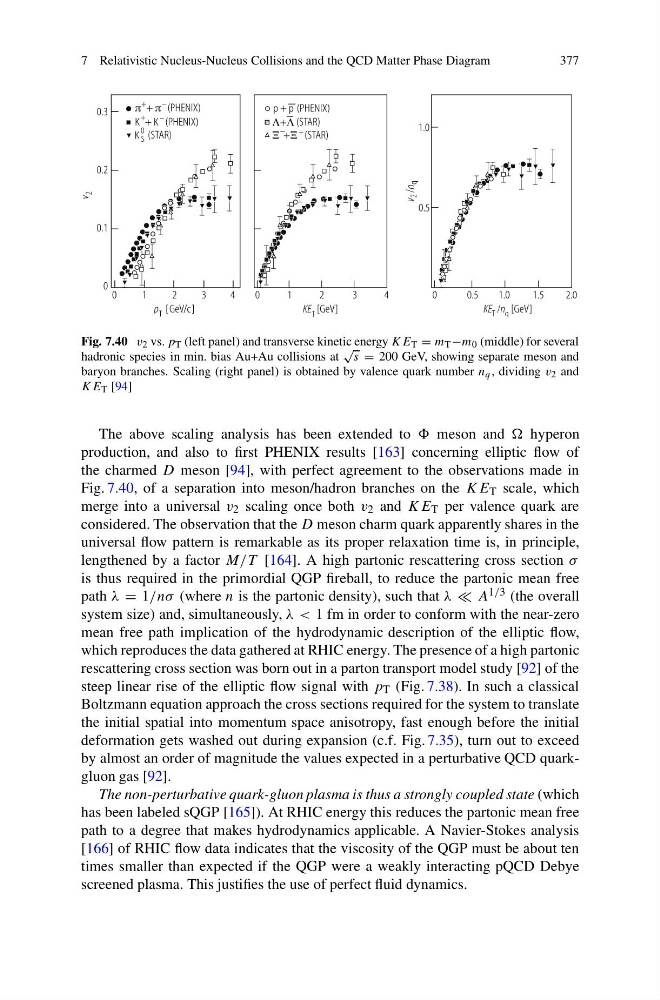
Fig. 7.40 v 2 vs. p T (left panel) and transverse kinetic energy KE T = m T −m 0 (middle) for several
hadronic species in min. bias Au+Au collisions at
√
s = 200 GeV, showing separate meson and
baryon branches. Scaling (right panel) is obtained by valence quark number n q , dividing v 2 and
KE T [94]
The above scaling analysis has been extended to meson and hyperon
production, and also to first PHENIX results [163] concerning elliptic flow of
the charmed D meson [94], with perfect agreement to the observations made in
Fig. 7.40, of a separation into meson/hadron branches on the KE T scale, which
merge into a universal v 2 scaling once both v 2 and KE T per valence quark are
considered. The observation that the D meson charm quark apparently shares in the
universal flow pattern is remarkable as its proper relaxation time is, in principle,
lengthened by a factor M/T [164]. A high partonic rescattering cross section σ
is thus required in the primordial QGP fireball, to reduce the partonic mean free
path λ = 1/nσ (where n is the partonic density), such that λ A 1/3 (the overall
system size) and, simultaneously, λ < 1 fm in order to conform with the near-zero
mean free path implication of the hydrodynamic description of the elliptic flow,
which reproduces the data gathered at RHIC energy. The presence of a high partonic
rescattering cross section was born out in a parton transport model study [92] of the
steep linear rise of the elliptic flow signal with p T (Fig. 7.38). In such a classical
Boltzmann equation approach the cross sections required for the system to translate
the initial spatial into momentum space anisotropy, fast enough before the initial
deformation gets washed out during expansion (c.f. Fig. 7.35), turn out to exceed
by almost an order of magnitude the values expected in a perturbative QCD quarkgluon gas [92].
The non-perturbative quark-gluon plasma is thus a strongly coupled state (which
has been labeled sQGP [165]). At RHIC energy this reduces the partonic mean free
path to a degree that makes hydrodynamics applicable. A Navier-Stokes analysis
[166] of RHIC flow data indicates that the viscosity of the QGP must be about ten
times smaller than expected if the QGP were a weakly interacting pQCD Debye
screened plasma. This justifies the use of perfect fluid dynamics.
377
Fig. 7.40 v 2 vs. p T (left panel) and transverse kinetic energy KE T = m T −m 0 (middle) for several
hadronic species in min. bias Au+Au collisions at
√
s = 200 GeV, showing separate meson and
baryon branches. Scaling (right panel) is obtained by valence quark number n q , dividing v 2 and
KE T [94]
The above scaling analysis has been extended to meson and hyperon
production, and also to first PHENIX results [163] concerning elliptic flow of
the charmed D meson [94], with perfect agreement to the observations made in
Fig. 7.40, of a separation into meson/hadron branches on the KE T scale, which
merge into a universal v 2 scaling once both v 2 and KE T per valence quark are
considered. The observation that the D meson charm quark apparently shares in the
universal flow pattern is remarkable as its proper relaxation time is, in principle,
lengthened by a factor M/T [164]. A high partonic rescattering cross section σ
is thus required in the primordial QGP fireball, to reduce the partonic mean free
path λ = 1/nσ (where n is the partonic density), such that λ A 1/3 (the overall
system size) and, simultaneously, λ < 1 fm in order to conform with the near-zero
mean free path implication of the hydrodynamic description of the elliptic flow,
which reproduces the data gathered at RHIC energy. The presence of a high partonic
rescattering cross section was born out in a parton transport model study [92] of the
steep linear rise of the elliptic flow signal with p T (Fig. 7.38). In such a classical
Boltzmann equation approach the cross sections required for the system to translate
the initial spatial into momentum space anisotropy, fast enough before the initial
deformation gets washed out during expansion (c.f. Fig. 7.35), turn out to exceed
by almost an order of magnitude the values expected in a perturbative QCD quarkgluon gas [92].
The non-perturbative quark-gluon plasma is thus a strongly coupled state (which
has been labeled sQGP [165]). At RHIC energy this reduces the partonic mean free
path to a degree that makes hydrodynamics applicable. A Navier-Stokes analysis
[166] of RHIC flow data indicates that the viscosity of the QGP must be about ten
times smaller than expected if the QGP were a weakly interacting pQCD Debye
screened plasma. This justifies the use of perfect fluid dynamics.