

7 Relativistic Nucleus-Nucleus Collisions and the QCD Matter Phase Diagram
375
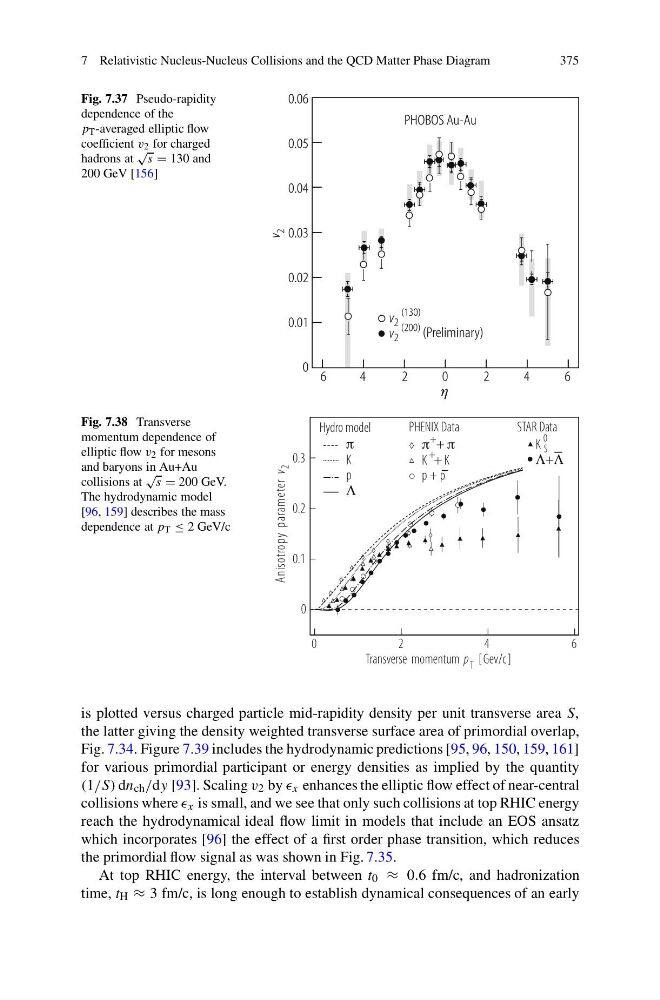
Fig. 7.37 Pseudo-rapidity
dependence of the
p T -averaged elliptic flow
coefficient v 2 for charged
hadrons at
√
s = 130 and
200 GeV [156]
Fig. 7.38 Transverse
momentum dependence of
elliptic flow v 2 for mesons
and baryons in Au+Au
collisions at
√
s = 200 GeV.
The hydrodynamic model
[96, 159] describes the mass
dependence at p T ≤ 2 GeV/c
0.3
0.2
0.1
0
0
2
4
6
Hydro model
PHENIX Data
STAR Data
K
p
+
+
+
K + K
p + p
K
+
0
S
Transverse momentum [Gev/c]
p T
r
e
t
e
m
a
r
a
p
y
p
o
r
t
o
s
i
n
A
v 2
is plotted versus charged particle mid-rapidity density per unit transverse area S,
the latter giving the density weighted transverse surface area of primordial overlap,
Fig. 7.34. Figure 7.39 includes the hydrodynamic predictions [95, 96, 150, 159, 161]
for various primordial participant or energy densities as implied by the quantity
(1/S) dn ch /dy [93]. Scaling v 2 by x enhances the elliptic flow effect of near-central
collisions where x is small, and we see that only such collisions at top RHIC energy
reach the hydrodynamical ideal flow limit in models that include an EOS ansatz
which incorporates [96] the effect of a first order phase transition, which reduces
the primordial flow signal as was shown in Fig. 7.35.
At top RHIC energy, the interval between t 0 ≈ 0.6 fm/c, and hadronization
time, t H ≈ 3 fm/c, is long enough to establish dynamical consequences of an early
375
Fig. 7.37 Pseudo-rapidity
dependence of the
p T -averaged elliptic flow
coefficient v 2 for charged
hadrons at
√
s = 130 and
200 GeV [156]
Fig. 7.38 Transverse
momentum dependence of
elliptic flow v 2 for mesons
and baryons in Au+Au
collisions at
√
s = 200 GeV.
The hydrodynamic model
[96, 159] describes the mass
dependence at p T ≤ 2 GeV/c
0.3
0.2
0.1
0
0
2
4
6
Hydro model
PHENIX Data
STAR Data
K
p
+
+
+
K + K
p + p
K
+
0
S
Transverse momentum [Gev/c]
p T
r
e
t
e
m
a
r
a
p
y
p
o
r
t
o
s
i
n
A
v 2
is plotted versus charged particle mid-rapidity density per unit transverse area S,
the latter giving the density weighted transverse surface area of primordial overlap,
Fig. 7.34. Figure 7.39 includes the hydrodynamic predictions [95, 96, 150, 159, 161]
for various primordial participant or energy densities as implied by the quantity
(1/S) dn ch /dy [93]. Scaling v 2 by x enhances the elliptic flow effect of near-central
collisions where x is small, and we see that only such collisions at top RHIC energy
reach the hydrodynamical ideal flow limit in models that include an EOS ansatz
which incorporates [96] the effect of a first order phase transition, which reduces
the primordial flow signal as was shown in Fig. 7.35.
At top RHIC energy, the interval between t 0 ≈ 0.6 fm/c, and hadronization
time, t H ≈ 3 fm/c, is long enough to establish dynamical consequences of an early