

374
R. Stock
mixed phase, such that the emerging signal is almost entirely due to the partonic
phase. We have to note here that the “ideal fluid” (zero viscosity) hydrodynamics
[150] employed in Fig. 7.35 is, at first, a mere hypothesis, in view also of the fact
that microscopic transport models have predicted a significant viscosity, both for a
perturbative QCD parton gas [92, 151] and for a hadron gas [95, 152]. Proven to be
correct by the data, the ideal fluid description of elliptic flow tells us that the QGP
is a non-perturbative liquid [153, 154].
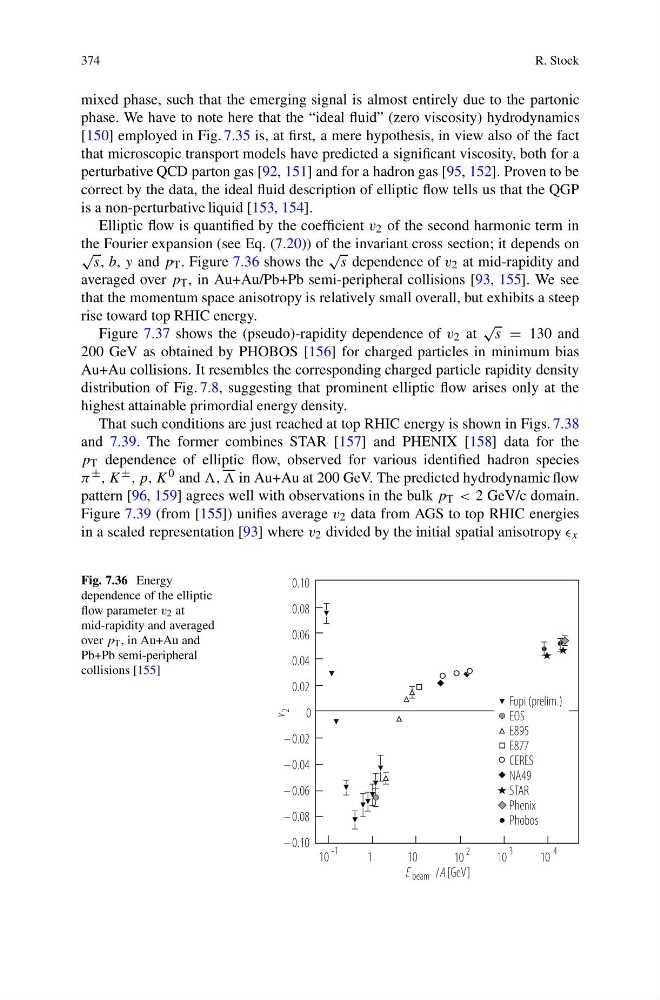
Elliptic flow is quantified by the coefficient v 2 of the second harmonic term in
the Fourier expansion (see Eq. (7.20)) of the invariant cross section; it depends on
√
s, b, y and p T . Figure 7.36 shows the
√
s dependence of v 2 at mid-rapidity and
averaged over p T , in Au+Au/Pb+Pb semi-peripheral collisions [93, 155]. We see
that the momentum space anisotropy is relatively small overall, but exhibits a steep
rise toward top RHIC energy.
Figure 7.37 shows the (pseudo)-rapidity dependence of v 2 at
√
s = 130 and
200 GeV as obtained by PHOBOS [156] for charged particles in minimum bias
Au+Au collisions. It resembles the corresponding charged particle rapidity density
distribution of Fig. 7.8, suggesting that prominent elliptic flow arises only at the
highest attainable primordial energy density.
That such conditions are just reached at top RHIC energy is shown in Figs. 7.38
and 7.39. The former combines STAR [157] and PHENIX [158] data for the
p T dependence of elliptic flow, observed for various identified hadron species
π ± , K ± , p, K 0 and , in Au+Au at 200 GeV. The predicted hydrodynamic flow
pattern [96, 159] agrees well with observations in the bulk p T < 2 GeV/c domain.
Figure 7.39 (from [155]) unifies average v 2 data from AGS to top RHIC energies
in a scaled representation [93] where v 2 divided by the initial spatial anisotropy x
Fig. 7.36 Energy
dependence of the elliptic
flow parameter v 2 at
mid-rapidity and averaged
over p T , in Au+Au and
Pb+Pb semi-peripheral
collisions [155]
10
1
10
10
10
10
-1
2
3
4
E
A
beam / [GeV]
v 2
0.10
0.08
0.06
0.04
0.02
0
– 0.02
– 0.04
– 0.06
– 0.08
– 0.10
Fopi (prelim.)
EOS
E895
E877
CERES
NA49
STAR
Phenix
Phobos
R. Stock
mixed phase, such that the emerging signal is almost entirely due to the partonic
phase. We have to note here that the “ideal fluid” (zero viscosity) hydrodynamics
[150] employed in Fig. 7.35 is, at first, a mere hypothesis, in view also of the fact
that microscopic transport models have predicted a significant viscosity, both for a
perturbative QCD parton gas [92, 151] and for a hadron gas [95, 152]. Proven to be
correct by the data, the ideal fluid description of elliptic flow tells us that the QGP
is a non-perturbative liquid [153, 154].
Elliptic flow is quantified by the coefficient v 2 of the second harmonic term in
the Fourier expansion (see Eq. (7.20)) of the invariant cross section; it depends on
√
s, b, y and p T . Figure 7.36 shows the
√
s dependence of v 2 at mid-rapidity and
averaged over p T , in Au+Au/Pb+Pb semi-peripheral collisions [93, 155]. We see
that the momentum space anisotropy is relatively small overall, but exhibits a steep
rise toward top RHIC energy.
Figure 7.37 shows the (pseudo)-rapidity dependence of v 2 at
√
s = 130 and
200 GeV as obtained by PHOBOS [156] for charged particles in minimum bias
Au+Au collisions. It resembles the corresponding charged particle rapidity density
distribution of Fig. 7.8, suggesting that prominent elliptic flow arises only at the
highest attainable primordial energy density.
That such conditions are just reached at top RHIC energy is shown in Figs. 7.38
and 7.39. The former combines STAR [157] and PHENIX [158] data for the
p T dependence of elliptic flow, observed for various identified hadron species
π ± , K ± , p, K 0 and , in Au+Au at 200 GeV. The predicted hydrodynamic flow
pattern [96, 159] agrees well with observations in the bulk p T < 2 GeV/c domain.
Figure 7.39 (from [155]) unifies average v 2 data from AGS to top RHIC energies
in a scaled representation [93] where v 2 divided by the initial spatial anisotropy x
Fig. 7.36 Energy
dependence of the elliptic
flow parameter v 2 at
mid-rapidity and averaged
over p T , in Au+Au and
Pb+Pb semi-peripheral
collisions [155]
10
1
10
10
10
10
-1
2
3
4
E
A
beam / [GeV]
v 2
0.10
0.08
0.06
0.04
0.02
0
– 0.02
– 0.04
– 0.06
– 0.08
– 0.10
Fopi (prelim.)
EOS
E895
E877
CERES
NA49
STAR
Phenix
Phobos