

7 Relativistic Nucleus-Nucleus Collisions and the QCD Matter Phase Diagram
363
the hadronization of an Omega hyperon in A+A collisions faces the phase space
penalty factor of only three s quarks to be gathered, the corresponding three s
quarks being taken care of elsewhere in the extended volume by global strangeness
conservation. In the framework of the SHM this situation is represented by the grand
canonical ensemble (Eqs. (7.34), (7.36)); the global chemical potential μ B expresses
quantum number conservation on average. Strict, local conservation is represented
by the canonical ensemble.
The grand canonical (GC) situation can be shown to be the large collision volume
limit (with high multiplicities {N i }) of the canonical (C) formulation [118, 119],
with a continuous transition concerning the degree of canonical strangeness suppression [119]. To see this one starts from a system that is already in the GC limit with
respect to baryon number and charge conservation whereas strangeness is treated
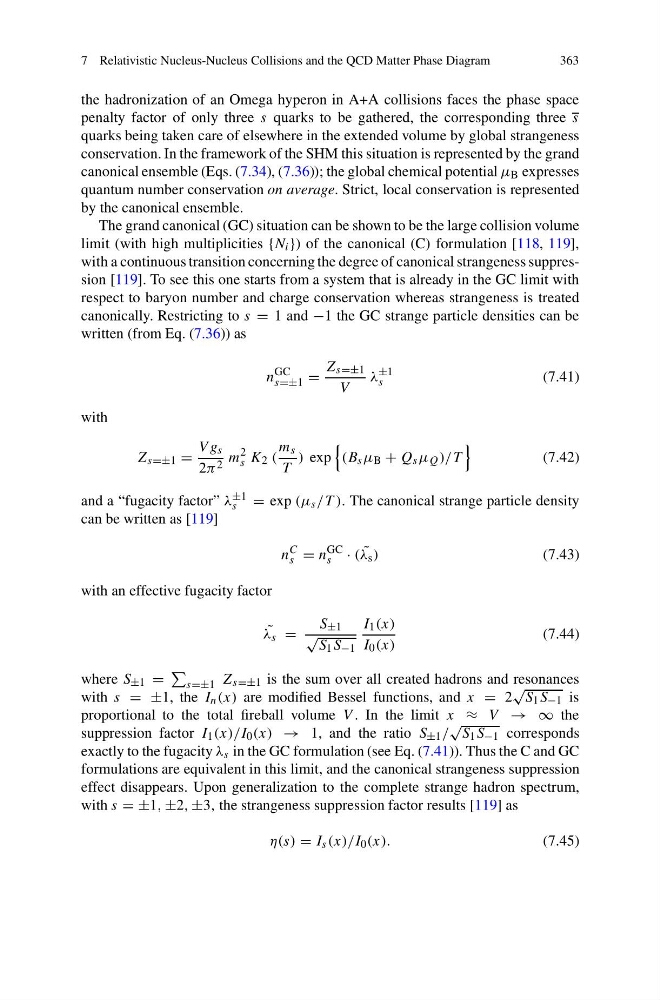
canonically. Restricting to s = 1 and −1 the GC strange particle densities can be
written (from Eq. (7.36)) as
n
GC
s=±1 =
Z s=±1
V
λ
±1
s
(7.41)
with
Z s=±1 =
V g s
2π 2 m
2
s K 2 (
m s
T
) exp
(B s μ B + Q s μ Q )/T
(7.42)
and a “fugacity factor” λ ±1
s = exp (μ s /T ). The canonical strange particle density
can be written as [119]
n
C
s = n
GC
s · ( ˜
λ s )
(7.43)
with an effective fugacity factor
˜
λ s =
S ±1
√
S 1 S −1
I 1 (x)
I 0 (x)
(7.44)
where S ±1 =
s=±1 Z s=±1 is the sum over all created hadrons and resonances
with s = ±1, the I n (x) are modified Bessel functions, and x = 2
√
S 1 S −1 is
proportional to the total fireball volume V . In the limit x ≈ V → ∞ the
suppression factor I 1 (x)/I 0 (x) → 1, and the ratio S ±1 /
√
S 1 S −1 corresponds
exactly to the fugacity λ s in the GC formulation (see Eq. (7.41)). Thus the C and GC
formulations are equivalent in this limit, and the canonical strangeness suppression
effect disappears. Upon generalization to the complete strange hadron spectrum,
with s = ±1, ±2, ±3, the strangeness suppression factor results [119] as
η(s) = I s (x)/I 0 (x).
(7.45)
363
the hadronization of an Omega hyperon in A+A collisions faces the phase space
penalty factor of only three s quarks to be gathered, the corresponding three s
quarks being taken care of elsewhere in the extended volume by global strangeness
conservation. In the framework of the SHM this situation is represented by the grand
canonical ensemble (Eqs. (7.34), (7.36)); the global chemical potential μ B expresses
quantum number conservation on average. Strict, local conservation is represented
by the canonical ensemble.
The grand canonical (GC) situation can be shown to be the large collision volume
limit (with high multiplicities {N i }) of the canonical (C) formulation [118, 119],
with a continuous transition concerning the degree of canonical strangeness suppression [119]. To see this one starts from a system that is already in the GC limit with
respect to baryon number and charge conservation whereas strangeness is treated
canonically. Restricting to s = 1 and −1 the GC strange particle densities can be
written (from Eq. (7.36)) as
n
GC
s=±1 =
Z s=±1
V
λ
±1
s
(7.41)
with
Z s=±1 =
V g s
2π 2 m
2
s K 2 (
m s
T
) exp
(B s μ B + Q s μ Q )/T
(7.42)
and a “fugacity factor” λ ±1
s = exp (μ s /T ). The canonical strange particle density
can be written as [119]
n
C
s = n
GC
s · ( ˜
λ s )
(7.43)
with an effective fugacity factor
˜
λ s =
S ±1
√
S 1 S −1
I 1 (x)
I 0 (x)
(7.44)
where S ±1 =
s=±1 Z s=±1 is the sum over all created hadrons and resonances
with s = ±1, the I n (x) are modified Bessel functions, and x = 2
√
S 1 S −1 is
proportional to the total fireball volume V . In the limit x ≈ V → ∞ the
suppression factor I 1 (x)/I 0 (x) → 1, and the ratio S ±1 /
√
S 1 S −1 corresponds
exactly to the fugacity λ s in the GC formulation (see Eq. (7.41)). Thus the C and GC
formulations are equivalent in this limit, and the canonical strangeness suppression
effect disappears. Upon generalization to the complete strange hadron spectrum,
with s = ±1, ±2, ±3, the strangeness suppression factor results [119] as
η(s) = I s (x)/I 0 (x).
(7.45)