

362
R. Stock
it is also referred to as a strangeness saturation, in SHM analysis [107, 108], for
the reason that λ s ≈ 0.45 corresponds to the grand canonical limit of strangeness
production, implicit in the analysis illustrated in Figs. 7.25 and 7.26. The average
R AA
s=1 at
√
s ≥ 10 GeV thus is about 2.2, both in the data of Fig. 7.28 and in the
statistical model. It increases (Fig. 7.29) toward about 10 in s = 3 production of
hyperons.
In order to provide for a first guidance concerning the above facts and
terminology regarding strangeness production we propose an extremely naive
argument, based on the empirical fact of a universal hadronization temperature
(Figs. 7.17, 7.25, and 7.26) at high
√
s. Noting that s = s and u ≈ u ≈
d ≈
d
in a QGP system at μ B near zero, and T = 165 MeV, just prior to
hadronization, λ s ≈ s / u ≈ exp{(m u − m s )/T } = 0.45 at p T → 0 if we take
current quark masses, m s − m u ≈ 130 MeV. I.e. the value of λ s in A+A collisions
at high
√
s resembles that of a grand canonical QGP at μ B → 0, as was indeed
shown in a 3 flavor lattice QCD calculation [115] at T ≈ T c . On the contrary,
a p+p collision features no QGP but a small fireball volume, at T ≈ T c , within
which local strangeness neutrality, s = s has to be strictly enforced, implying
a canonical treatment [109]. In our naive model the exponential penalty factor thus
contains twice the strangeness quark mass in the exponent, λ s in pp collisions
≈ exp{2(m u − m s )/T } ≈ 0.2, in agreement with the observations concerning
strangeness suppression, which are thus referred to as canonical suppression. In a
further extension of our toy model, now ignoring the u, d masses in comparison to
m s ≈ 135 MeV, we can estimate the hierarchy of hyperon enhancement in A+A
collisions,
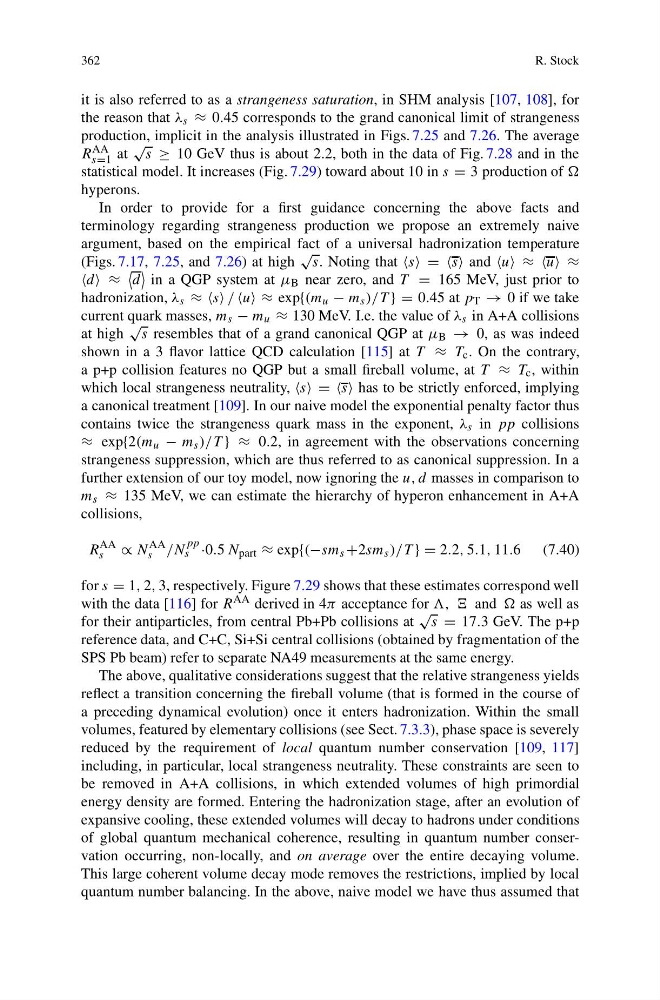
R
AA
s
∝ N
AA
s /N
pp
s ·0.5 N part ≈ exp{(−sm s +2sm s )/T } = 2.2, 5.1, 11.6 (7.40)
for s = 1, 2, 3, respectively. Figure 7.29 shows that these estimates correspond well
with the data [116] for R AA derived in 4π acceptance for , , and as well as
for their antiparticles, from central Pb+Pb collisions at
√
s = 17.3 GeV. The p+p
reference data, and C+C, Si+Si central collisions (obtained by fragmentation of the
SPS Pb beam) refer to separate NA49 measurements at the same energy.
The above, qualitative considerations suggest that the relative strangeness yields
reflect a transition concerning the fireball volume (that is formed in the course of
a preceding dynamical evolution) once it enters hadronization. Within the small
volumes, featured by elementary collisions (see Sect. 7.3.3), phase space is severely
reduced by the requirement of local quantum number conservation [109, 117]
including, in particular, local strangeness neutrality. These constraints are seen to
be removed in A+A collisions, in which extended volumes of high primordial
energy density are formed. Entering the hadronization stage, after an evolution of
expansive cooling, these extended volumes will decay to hadrons under conditions
of global quantum mechanical coherence, resulting in quantum number conservation occurring, non-locally, and on average over the entire decaying volume.
This large coherent volume decay mode removes the restrictions, implied by local
quantum number balancing. In the above, naive model we have thus assumed that
R. Stock
it is also referred to as a strangeness saturation, in SHM analysis [107, 108], for
the reason that λ s ≈ 0.45 corresponds to the grand canonical limit of strangeness
production, implicit in the analysis illustrated in Figs. 7.25 and 7.26. The average
R AA
s=1 at
√
s ≥ 10 GeV thus is about 2.2, both in the data of Fig. 7.28 and in the
statistical model. It increases (Fig. 7.29) toward about 10 in s = 3 production of
hyperons.
In order to provide for a first guidance concerning the above facts and
terminology regarding strangeness production we propose an extremely naive
argument, based on the empirical fact of a universal hadronization temperature
(Figs. 7.17, 7.25, and 7.26) at high
√
s. Noting that s = s and u ≈ u ≈
d ≈
d
in a QGP system at μ B near zero, and T = 165 MeV, just prior to
hadronization, λ s ≈ s / u ≈ exp{(m u − m s )/T } = 0.45 at p T → 0 if we take
current quark masses, m s − m u ≈ 130 MeV. I.e. the value of λ s in A+A collisions
at high
√
s resembles that of a grand canonical QGP at μ B → 0, as was indeed
shown in a 3 flavor lattice QCD calculation [115] at T ≈ T c . On the contrary,
a p+p collision features no QGP but a small fireball volume, at T ≈ T c , within
which local strangeness neutrality, s = s has to be strictly enforced, implying
a canonical treatment [109]. In our naive model the exponential penalty factor thus
contains twice the strangeness quark mass in the exponent, λ s in pp collisions
≈ exp{2(m u − m s )/T } ≈ 0.2, in agreement with the observations concerning
strangeness suppression, which are thus referred to as canonical suppression. In a
further extension of our toy model, now ignoring the u, d masses in comparison to
m s ≈ 135 MeV, we can estimate the hierarchy of hyperon enhancement in A+A
collisions,
R
AA
s
∝ N
AA
s /N
pp
s ·0.5 N part ≈ exp{(−sm s +2sm s )/T } = 2.2, 5.1, 11.6 (7.40)
for s = 1, 2, 3, respectively. Figure 7.29 shows that these estimates correspond well
with the data [116] for R AA derived in 4π acceptance for , , and as well as
for their antiparticles, from central Pb+Pb collisions at
√
s = 17.3 GeV. The p+p
reference data, and C+C, Si+Si central collisions (obtained by fragmentation of the
SPS Pb beam) refer to separate NA49 measurements at the same energy.
The above, qualitative considerations suggest that the relative strangeness yields
reflect a transition concerning the fireball volume (that is formed in the course of
a preceding dynamical evolution) once it enters hadronization. Within the small
volumes, featured by elementary collisions (see Sect. 7.3.3), phase space is severely
reduced by the requirement of local quantum number conservation [109, 117]
including, in particular, local strangeness neutrality. These constraints are seen to
be removed in A+A collisions, in which extended volumes of high primordial
energy density are formed. Entering the hadronization stage, after an evolution of
expansive cooling, these extended volumes will decay to hadrons under conditions
of global quantum mechanical coherence, resulting in quantum number conservation occurring, non-locally, and on average over the entire decaying volume.
This large coherent volume decay mode removes the restrictions, implied by local
quantum number balancing. In the above, naive model we have thus assumed that