

358
R. Stock
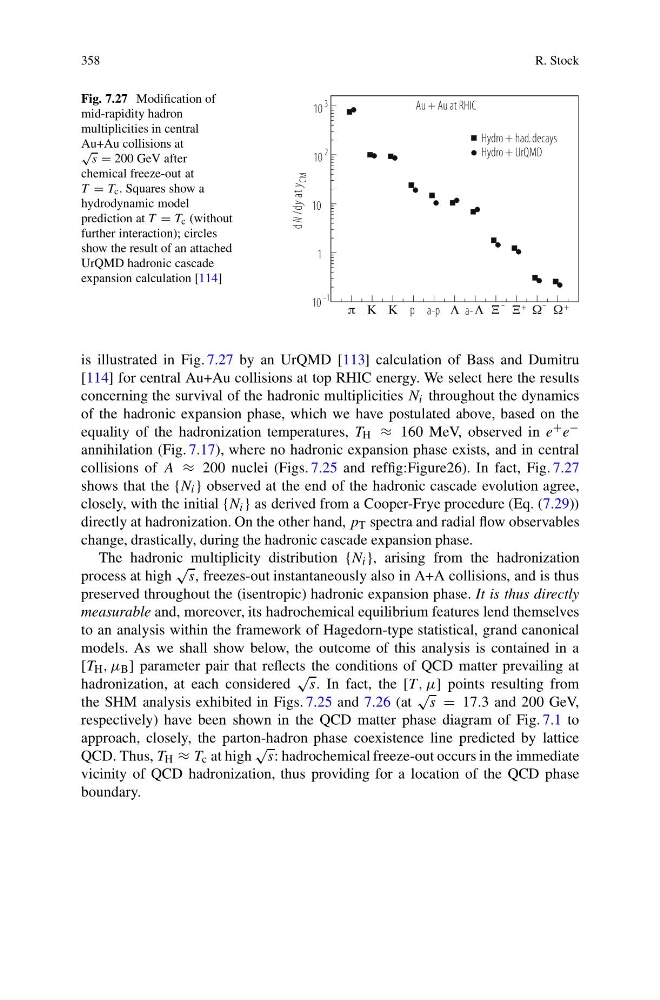
Fig. 7.27 Modification of
mid-rapidity hadron
multiplicities in central
Au+Au collisions at
√
s = 200 GeV after
chemical freeze-out at
T = T c . Squares show a
hydrodynamic model
prediction at T = T c (without
further interaction); circles
show the result of an attached
UrQMD hadronic cascade
expansion calculation [114]
10
10
10
1
10
3
2
-1
+
+
p
-
-
a-p
aHydro + had.decays
Hydro + UrQMD
Au + Au at RHIC
t
a
d
/
d
y
y
N M
C
is illustrated in Fig. 7.27 by an UrQMD [113] calculation of Bass and Dumitru
[114] for central Au+Au collisions at top RHIC energy. We select here the results
concerning the survival of the hadronic multiplicities N i throughout the dynamics
of the hadronic expansion phase, which we have postulated above, based on the
equality of the hadronization temperatures, T H ≈ 160 MeV, observed in e + e −
annihilation (Fig. 7.17), where no hadronic expansion phase exists, and in central
collisions of A ≈ 200 nuclei (Figs. 7.25 and reffig:Figure26). In fact, Fig. 7.27
shows that the {N i } observed at the end of the hadronic cascade evolution agree,
closely, with the initial {N i } as derived from a Cooper-Frye procedure (Eq. (7.29))
directly at hadronization. On the other hand, p T spectra and radial flow observables
change, drastically, during the hadronic cascade expansion phase.
The hadronic multiplicity distribution {N i }, arising from the hadronization
process at high
√
s, freezes-out instantaneously also in A+A collisions, and is thus
preserved throughout the (isentropic) hadronic expansion phase. It is thus directly
measurable and, moreover, its hadrochemical equilibrium features lend themselves
to an analysis within the framework of Hagedorn-type statistical, grand canonical
models. As we shall show below, the outcome of this analysis is contained in a
[T H , μ B ] parameter pair that reflects the conditions of QCD matter prevailing at
hadronization, at each considered
√
s. In fact, the [T , μ] points resulting from
the SHM analysis exhibited in Figs. 7.25 and 7.26 (at
√
s = 17.3 and 200 GeV,
respectively) have been shown in the QCD matter phase diagram of Fig. 7.1 to
approach, closely, the parton-hadron phase coexistence line predicted by lattice
QCD. Thus, T H ≈ T c at high
√
s: hadrochemical freeze-out occurs in the immediate
vicinity of QCD hadronization, thus providing for a location of the QCD phase
boundary.
R. Stock
Fig. 7.27 Modification of
mid-rapidity hadron
multiplicities in central
Au+Au collisions at
√
s = 200 GeV after
chemical freeze-out at
T = T c . Squares show a
hydrodynamic model
prediction at T = T c (without
further interaction); circles
show the result of an attached
UrQMD hadronic cascade
expansion calculation [114]
10
10
10
1
10
3
2
-1
+
+
p
-
-
a-p
aHydro + had.decays
Hydro + UrQMD
Au + Au at RHIC
t
a
d
/
d
y
y
N M
C
is illustrated in Fig. 7.27 by an UrQMD [113] calculation of Bass and Dumitru
[114] for central Au+Au collisions at top RHIC energy. We select here the results
concerning the survival of the hadronic multiplicities N i throughout the dynamics
of the hadronic expansion phase, which we have postulated above, based on the
equality of the hadronization temperatures, T H ≈ 160 MeV, observed in e + e −
annihilation (Fig. 7.17), where no hadronic expansion phase exists, and in central
collisions of A ≈ 200 nuclei (Figs. 7.25 and reffig:Figure26). In fact, Fig. 7.27
shows that the {N i } observed at the end of the hadronic cascade evolution agree,
closely, with the initial {N i } as derived from a Cooper-Frye procedure (Eq. (7.29))
directly at hadronization. On the other hand, p T spectra and radial flow observables
change, drastically, during the hadronic cascade expansion phase.
The hadronic multiplicity distribution {N i }, arising from the hadronization
process at high
√
s, freezes-out instantaneously also in A+A collisions, and is thus
preserved throughout the (isentropic) hadronic expansion phase. It is thus directly
measurable and, moreover, its hadrochemical equilibrium features lend themselves
to an analysis within the framework of Hagedorn-type statistical, grand canonical
models. As we shall show below, the outcome of this analysis is contained in a
[T H , μ B ] parameter pair that reflects the conditions of QCD matter prevailing at
hadronization, at each considered
√
s. In fact, the [T , μ] points resulting from
the SHM analysis exhibited in Figs. 7.25 and 7.26 (at
√
s = 17.3 and 200 GeV,
respectively) have been shown in the QCD matter phase diagram of Fig. 7.1 to
approach, closely, the parton-hadron phase coexistence line predicted by lattice
QCD. Thus, T H ≈ T c at high
√
s: hadrochemical freeze-out occurs in the immediate
vicinity of QCD hadronization, thus providing for a location of the QCD phase
boundary.