

7 Relativistic Nucleus-Nucleus Collisions and the QCD Matter Phase Diagram
359
7.3.2 Grand Canonical Strangeness Enhancement
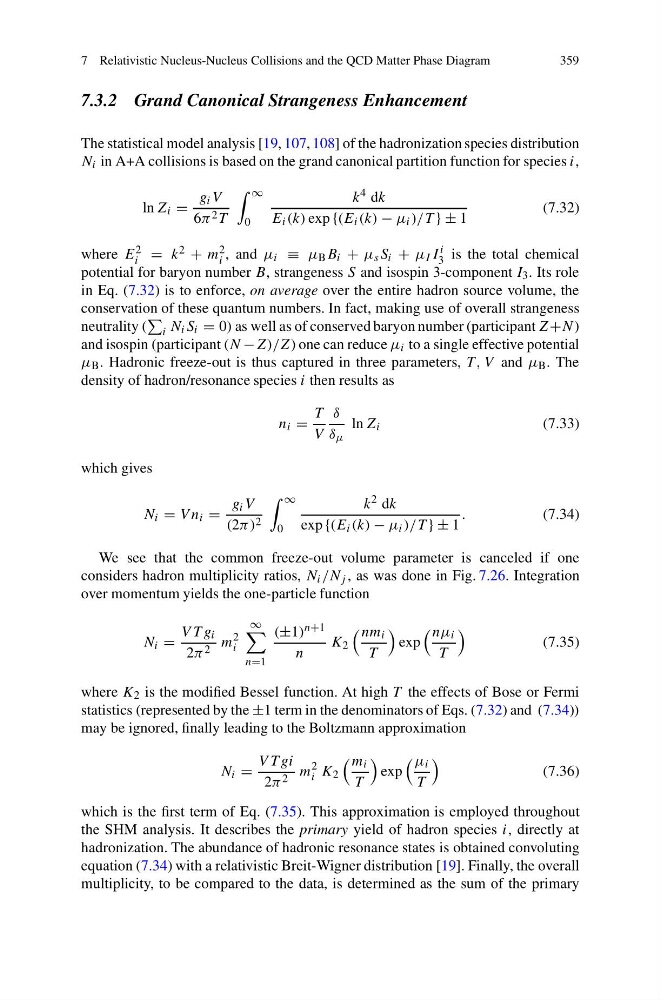
The statistical model analysis [19, 107, 108] of the hadronization species distribution
N i in A+A collisions is based on the grand canonical partition function for species i,
ln Z i =
g i V
6π 2 T
∞
0
k 4 dk
E i (k) exp {(E i (k) − μ i )/T } ± 1
(7.32)
where E 2
i = k 2 + m 2
i , and μ i ≡ μ B B i + μ s S i + μ I I
i
3 is the total chemical
potential for baryon number B, strangeness S and isospin 3-component I 3 . Its role
in Eq. (7.32) is to enforce, on average over the entire hadron source volume, the
conservation of these quantum numbers. In fact, making use of overall strangeness
neutrality (
i N i S i = 0) as well as of conserved baryon number (participant Z+N)
and isospin (participant (N −Z)/Z) one can reduce μ i to a single effective potential
μ B . Hadronic freeze-out is thus captured in three parameters, T , V and μ B . The
density of hadron/resonance species i then results as
n i =
T
V
δ
δ μ
ln Z i
(7.33)
which gives
N i = V n i =
g i V
(2π) 2
∞
0
k 2 dk
exp {(E i (k) − μ i )/T } ± 1
.
(7.34)
We see that the common freeze-out volume parameter is canceled if one
considers hadron multiplicity ratios, N i /N j , as was done in Fig. 7.26. Integration
over momentum yields the one-particle function
N i =
V T g i
2π 2 m
2
i
∞
n=1
(±1) n+1
n
K 2
nm i
T
exp
nμ i
T
(7.35)
where K 2 is the modified Bessel function. At high T the effects of Bose or Fermi
statistics (represented by the ±1 term in the denominators of Eqs. (7.32) and (7.34))
may be ignored, finally leading to the Boltzmann approximation
N i =
V T gi
2π 2 m
2
i K 2
m i
T
exp
μ i
T
(7.36)
which is the first term of Eq. (7.35). This approximation is employed throughout
the SHM analysis. It describes the primary yield of hadron species i, directly at
hadronization. The abundance of hadronic resonance states is obtained convoluting
equation (7.34) with a relativistic Breit-Wigner distribution [19]. Finally, the overall
multiplicity, to be compared to the data, is determined as the sum of the primary
359
7.3.2 Grand Canonical Strangeness Enhancement
The statistical model analysis [19, 107, 108] of the hadronization species distribution
N i in A+A collisions is based on the grand canonical partition function for species i,
ln Z i =
g i V
6π 2 T
∞
0
k 4 dk
E i (k) exp {(E i (k) − μ i )/T } ± 1
(7.32)
where E 2
i = k 2 + m 2
i , and μ i ≡ μ B B i + μ s S i + μ I I
i
3 is the total chemical
potential for baryon number B, strangeness S and isospin 3-component I 3 . Its role
in Eq. (7.32) is to enforce, on average over the entire hadron source volume, the
conservation of these quantum numbers. In fact, making use of overall strangeness
neutrality (
i N i S i = 0) as well as of conserved baryon number (participant Z+N)
and isospin (participant (N −Z)/Z) one can reduce μ i to a single effective potential
μ B . Hadronic freeze-out is thus captured in three parameters, T , V and μ B . The
density of hadron/resonance species i then results as
n i =
T
V
δ
δ μ
ln Z i
(7.33)
which gives
N i = V n i =
g i V
(2π) 2
∞
0
k 2 dk
exp {(E i (k) − μ i )/T } ± 1
.
(7.34)
We see that the common freeze-out volume parameter is canceled if one
considers hadron multiplicity ratios, N i /N j , as was done in Fig. 7.26. Integration
over momentum yields the one-particle function
N i =
V T g i
2π 2 m
2
i
∞
n=1
(±1) n+1
n
K 2
nm i
T
exp
nμ i
T
(7.35)
where K 2 is the modified Bessel function. At high T the effects of Bose or Fermi
statistics (represented by the ±1 term in the denominators of Eqs. (7.32) and (7.34))
may be ignored, finally leading to the Boltzmann approximation
N i =
V T gi
2π 2 m
2
i K 2
m i
T
exp
μ i
T
(7.36)
which is the first term of Eq. (7.35). This approximation is employed throughout
the SHM analysis. It describes the primary yield of hadron species i, directly at
hadronization. The abundance of hadronic resonance states is obtained convoluting
equation (7.34) with a relativistic Breit-Wigner distribution [19]. Finally, the overall
multiplicity, to be compared to the data, is determined as the sum of the primary