

7 Relativistic Nucleus-Nucleus Collisions and the QCD Matter Phase Diagram
333
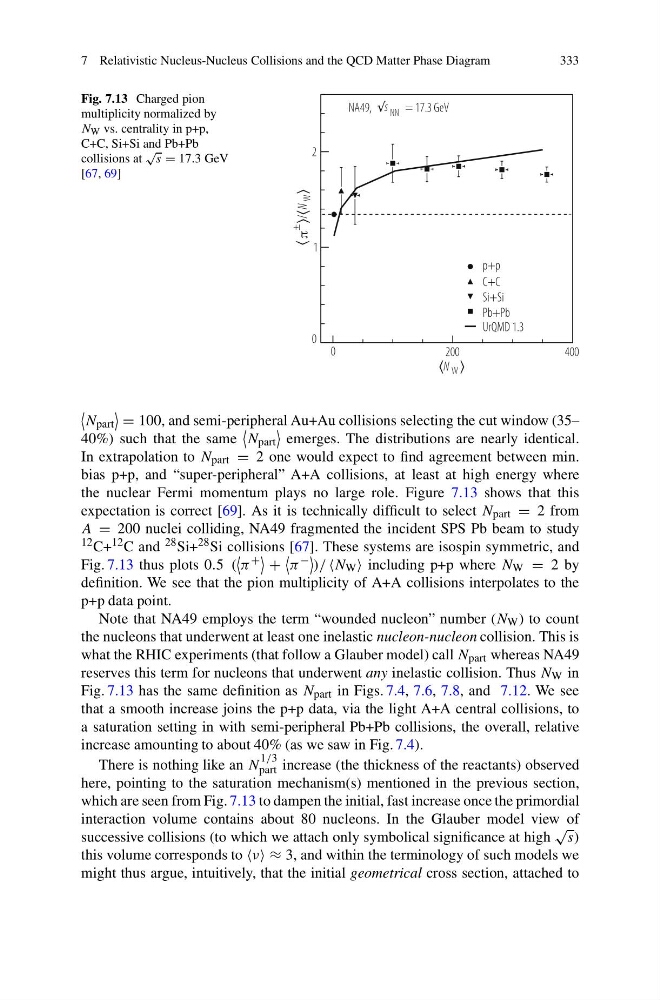
Fig. 7.13 Charged pion
multiplicity normalized by
N W vs. centrality in p+p,
C+C, Si+Si and Pb+Pb
collisions at
√
s = 17.3 GeV
[67, 69]
W
N
0
200
400
W
/
N
±
0
1
2
p+p
C+C
Si+Si
Pb+Pb
UrQMD 1.3
= 17.3 GeV
NN
s
NA49,
N part
= 100, and semi-peripheral Au+Au collisions selecting the cut window (35–
40%) such that the same
N part
emerges. The distributions are nearly identical.
In extrapolation to N part = 2 one would expect to find agreement between min.
bias p+p, and “super-peripheral” A+A collisions, at least at high energy where
the nuclear Fermi momentum plays no large role. Figure 7.13 shows that this
expectation is correct [69]. As it is technically difficult to select N part = 2 from
A = 200 nuclei colliding, NA49 fragmented the incident SPS Pb beam to study
12 C+ 12 C and 28 Si+ 28 Si collisions [67]. These systems are isospin symmetric, and
Fig. 7.13 thus plots 0.5 (
π + +
π −
)/ N W including p+p where N W = 2 by
definition. We see that the pion multiplicity of A+A collisions interpolates to the
p+p data point.
Note that NA49 employs the term “wounded nucleon” number (N W ) to count
the nucleons that underwent at least one inelastic nucleon-nucleon collision. This is
what the RHIC experiments (that follow a Glauber model) call N part whereas NA49
reserves this term for nucleons that underwent any inelastic collision. Thus N W in
Fig. 7.13 has the same definition as N part in Figs. 7.4, 7.6, 7.8, and 7.12. We see
that a smooth increase joins the p+p data, via the light A+A central collisions, to
a saturation setting in with semi-peripheral Pb+Pb collisions, the overall, relative
increase amounting to about 40% (as we saw in Fig. 7.4).
There is nothing like an N
1/3
part increase (the thickness of the reactants) observed
here, pointing to the saturation mechanism(s) mentioned in the previous section,
which are seen from Fig. 7.13 to dampen the initial, fast increase once the primordial
interaction volume contains about 80 nucleons. In the Glauber model view of
successive collisions (to which we attach only symbolical significance at high
√
s)
this volume corresponds to ν ≈ 3, and within the terminology of such models we
might thus argue, intuitively, that the initial geometrical cross section, attached to
333
Fig. 7.13 Charged pion
multiplicity normalized by
N W vs. centrality in p+p,
C+C, Si+Si and Pb+Pb
collisions at
√
s = 17.3 GeV
[67, 69]
W
N
0
200
400
W
/
N
±
0
1
2
p+p
C+C
Si+Si
Pb+Pb
UrQMD 1.3
= 17.3 GeV
NN
s
NA49,
N part
= 100, and semi-peripheral Au+Au collisions selecting the cut window (35–
40%) such that the same
N part
emerges. The distributions are nearly identical.
In extrapolation to N part = 2 one would expect to find agreement between min.
bias p+p, and “super-peripheral” A+A collisions, at least at high energy where
the nuclear Fermi momentum plays no large role. Figure 7.13 shows that this
expectation is correct [69]. As it is technically difficult to select N part = 2 from
A = 200 nuclei colliding, NA49 fragmented the incident SPS Pb beam to study
12 C+ 12 C and 28 Si+ 28 Si collisions [67]. These systems are isospin symmetric, and
Fig. 7.13 thus plots 0.5 (
π + +
π −
)/ N W including p+p where N W = 2 by
definition. We see that the pion multiplicity of A+A collisions interpolates to the
p+p data point.
Note that NA49 employs the term “wounded nucleon” number (N W ) to count
the nucleons that underwent at least one inelastic nucleon-nucleon collision. This is
what the RHIC experiments (that follow a Glauber model) call N part whereas NA49
reserves this term for nucleons that underwent any inelastic collision. Thus N W in
Fig. 7.13 has the same definition as N part in Figs. 7.4, 7.6, 7.8, and 7.12. We see
that a smooth increase joins the p+p data, via the light A+A central collisions, to
a saturation setting in with semi-peripheral Pb+Pb collisions, the overall, relative
increase amounting to about 40% (as we saw in Fig. 7.4).
There is nothing like an N
1/3
part increase (the thickness of the reactants) observed
here, pointing to the saturation mechanism(s) mentioned in the previous section,
which are seen from Fig. 7.13 to dampen the initial, fast increase once the primordial
interaction volume contains about 80 nucleons. In the Glauber model view of
successive collisions (to which we attach only symbolical significance at high
√
s)
this volume corresponds to ν ≈ 3, and within the terminology of such models we
might thus argue, intuitively, that the initial geometrical cross section, attached to