

334
R. Stock
the nucleon structure function as a whole, has disappeared at ν ≈ 3, all constituent
partons being freed.
7.2.4 Gluon Saturation in A+A Collisions
We will now take a closer look at the saturation phenomena of high energy QCD
scattering, and apply results obtained for deep inelastic electron-proton reactions to
nuclear collisions, a procedure that relies on a universality of high energy hadron
scattering. This arises at high
√
s, and at relatively low momentum transfer squared
Q 2 (the condition governing bulk charged particle production near mid-rapidity at
RHIC, where Feynman x ≈ 0.01 and Q 2 ≤ 5 GeV 2 ). Universality comes about
as the transverse resolution becomes higher and higher, with Q 2 , so that within the
small area tested by the collision there is no difference whether the partons sampled
there belong to the transverse gluon and quark density projection of any hadron
species, or even of a nucleus. And saturation arises once the areal transverse parton
density exceeds the resolution, leading to interfering QCD sub-amplitudes that do
not reflect in the total cross section in a manner similar to the mere summation of
separate, resolved color charges [61–65, 70, 71].
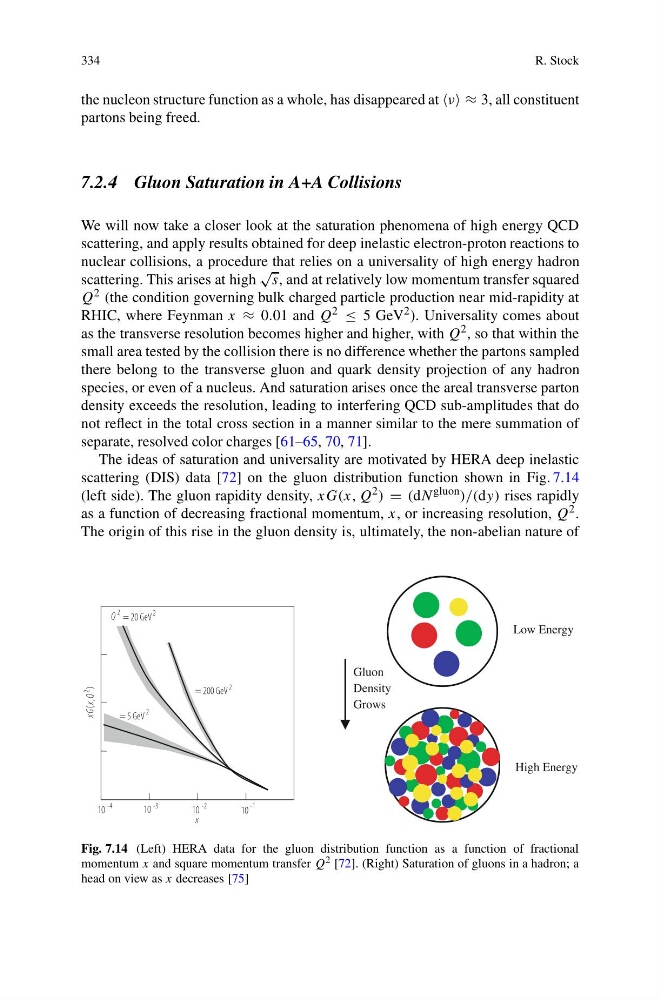
The ideas of saturation and universality are motivated by HERA deep inelastic
scattering (DIS) data [72] on the gluon distribution function shown in Fig. 7.14
(left side). The gluon rapidity density, xG(x, Q 2 ) = (dN gluon )/(dy) rises rapidly
as a function of decreasing fractional momentum, x, or increasing resolution, Q 2 .
The origin of this rise in the gluon density is, ultimately, the non-abelian nature of
x
10
10
10
10
= 200 GeV
Q = 20 GeV
Q
x
G
x ( ,
)
2
2
2
-4
-3
-2
-1
= 5 GeV
2
2
Fig. 7.14 (Left) HERA data for the gluon distribution function as a function of fractional
momentum x and square momentum transfer Q 2 [72]. (Right) Saturation of gluons in a hadron; a
head on view as x decreases [75]
R. Stock
the nucleon structure function as a whole, has disappeared at ν ≈ 3, all constituent
partons being freed.
7.2.4 Gluon Saturation in A+A Collisions
We will now take a closer look at the saturation phenomena of high energy QCD
scattering, and apply results obtained for deep inelastic electron-proton reactions to
nuclear collisions, a procedure that relies on a universality of high energy hadron
scattering. This arises at high
√
s, and at relatively low momentum transfer squared
Q 2 (the condition governing bulk charged particle production near mid-rapidity at
RHIC, where Feynman x ≈ 0.01 and Q 2 ≤ 5 GeV 2 ). Universality comes about
as the transverse resolution becomes higher and higher, with Q 2 , so that within the
small area tested by the collision there is no difference whether the partons sampled
there belong to the transverse gluon and quark density projection of any hadron
species, or even of a nucleus. And saturation arises once the areal transverse parton
density exceeds the resolution, leading to interfering QCD sub-amplitudes that do
not reflect in the total cross section in a manner similar to the mere summation of
separate, resolved color charges [61–65, 70, 71].
The ideas of saturation and universality are motivated by HERA deep inelastic
scattering (DIS) data [72] on the gluon distribution function shown in Fig. 7.14
(left side). The gluon rapidity density, xG(x, Q 2 ) = (dN gluon )/(dy) rises rapidly
as a function of decreasing fractional momentum, x, or increasing resolution, Q 2 .
The origin of this rise in the gluon density is, ultimately, the non-abelian nature of
x
10
10
10
10
= 200 GeV
Q = 20 GeV
Q
x
G
x ( ,
)
2
2
2
-4
-3
-2
-1
= 5 GeV
2
2
Fig. 7.14 (Left) HERA data for the gluon distribution function as a function of fractional
momentum x and square momentum transfer Q 2 [72]. (Right) Saturation of gluons in a hadron; a
head on view as x decreases [75]