

7 Relativistic Nucleus-Nucleus Collisions and the QCD Matter Phase Diagram
327
y
-5 -4 -3 -2 -1 0
1
2 3
4
5
d
/
d
y
n
0
50
100
150
200
250
300
350
E895
NA49
BRAHMS
-
[GeV]
NN
s
s
10
2
10
0
0.5
1.0
1.5
2.0
2.5
3.0
E895
NA49
BRAHMS
)
P
/2 m
NN
= ln(
2
beam
y
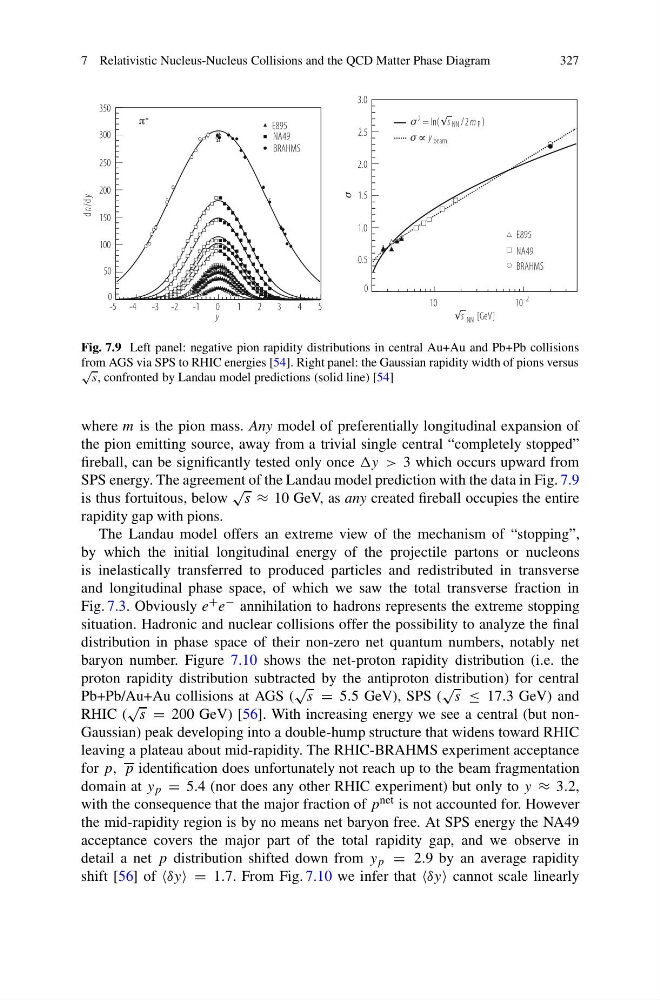
Fig. 7.9 Left panel: negative pion rapidity distributions in central Au+Au and Pb+Pb collisions
from AGS via SPS to RHIC energies [54]. Right panel: the Gaussian rapidity width of pions versus
√
s, confronted by Landau model predictions (solid line) [54]
where m is the pion mass. Any model of preferentially longitudinal expansion of
the pion emitting source, away from a trivial single central “completely stopped”
fireball, can be significantly tested only once y > 3 which occurs upward from
SPS energy. The agreement of the Landau model prediction with the data in Fig. 7.9
is thus fortuitous, below
√
s ≈ 10 GeV, as any created fireball occupies the entire
rapidity gap with pions.
The Landau model offers an extreme view of the mechanism of “stopping”,
by which the initial longitudinal energy of the projectile partons or nucleons
is inelastically transferred to produced particles and redistributed in transverse
and longitudinal phase space, of which we saw the total transverse fraction in
Fig. 7.3. Obviously e + e − annihilation to hadrons represents the extreme stopping
situation. Hadronic and nuclear collisions offer the possibility to analyze the final
distribution in phase space of their non-zero net quantum numbers, notably net
baryon number. Figure 7.10 shows the net-proton rapidity distribution (i.e. the
proton rapidity distribution subtracted by the antiproton distribution) for central
Pb+Pb/Au+Au collisions at AGS (
√
s = 5.5 GeV), SPS (
√
s ≤ 17.3 GeV) and
RHIC (
√
s = 200 GeV) [56]. With increasing energy we see a central (but nonGaussian) peak developing into a double-hump structure that widens toward RHIC
leaving a plateau about mid-rapidity. The RHIC-BRAHMS experiment acceptance
for p, p identification does unfortunately not reach up to the beam fragmentation
domain at y p = 5.4 (nor does any other RHIC experiment) but only to y ≈ 3.2,
with the consequence that the major fraction of p net is not accounted for. However
the mid-rapidity region is by no means net baryon free. At SPS energy the NA49
acceptance covers the major part of the total rapidity gap, and we observe in
detail a net p distribution shifted down from y p = 2.9 by an average rapidity
shift [56] of δy = 1.7. From Fig. 7.10 we infer that δy cannot scale linearly
327
y
-5 -4 -3 -2 -1 0
1
2 3
4
5
d
/
d
y
n
0
50
100
150
200
250
300
350
E895
NA49
BRAHMS
-
[GeV]
NN
s
s
10
2
10
0
0.5
1.0
1.5
2.0
2.5
3.0
E895
NA49
BRAHMS
)
P
/2 m
NN
= ln(
2
beam
y
Fig. 7.9 Left panel: negative pion rapidity distributions in central Au+Au and Pb+Pb collisions
from AGS via SPS to RHIC energies [54]. Right panel: the Gaussian rapidity width of pions versus
√
s, confronted by Landau model predictions (solid line) [54]
where m is the pion mass. Any model of preferentially longitudinal expansion of
the pion emitting source, away from a trivial single central “completely stopped”
fireball, can be significantly tested only once y > 3 which occurs upward from
SPS energy. The agreement of the Landau model prediction with the data in Fig. 7.9
is thus fortuitous, below
√
s ≈ 10 GeV, as any created fireball occupies the entire
rapidity gap with pions.
The Landau model offers an extreme view of the mechanism of “stopping”,
by which the initial longitudinal energy of the projectile partons or nucleons
is inelastically transferred to produced particles and redistributed in transverse
and longitudinal phase space, of which we saw the total transverse fraction in
Fig. 7.3. Obviously e + e − annihilation to hadrons represents the extreme stopping
situation. Hadronic and nuclear collisions offer the possibility to analyze the final
distribution in phase space of their non-zero net quantum numbers, notably net
baryon number. Figure 7.10 shows the net-proton rapidity distribution (i.e. the
proton rapidity distribution subtracted by the antiproton distribution) for central
Pb+Pb/Au+Au collisions at AGS (
√
s = 5.5 GeV), SPS (
√
s ≤ 17.3 GeV) and
RHIC (
√
s = 200 GeV) [56]. With increasing energy we see a central (but nonGaussian) peak developing into a double-hump structure that widens toward RHIC
leaving a plateau about mid-rapidity. The RHIC-BRAHMS experiment acceptance
for p, p identification does unfortunately not reach up to the beam fragmentation
domain at y p = 5.4 (nor does any other RHIC experiment) but only to y ≈ 3.2,
with the consequence that the major fraction of p net is not accounted for. However
the mid-rapidity region is by no means net baryon free. At SPS energy the NA49
acceptance covers the major part of the total rapidity gap, and we observe in
detail a net p distribution shifted down from y p = 2.9 by an average rapidity
shift [56] of δy = 1.7. From Fig. 7.10 we infer that δy cannot scale linearly