

7 Relativistic Nucleus-Nucleus Collisions and the QCD Matter Phase Diagram
321
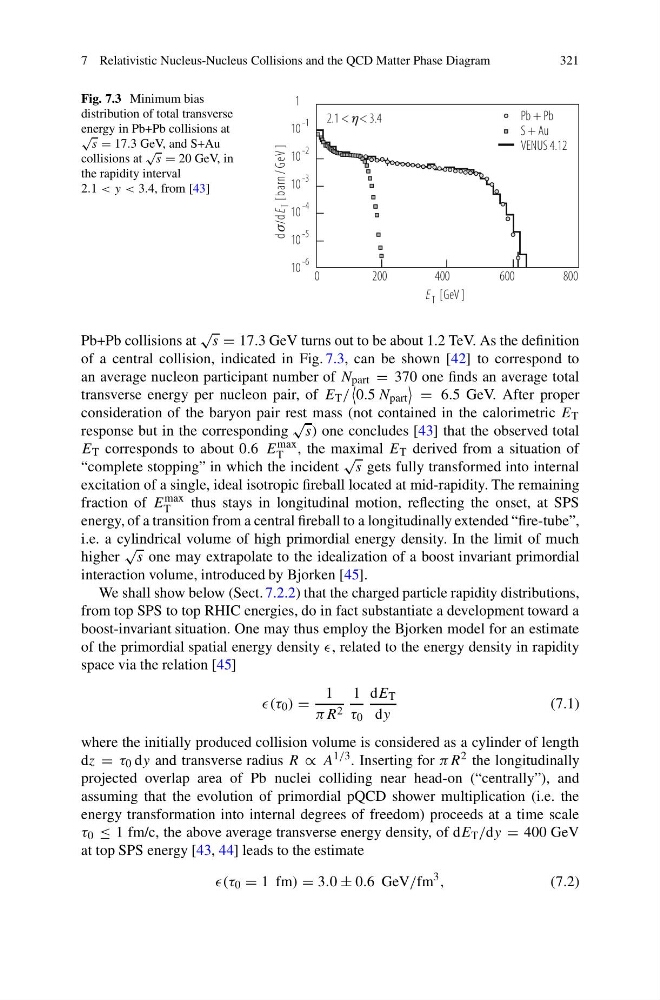
Fig. 7.3 Minimum bias
distribution of total transverse
energy in Pb+Pb collisions at
√
s = 17.3 GeV, and S+Au
collisions at
√
s = 20 GeV, in
the rapidity interval
2.1 < y < 3.4, from [43]
1
10
10
10
10
10
10
-1
-2
-3
-4
-5
-6
0
200
400
600
800
E T [GeV ]
2.1 < < 3.4
Pb + Pb
S + Au
VENUS 4.12
]
V e
G
/
n r
a
b [
d
/
d
E T
Pb+Pb collisions at
√
s = 17.3 GeV turns out to be about 1.2 TeV. As the definition
of a central collision, indicated in Fig. 7.3, can be shown [42] to correspond to
an average nucleon participant number of N part = 370 one finds an average total
transverse energy per nucleon pair, of E T /
0.5 N part
= 6.5 GeV. After proper
consideration of the baryon pair rest mass (not contained in the calorimetric E T
response but in the corresponding
√
s) one concludes [43] that the observed total
E T corresponds to about 0.6 E
max
T , the maximal E T derived from a situation of
“complete stopping” in which the incident
√
s gets fully transformed into internal
excitation of a single, ideal isotropic fireball located at mid-rapidity. The remaining
fraction of E
max
T
thus stays in longitudinal motion, reflecting the onset, at SPS
energy, of a transition from a central fireball to a longitudinally extended “fire-tube”,
i.e. a cylindrical volume of high primordial energy density. In the limit of much
higher
√
s one may extrapolate to the idealization of a boost invariant primordial
interaction volume, introduced by Bjorken [45].
We shall show below (Sect. 7.2.2) that the charged particle rapidity distributions,
from top SPS to top RHIC energies, do in fact substantiate a development toward a
boost-invariant situation. One may thus employ the Bjorken model for an estimate
of the primordial spatial energy density , related to the energy density in rapidity
space via the relation [45]
(τ 0 ) =
1
πR 2
1
τ 0
dE T
dy
(7.1)
where the initially produced collision volume is considered as a cylinder of length
dz = τ 0 dy and transverse radius R ∝ A 1/3 . Inserting for πR 2 the longitudinally
projected overlap area of Pb nuclei colliding near head-on (“centrally”), and
assuming that the evolution of primordial pQCD shower multiplication (i.e. the
energy transformation into internal degrees of freedom) proceeds at a time scale
τ 0 ≤ 1 fm/c, the above average transverse energy density, of dE T /dy = 400 GeV
at top SPS energy [43, 44] leads to the estimate
(τ 0 = 1 fm) = 3.0 ± 0.6 GeV/fm
3 ,
(7.2)
321
Fig. 7.3 Minimum bias
distribution of total transverse
energy in Pb+Pb collisions at
√
s = 17.3 GeV, and S+Au
collisions at
√
s = 20 GeV, in
the rapidity interval
2.1 < y < 3.4, from [43]
1
10
10
10
10
10
10
-1
-2
-3
-4
-5
-6
0
200
400
600
800
E T [GeV ]
2.1 < < 3.4
Pb + Pb
S + Au
VENUS 4.12
]
V e
G
/
n r
a
b [
d
/
d
E T
Pb+Pb collisions at
√
s = 17.3 GeV turns out to be about 1.2 TeV. As the definition
of a central collision, indicated in Fig. 7.3, can be shown [42] to correspond to
an average nucleon participant number of N part = 370 one finds an average total
transverse energy per nucleon pair, of E T /
0.5 N part
= 6.5 GeV. After proper
consideration of the baryon pair rest mass (not contained in the calorimetric E T
response but in the corresponding
√
s) one concludes [43] that the observed total
E T corresponds to about 0.6 E
max
T , the maximal E T derived from a situation of
“complete stopping” in which the incident
√
s gets fully transformed into internal
excitation of a single, ideal isotropic fireball located at mid-rapidity. The remaining
fraction of E
max
T
thus stays in longitudinal motion, reflecting the onset, at SPS
energy, of a transition from a central fireball to a longitudinally extended “fire-tube”,
i.e. a cylindrical volume of high primordial energy density. In the limit of much
higher
√
s one may extrapolate to the idealization of a boost invariant primordial
interaction volume, introduced by Bjorken [45].
We shall show below (Sect. 7.2.2) that the charged particle rapidity distributions,
from top SPS to top RHIC energies, do in fact substantiate a development toward a
boost-invariant situation. One may thus employ the Bjorken model for an estimate
of the primordial spatial energy density , related to the energy density in rapidity
space via the relation [45]
(τ 0 ) =
1
πR 2
1
τ 0
dE T
dy
(7.1)
where the initially produced collision volume is considered as a cylinder of length
dz = τ 0 dy and transverse radius R ∝ A 1/3 . Inserting for πR 2 the longitudinally
projected overlap area of Pb nuclei colliding near head-on (“centrally”), and
assuming that the evolution of primordial pQCD shower multiplication (i.e. the
energy transformation into internal degrees of freedom) proceeds at a time scale
τ 0 ≤ 1 fm/c, the above average transverse energy density, of dE T /dy = 400 GeV
at top SPS energy [43, 44] leads to the estimate
(τ 0 = 1 fm) = 3.0 ± 0.6 GeV/fm
3 ,
(7.2)