

322
R. Stock
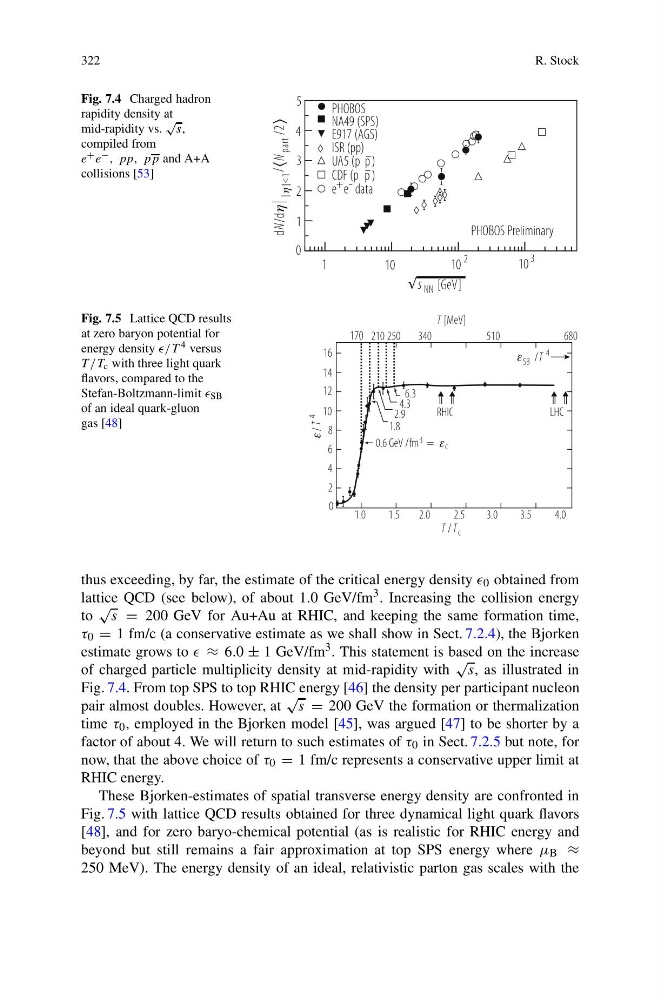
Fig. 7.4 Charged hadron
rapidity density at
mid-rapidity vs.
√
s,
compiled from
e + e − , pp, pp and A+A
collisions [53]
[GeV]
NN
s
1
10
10
2
10
3
2
/ t
r
a
p
N / <1 | |
| d
/
dN
0
1
2
3
4
5
PHOBOS
NA49 (SPS)
E917 (AGS)
ISR (pp)
)
p
UA5 (p
)
p
CDF (p
data
-
e
+
e
PHOBOS Preliminary
Fig. 7.5 Lattice QCD results
at zero baryon potential for
energy density /T 4 versus
T /T c with three light quark
flavors, compared to the
Stefan-Boltzmann-limit SB
of an ideal quark-gluon
gas [48]
170
16
14
12
10
8
6
4
2
0
1.0
1.5
2.0
2.5
3.0
3.5
4.0
210 250 340
510
LHC
RHIC
680
SB /T
T T
T
/
[MeV]
c
4
/
T
4
6.3
4.3
2.9
1.8
0.6 GeV /fm =
3
c
thus exceeding, by far, the estimate of the critical energy density 0 obtained from
lattice QCD (see below), of about 1.0 GeV/fm 3 . Increasing the collision energy
to
√
s = 200 GeV for Au+Au at RHIC, and keeping the same formation time,
τ 0 = 1 fm/c (a conservative estimate as we shall show in Sect. 7.2.4), the Bjorken
estimate grows to ≈ 6.0 ± 1 GeV/fm 3 . This statement is based on the increase
of charged particle multiplicity density at mid-rapidity with
√
s, as illustrated in
Fig. 7.4. From top SPS to top RHIC energy [46] the density per participant nucleon
pair almost doubles. However, at
√
s = 200 GeV the formation or thermalization
time τ 0 , employed in the Bjorken model [45], was argued [47] to be shorter by a
factor of about 4. We will return to such estimates of τ 0 in Sect. 7.2.5 but note, for
now, that the above choice of τ 0 = 1 fm/c represents a conservative upper limit at
RHIC energy.
These Bjorken-estimates of spatial transverse energy density are confronted in
Fig. 7.5 with lattice QCD results obtained for three dynamical light quark flavors
[48], and for zero baryo-chemical potential (as is realistic for RHIC energy and
beyond but still remains a fair approximation at top SPS energy where μ B ≈
250 MeV). The energy density of an ideal, relativistic parton gas scales with the
R. Stock
Fig. 7.4 Charged hadron
rapidity density at
mid-rapidity vs.
√
s,
compiled from
e + e − , pp, pp and A+A
collisions [53]
[GeV]
NN
s
1
10
10
2
10
3
2
/ t
r
a
p
N / <1 | |
| d
/
dN
0
1
2
3
4
5
PHOBOS
NA49 (SPS)
E917 (AGS)
ISR (pp)
)
p
UA5 (p
)
p
CDF (p
data
-
e
+
e
PHOBOS Preliminary
Fig. 7.5 Lattice QCD results
at zero baryon potential for
energy density /T 4 versus
T /T c with three light quark
flavors, compared to the
Stefan-Boltzmann-limit SB
of an ideal quark-gluon
gas [48]
170
16
14
12
10
8
6
4
2
0
1.0
1.5
2.0
2.5
3.0
3.5
4.0
210 250 340
510
LHC
RHIC
680
SB /T
T T
T
/
[MeV]
c
4
/
T
4
6.3
4.3
2.9
1.8
0.6 GeV /fm =
3
c
thus exceeding, by far, the estimate of the critical energy density 0 obtained from
lattice QCD (see below), of about 1.0 GeV/fm 3 . Increasing the collision energy
to
√
s = 200 GeV for Au+Au at RHIC, and keeping the same formation time,
τ 0 = 1 fm/c (a conservative estimate as we shall show in Sect. 7.2.4), the Bjorken
estimate grows to ≈ 6.0 ± 1 GeV/fm 3 . This statement is based on the increase
of charged particle multiplicity density at mid-rapidity with
√
s, as illustrated in
Fig. 7.4. From top SPS to top RHIC energy [46] the density per participant nucleon
pair almost doubles. However, at
√
s = 200 GeV the formation or thermalization
time τ 0 , employed in the Bjorken model [45], was argued [47] to be shorter by a
factor of about 4. We will return to such estimates of τ 0 in Sect. 7.2.5 but note, for
now, that the above choice of τ 0 = 1 fm/c represents a conservative upper limit at
RHIC energy.
These Bjorken-estimates of spatial transverse energy density are confronted in
Fig. 7.5 with lattice QCD results obtained for three dynamical light quark flavors
[48], and for zero baryo-chemical potential (as is realistic for RHIC energy and
beyond but still remains a fair approximation at top SPS energy where μ B ≈
250 MeV). The energy density of an ideal, relativistic parton gas scales with the