

5 QCD on the Lattice
243
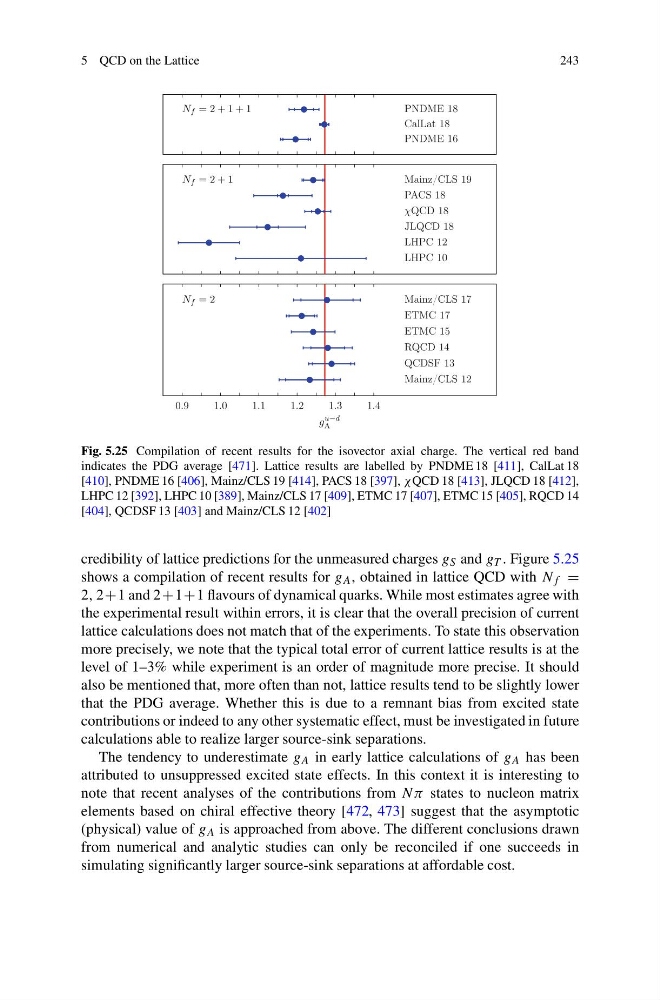
Fig. 5.25 Compilation of recent results for the isovector axial charge. The vertical red band
indicates the PDG average [471]. Lattice results are labelled by PNDME 18 [411], CalLat 18
[410], PNDME 16 [406], Mainz/CLS 19 [414], PACS 18 [397], χQCD 18 [413], JLQCD 18 [412],
LHPC 12 [392], LHPC 10 [389], Mainz/CLS 17 [409], ETMC 17 [407], ETMC 15 [405], RQCD 14
[404], QCDSF 13 [403] and Mainz/CLS 12 [402]
credibility of lattice predictions for the unmeasured charges g S and g T . Figure 5.25
shows a compilation of recent results for g A , obtained in lattice QCD with N f =
2, 2+1 and 2+1+1 flavours of dynamical quarks. While most estimates agree with
the experimental result within errors, it is clear that the overall precision of current
lattice calculations does not match that of the experiments. To state this observation
more precisely, we note that the typical total error of current lattice results is at the
level of 1–3% while experiment is an order of magnitude more precise. It should
also be mentioned that, more often than not, lattice results tend to be slightly lower
that the PDG average. Whether this is due to a remnant bias from excited state
contributions or indeed to any other systematic effect, must be investigated in future
calculations able to realize larger source-sink separations.
The tendency to underestimate g A in early lattice calculations of g A has been
attributed to unsuppressed excited state effects. In this context it is interesting to
note that recent analyses of the contributions from Nπ states to nucleon matrix
elements based on chiral effective theory [472, 473] suggest that the asymptotic
(physical) value of g A is approached from above. The different conclusions drawn
from numerical and analytic studies can only be reconciled if one succeeds in
simulating significantly larger source-sink separations at affordable cost.
243
Fig. 5.25 Compilation of recent results for the isovector axial charge. The vertical red band
indicates the PDG average [471]. Lattice results are labelled by PNDME 18 [411], CalLat 18
[410], PNDME 16 [406], Mainz/CLS 19 [414], PACS 18 [397], χQCD 18 [413], JLQCD 18 [412],
LHPC 12 [392], LHPC 10 [389], Mainz/CLS 17 [409], ETMC 17 [407], ETMC 15 [405], RQCD 14
[404], QCDSF 13 [403] and Mainz/CLS 12 [402]
credibility of lattice predictions for the unmeasured charges g S and g T . Figure 5.25
shows a compilation of recent results for g A , obtained in lattice QCD with N f =
2, 2+1 and 2+1+1 flavours of dynamical quarks. While most estimates agree with
the experimental result within errors, it is clear that the overall precision of current
lattice calculations does not match that of the experiments. To state this observation
more precisely, we note that the typical total error of current lattice results is at the
level of 1–3% while experiment is an order of magnitude more precise. It should
also be mentioned that, more often than not, lattice results tend to be slightly lower
that the PDG average. Whether this is due to a remnant bias from excited state
contributions or indeed to any other systematic effect, must be investigated in future
calculations able to realize larger source-sink separations.
The tendency to underestimate g A in early lattice calculations of g A has been
attributed to unsuppressed excited state effects. In this context it is interesting to
note that recent analyses of the contributions from Nπ states to nucleon matrix
elements based on chiral effective theory [472, 473] suggest that the asymptotic
(physical) value of g A is approached from above. The different conclusions drawn
from numerical and analytic studies can only be reconciled if one succeeds in
simulating significantly larger source-sink separations at affordable cost.