

242
H. Wittig
• increasing the projection of nucleon interpolators onto the ground state [404,
469], as well as the construction of an operator basis for the variational method,
which allows for the projection onto the approximate ground state [456, 469,
470].
The first two approaches proceed by fitting data obtained in a finite interval of
source-sink separations t s to a function that describes the approach to the asymptotic
behaviour. To be able to resolve the sub-leading contributions from excited states in
such a fit obviously requires sufficiently precise input data.
Another challenge for lattice calculations of nucleon matrix elements is the
accurate description of the pion mass dependence. Although simulations at or near
the physical pion mass are now routinely performed, the result at the physical
point is often obtained via an extrapolation in the pion mass. The fit ansatz for
the pion mass dependence is usually derived from chiral effective theory. However,
the convergence properties of baryonic chiral perturbation theory are not as well
understood as in the mesonic sector, and it is still unclear whether the predicted
functional form provides a good description in the pion mass range over which it is
applied. It is thus mandatory to gather sufficiently precise results at small enough
pion mass, in order to control the systematic uncertainty associated with the chiral
extrapolation.
Instead of performing a detailed survey of a variety of nucleon observables, we
single out one particular quantity—the iso-vector axial charge of the nucleon, g A ,
which is perhaps the most widely studied of nucleon matrix elements in lattice QCD
and serves to illustrate the current state of the art. The axial charge describes the
coupling of the W boson to the nucleon. In Minkowski space notation it is defined
by
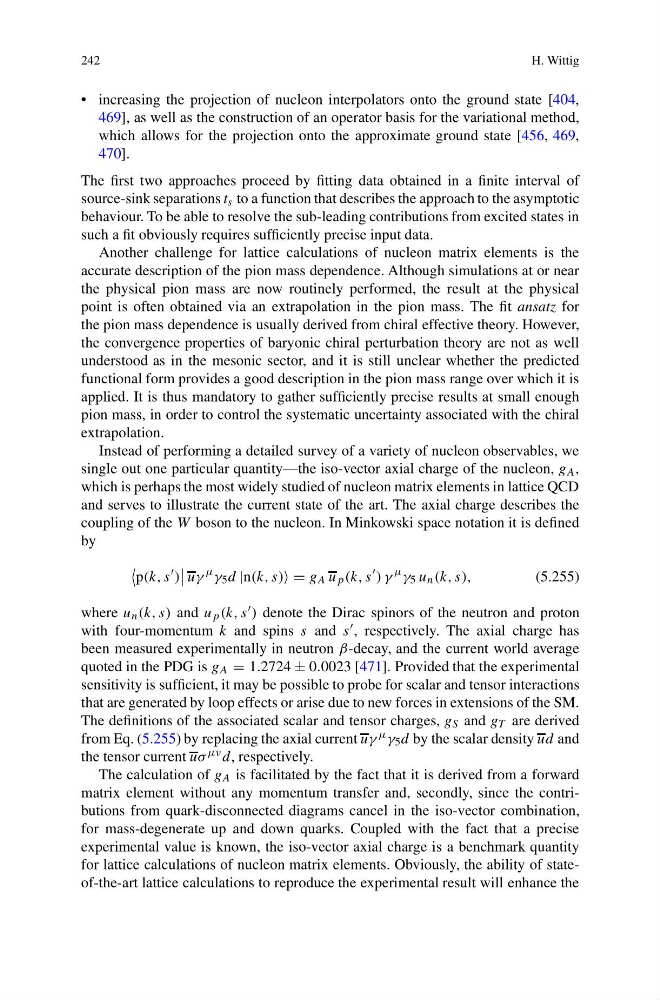
p(k, s
)
uγ
μ γ 5 d |n(k, s) = g A u p (k, s
) γ
μ γ 5 u n (k, s),
(5.255)
where u n (k, s) and u p (k, s ) denote the Dirac spinors of the neutron and proton
with four-momentum k and spins s and s , respectively. The axial charge has
been measured experimentally in neutron β-decay, and the current world average
quoted in the PDG is g A = 1.2724 ± 0.0023 [471]. Provided that the experimental
sensitivity is sufficient, it may be possible to probe for scalar and tensor interactions
that are generated by loop effects or arise due to new forces in extensions of the SM.
The definitions of the associated scalar and tensor charges, g S and g T are derived
from Eq. (5.255) by replacing the axial current uγ μ γ 5 d by the scalar density ud and
the tensor current uσ μν d, respectively.
The calculation of g A is facilitated by the fact that it is derived from a forward
matrix element without any momentum transfer and, secondly, since the contributions from quark-disconnected diagrams cancel in the iso-vector combination,
for mass-degenerate up and down quarks. Coupled with the fact that a precise
experimental value is known, the iso-vector axial charge is a benchmark quantity
for lattice calculations of nucleon matrix elements. Obviously, the ability of stateof-the-art lattice calculations to reproduce the experimental result will enhance the
H. Wittig
• increasing the projection of nucleon interpolators onto the ground state [404,
469], as well as the construction of an operator basis for the variational method,
which allows for the projection onto the approximate ground state [456, 469,
470].
The first two approaches proceed by fitting data obtained in a finite interval of
source-sink separations t s to a function that describes the approach to the asymptotic
behaviour. To be able to resolve the sub-leading contributions from excited states in
such a fit obviously requires sufficiently precise input data.
Another challenge for lattice calculations of nucleon matrix elements is the
accurate description of the pion mass dependence. Although simulations at or near
the physical pion mass are now routinely performed, the result at the physical
point is often obtained via an extrapolation in the pion mass. The fit ansatz for
the pion mass dependence is usually derived from chiral effective theory. However,
the convergence properties of baryonic chiral perturbation theory are not as well
understood as in the mesonic sector, and it is still unclear whether the predicted
functional form provides a good description in the pion mass range over which it is
applied. It is thus mandatory to gather sufficiently precise results at small enough
pion mass, in order to control the systematic uncertainty associated with the chiral
extrapolation.
Instead of performing a detailed survey of a variety of nucleon observables, we
single out one particular quantity—the iso-vector axial charge of the nucleon, g A ,
which is perhaps the most widely studied of nucleon matrix elements in lattice QCD
and serves to illustrate the current state of the art. The axial charge describes the
coupling of the W boson to the nucleon. In Minkowski space notation it is defined
by
p(k, s
)
uγ
μ γ 5 d |n(k, s) = g A u p (k, s
) γ
μ γ 5 u n (k, s),
(5.255)
where u n (k, s) and u p (k, s ) denote the Dirac spinors of the neutron and proton
with four-momentum k and spins s and s , respectively. The axial charge has
been measured experimentally in neutron β-decay, and the current world average
quoted in the PDG is g A = 1.2724 ± 0.0023 [471]. Provided that the experimental
sensitivity is sufficient, it may be possible to probe for scalar and tensor interactions
that are generated by loop effects or arise due to new forces in extensions of the SM.
The definitions of the associated scalar and tensor charges, g S and g T are derived
from Eq. (5.255) by replacing the axial current uγ μ γ 5 d by the scalar density ud and
the tensor current uσ μν d, respectively.
The calculation of g A is facilitated by the fact that it is derived from a forward
matrix element without any momentum transfer and, secondly, since the contributions from quark-disconnected diagrams cancel in the iso-vector combination,
for mass-degenerate up and down quarks. Coupled with the fact that a precise
experimental value is known, the iso-vector axial charge is a benchmark quantity
for lattice calculations of nucleon matrix elements. Obviously, the ability of stateof-the-art lattice calculations to reproduce the experimental result will enhance the