

5 QCD on the Lattice
241
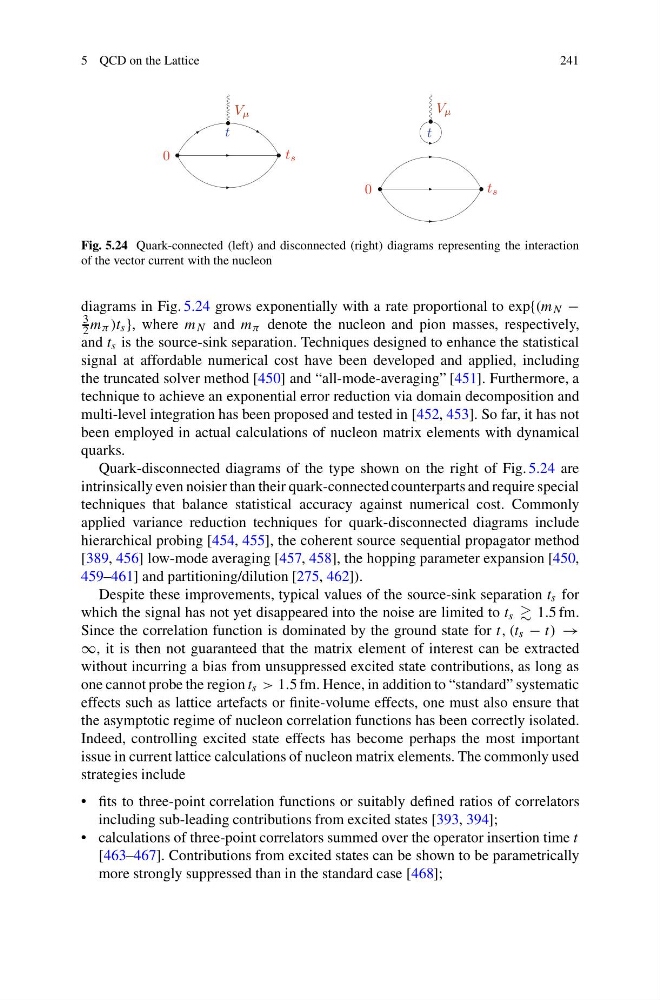
Fig. 5.24 Quark-connected (left) and disconnected (right) diagrams representing the interaction
of the vector current with the nucleon
diagrams in Fig. 5.24 grows exponentially with a rate proportional to exp{(m N −
3
2 m π )t s }, where m N and m π denote the nucleon and pion masses, respectively,
and t s is the source-sink separation. Techniques designed to enhance the statistical
signal at affordable numerical cost have been developed and applied, including
the truncated solver method [450] and “all-mode-averaging” [451]. Furthermore, a
technique to achieve an exponential error reduction via domain decomposition and
multi-level integration has been proposed and tested in [452, 453]. So far, it has not
been employed in actual calculations of nucleon matrix elements with dynamical
quarks.
Quark-disconnected diagrams of the type shown on the right of Fig. 5.24 are
intrinsically even noisier than their quark-connected counterparts and require special
techniques that balance statistical accuracy against numerical cost. Commonly
applied variance reduction techniques for quark-disconnected diagrams include
hierarchical probing [454, 455], the coherent source sequential propagator method
[389, 456] low-mode averaging [457, 458], the hopping parameter expansion [450,
459–461] and partitioning/dilution [275, 462]).
Despite these improvements, typical values of the source-sink separation t s for
which the signal has not yet disappeared into the noise are limited to t s 1.5 fm.
Since the correlation function is dominated by the ground state for t, (t s − t) →
∞, it is then not guaranteed that the matrix element of interest can be extracted
without incurring a bias from unsuppressed excited state contributions, as long as
one cannot probe the region t s > 1.5 fm. Hence, in addition to “standard” systematic
effects such as lattice artefacts or finite-volume effects, one must also ensure that
the asymptotic regime of nucleon correlation functions has been correctly isolated.
Indeed, controlling excited state effects has become perhaps the most important
issue in current lattice calculations of nucleon matrix elements. The commonly used
strategies include
• fits to three-point correlation functions or suitably defined ratios of correlators
including sub-leading contributions from excited states [393, 394];
• calculations of three-point correlators summed over the operator insertion time t
[463–467]. Contributions from excited states can be shown to be parametrically
more strongly suppressed than in the standard case [468];
241
Fig. 5.24 Quark-connected (left) and disconnected (right) diagrams representing the interaction
of the vector current with the nucleon
diagrams in Fig. 5.24 grows exponentially with a rate proportional to exp{(m N −
3
2 m π )t s }, where m N and m π denote the nucleon and pion masses, respectively,
and t s is the source-sink separation. Techniques designed to enhance the statistical
signal at affordable numerical cost have been developed and applied, including
the truncated solver method [450] and “all-mode-averaging” [451]. Furthermore, a
technique to achieve an exponential error reduction via domain decomposition and
multi-level integration has been proposed and tested in [452, 453]. So far, it has not
been employed in actual calculations of nucleon matrix elements with dynamical
quarks.
Quark-disconnected diagrams of the type shown on the right of Fig. 5.24 are
intrinsically even noisier than their quark-connected counterparts and require special
techniques that balance statistical accuracy against numerical cost. Commonly
applied variance reduction techniques for quark-disconnected diagrams include
hierarchical probing [454, 455], the coherent source sequential propagator method
[389, 456] low-mode averaging [457, 458], the hopping parameter expansion [450,
459–461] and partitioning/dilution [275, 462]).
Despite these improvements, typical values of the source-sink separation t s for
which the signal has not yet disappeared into the noise are limited to t s 1.5 fm.
Since the correlation function is dominated by the ground state for t, (t s − t) →
∞, it is then not guaranteed that the matrix element of interest can be extracted
without incurring a bias from unsuppressed excited state contributions, as long as
one cannot probe the region t s > 1.5 fm. Hence, in addition to “standard” systematic
effects such as lattice artefacts or finite-volume effects, one must also ensure that
the asymptotic regime of nucleon correlation functions has been correctly isolated.
Indeed, controlling excited state effects has become perhaps the most important
issue in current lattice calculations of nucleon matrix elements. The commonly used
strategies include
• fits to three-point correlation functions or suitably defined ratios of correlators
including sub-leading contributions from excited states [393, 394];
• calculations of three-point correlators summed over the operator insertion time t
[463–467]. Contributions from excited states can be shown to be parametrically
more strongly suppressed than in the standard case [468];