

244
H. Wittig
Given that lattice QCD calculations reproduce the experimental value of benchmark quantities such as the axial charge at the level of a few percent, it is interesting
to look at quantities that have not been measured so far. Results for the (iso-vector)
scalar and tensor charges have been reported in [386, 393, 404–406, 411, 412, 414–
419]. For both quantities one obtains g S , g T ≈ 1, and while the typical overall
uncertainty in g S is at the level of 10%, the tensor charge is determined with 3%
precision, similar to that of g A . The 2019 edition of the FLAG report contains
a detailed compilation and comparison of results for the axial, scalar and tensor
charges, as well as flavour-singlet charges and σ -terms. Calculations of these
quantities have matured to a level which allows for global averages to be determined.
Lattice calculations of nucleon matrix elements is a rich subject, and while a
comprehensive discussion of other quantities such as form factors and moments of
PDFs is beyond the scope of this short review, we refer the reader to recent reviews
[445–447], specific sections of [448] and the white paper on PDFs [449].
5.9.5 Hadronic Contributions to the Muon Anomalous
Magnetic Moment
The SM describes with great accuracy and precision the properties of the constituents of the visible matter in the universe but leaves several profound questions
unanswered. For instance, it cannot account for the matter-antimatter asymmetry
and does not explain the vast hierarchy between the electroweak scale and the Planck
mass. Most prominently, the SM cannot account for the presence of dark matter in
the universe for which there is overwhelming observational evidence. Against this
backdrop, the exploration of the limits of the SM and the search for “new physics”
has become a major activity in particle physics. Traditionally, high-energy particle
colliders have had the highest discovery potential. However, despite the fact that
the LHC is the most powerful accelerator in the world, new particles that can, for
instance, explain the dark matter puzzle have not been observed in the expected
region. Therefore, additional search strategies must be pursued to detect evidence
for physics beyond the SM.
Observables that can be measured with very high precision and for which
similarly accurate theoretical predictions exist at the same time, play an increasingly
important rôle for exploring the limits of the SM. One such quantity is the
anomalous magnetic moment of the muon, a μ ≡
1
2 (g μ − 2), where g μ denotes
the muon’s gyromagnetic ratio. There has been a persistent tension of about 3.5
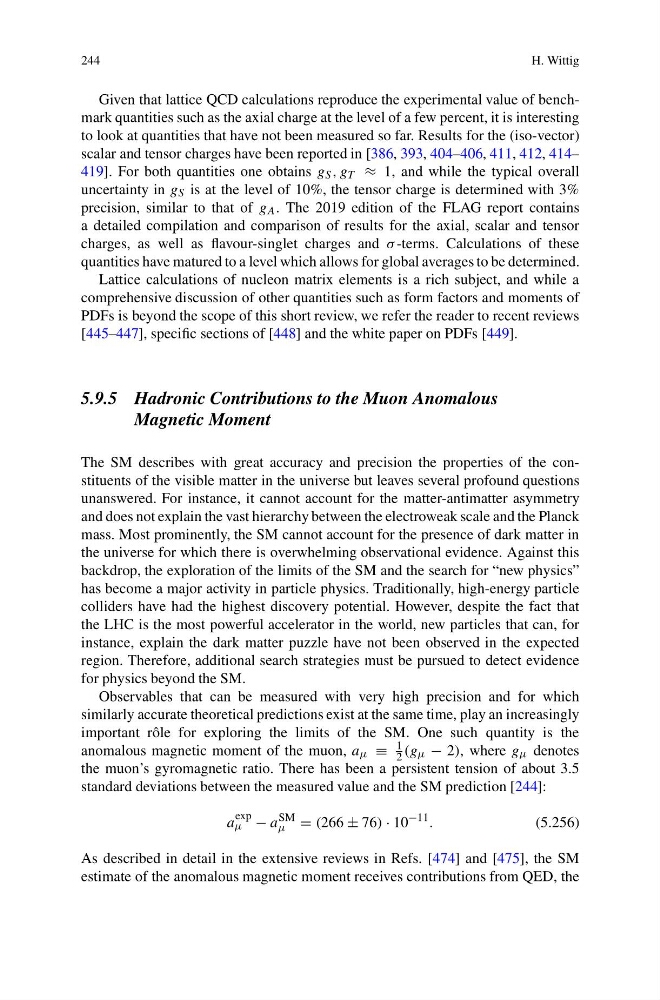
standard deviations between the measured value and the SM prediction [244]:
a
exp
μ − a
SM
μ = (266 ± 76) · 10
−11 .
(5.256)
As described in detail in the extensive reviews in Refs. [474] and [475], the SM
estimate of the anomalous magnetic moment receives contributions from QED, the
H. Wittig
Given that lattice QCD calculations reproduce the experimental value of benchmark quantities such as the axial charge at the level of a few percent, it is interesting
to look at quantities that have not been measured so far. Results for the (iso-vector)
scalar and tensor charges have been reported in [386, 393, 404–406, 411, 412, 414–
419]. For both quantities one obtains g S , g T ≈ 1, and while the typical overall
uncertainty in g S is at the level of 10%, the tensor charge is determined with 3%
precision, similar to that of g A . The 2019 edition of the FLAG report contains
a detailed compilation and comparison of results for the axial, scalar and tensor
charges, as well as flavour-singlet charges and σ -terms. Calculations of these
quantities have matured to a level which allows for global averages to be determined.
Lattice calculations of nucleon matrix elements is a rich subject, and while a
comprehensive discussion of other quantities such as form factors and moments of
PDFs is beyond the scope of this short review, we refer the reader to recent reviews
[445–447], specific sections of [448] and the white paper on PDFs [449].
5.9.5 Hadronic Contributions to the Muon Anomalous
Magnetic Moment
The SM describes with great accuracy and precision the properties of the constituents of the visible matter in the universe but leaves several profound questions
unanswered. For instance, it cannot account for the matter-antimatter asymmetry
and does not explain the vast hierarchy between the electroweak scale and the Planck
mass. Most prominently, the SM cannot account for the presence of dark matter in
the universe for which there is overwhelming observational evidence. Against this
backdrop, the exploration of the limits of the SM and the search for “new physics”
has become a major activity in particle physics. Traditionally, high-energy particle
colliders have had the highest discovery potential. However, despite the fact that
the LHC is the most powerful accelerator in the world, new particles that can, for
instance, explain the dark matter puzzle have not been observed in the expected
region. Therefore, additional search strategies must be pursued to detect evidence
for physics beyond the SM.
Observables that can be measured with very high precision and for which
similarly accurate theoretical predictions exist at the same time, play an increasingly
important rôle for exploring the limits of the SM. One such quantity is the
anomalous magnetic moment of the muon, a μ ≡
1
2 (g μ − 2), where g μ denotes
the muon’s gyromagnetic ratio. There has been a persistent tension of about 3.5
standard deviations between the measured value and the SM prediction [244]:
a
exp
μ − a
SM
μ = (266 ± 76) · 10
−11 .
(5.256)
As described in detail in the extensive reviews in Refs. [474] and [475], the SM
estimate of the anomalous magnetic moment receives contributions from QED, the