

5 QCD on the Lattice
235
counterparts vanish. More details are found in section 3.1.1 of the FLAG report
[247].
Another recent focus of lattice spectroscopy has been the determination of the
excitation spectrum and the properties of hadronic resonances. This is a major
refinement of previous calculations in which the masses of resonances (the simplest
being the ρ-meson) were extracted naively from the exponential decay of the vector
correlation function, thereby ignoring the fact that resonances are characterized
both by a mass and a width. The general framework for the study of resonance
properties in lattice QCD was developed by Lüscher already in the 1980s and
1990s [267–270], and it is only now that the potential of this elegant and powerful
formalism can be fully exploited. The key idea that underlies the Lüscher method
is the realization that computing the energy levels of multi-particle states in a finite
volume gives access to the scattering phase shifts in infinite volume, provided that
the spectrum (including excited states) can be determined sufficiently well for a
range of kinematical situations. The latter are typically determined by the lattice
volume and/or the total momentum of the multi-particle system in question.
To be more specific, let us consider the simplest resonance, the ρ-meson, whose
properties can be accessed in p-wave ππ scattering. For energies below the inelastic
threshold, the Lüscher condition reads
φ(q) + δ 1 (k) = 0 mod π,
q =
kL
2π
,
(5.250)
where φ(q) is a known kinematic function of the scaled scattering momentum
in units of the box size, q = kL/2π and δ 1 is the scattering phase shift. The
scattering momentum k is determined from the nth energy level ω n in a finite
volume, according to
ω n =
m 2
π + k 2 ,
(5.251)
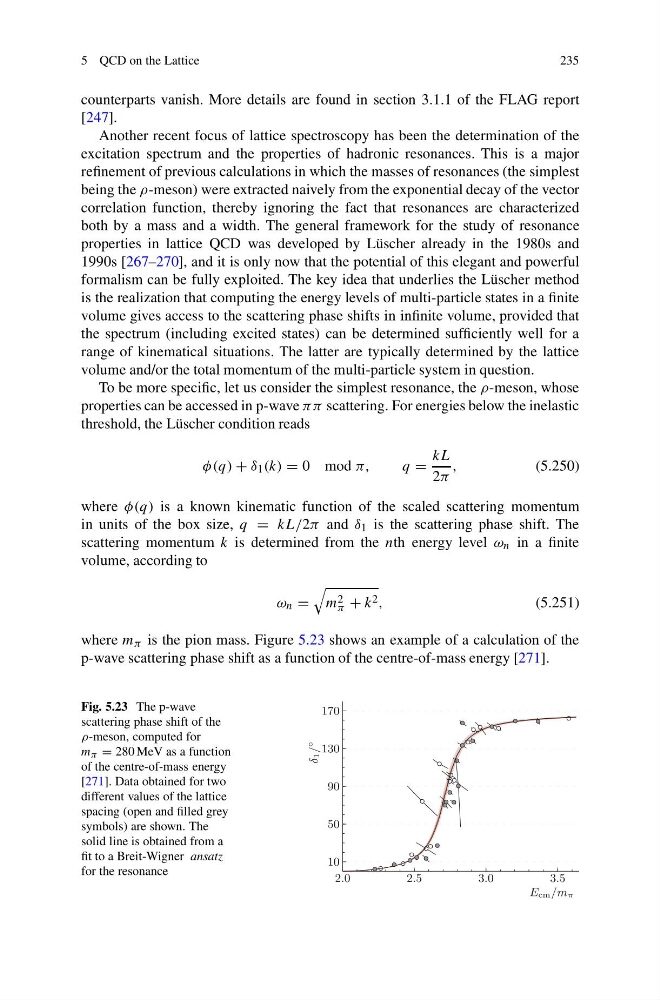
where m π is the pion mass. Figure 5.23 shows an example of a calculation of the
p-wave scattering phase shift as a function of the centre-of-mass energy [271].
Fig. 5.23 The p-wave
scattering phase shift of the
ρ-meson, computed for
m π = 280 MeV as a function
of the centre-of-mass energy
[271]. Data obtained for two
different values of the lattice
spacing (open and filled grey
symbols) are shown. The
solid line is obtained from a
fit to a Breit-Wigner ansatz
for the resonance
235
counterparts vanish. More details are found in section 3.1.1 of the FLAG report
[247].
Another recent focus of lattice spectroscopy has been the determination of the
excitation spectrum and the properties of hadronic resonances. This is a major
refinement of previous calculations in which the masses of resonances (the simplest
being the ρ-meson) were extracted naively from the exponential decay of the vector
correlation function, thereby ignoring the fact that resonances are characterized
both by a mass and a width. The general framework for the study of resonance
properties in lattice QCD was developed by Lüscher already in the 1980s and
1990s [267–270], and it is only now that the potential of this elegant and powerful
formalism can be fully exploited. The key idea that underlies the Lüscher method
is the realization that computing the energy levels of multi-particle states in a finite
volume gives access to the scattering phase shifts in infinite volume, provided that
the spectrum (including excited states) can be determined sufficiently well for a
range of kinematical situations. The latter are typically determined by the lattice
volume and/or the total momentum of the multi-particle system in question.
To be more specific, let us consider the simplest resonance, the ρ-meson, whose
properties can be accessed in p-wave ππ scattering. For energies below the inelastic
threshold, the Lüscher condition reads
φ(q) + δ 1 (k) = 0 mod π,
q =
kL
2π
,
(5.250)
where φ(q) is a known kinematic function of the scaled scattering momentum
in units of the box size, q = kL/2π and δ 1 is the scattering phase shift. The
scattering momentum k is determined from the nth energy level ω n in a finite
volume, according to
ω n =
m 2
π + k 2 ,
(5.251)
where m π is the pion mass. Figure 5.23 shows an example of a calculation of the
p-wave scattering phase shift as a function of the centre-of-mass energy [271].
Fig. 5.23 The p-wave
scattering phase shift of the
ρ-meson, computed for
m π = 280 MeV as a function
of the centre-of-mass energy
[271]. Data obtained for two
different values of the lattice
spacing (open and filled grey
symbols) are shown. The
solid line is obtained from a
fit to a Breit-Wigner ansatz
for the resonance