

236
H. Wittig
A crucial ingredient for the reliable determination of not just the energy level of
the ground state but also the excitation spectrum is the use of correlator matrices
computed using a suitable basis of interpolating operators (see Section 5.3 in
Ref. [241]). The diagonalization of the correlator matrix can be achieved by solving
a generalized eigenvalue problem from which the energy levels in a given channel
can be determined [272–274]. The sometimes arduous task of constructing efficient
interpolators for multi-particle states has been helped enormously by practical
methods to compute “all-to-all” quark propagators [275] and, in particular, the
so-called “distillation” technique [276, 277]. With these new developments it has
been possible to perform lattice investigations of ππ scattering and the ρ resonance
[278–291], as well as determinations of Kπ[292, 293] and KK scattering lengths
[294, 295]. The formalism has also been used to study meson-baryon [296–300] and
baryon-baryon [301, 302] interactions.
While the original Lüscher formalism was derived for the case of elastic twoparticle scattering, it has now been generalized to coupled-channel systems [303–
307], including the treatment of three-particle thresholds [308–315]. It also opens
the possibility to study weak non-leptonic kaon decays [316] and compute form
factors for timelike momentum transfers [317–320].
Moreover, the experimental discovery of new charmonium-like resonances,
commonly referred to as the X, Y and Z states, has kindled a new interest in
hadron spectroscopy. A distinctive feature of the new resonances is their closeness to
particle thresholds, and efforts are underway to gain a detailed understanding of the
resonance structure in the charm sector. Using the formalism described above, there
have been many calculations of a variety of charmonium-like resonances in lattice
QCD. In view of the vast literature, we refer the reader to several recent reviews of
the subject [321–323].
5.9.3 Parameters of the Standard Model
The Standard Model (SM) contains 19 parameters (excluding the neutrino sector)
whose values are not predicted by the theory itself but must instead be fixed using
experimental input. In many cases the relations between experimentally accessible
observables and SM parameters involve quantities that encode the effects of the
strong interactions. A well-known example is the kaon B-parameter B K that
enters the relation between the quantity K , which is a measure of indirect CP
violation, and a particular combination of Cabibbo–Kobayashi–Maskawa (CKM)
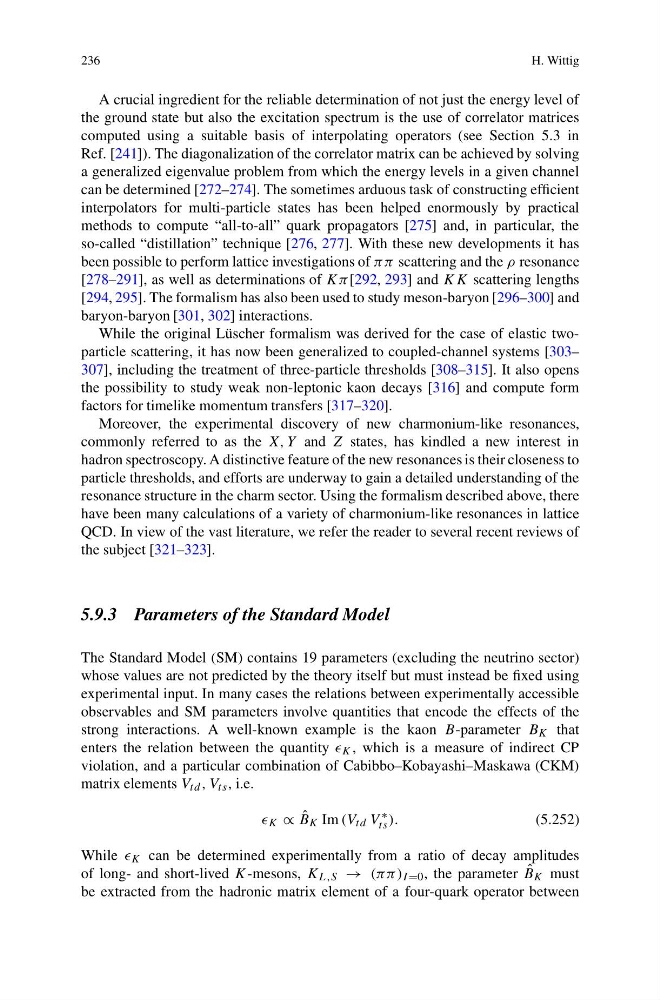
matrix elements V td , V ts , i.e.
K ∝ ˆ
B K Im (V td V
∗
ts ).
(5.252)
While K can be determined experimentally from a ratio of decay amplitudes
of long- and short-lived K-mesons, K L,S → (ππ) I =0 , the parameter ˆ
B K must
be extracted from the hadronic matrix element of a four-quark operator between
H. Wittig
A crucial ingredient for the reliable determination of not just the energy level of
the ground state but also the excitation spectrum is the use of correlator matrices
computed using a suitable basis of interpolating operators (see Section 5.3 in
Ref. [241]). The diagonalization of the correlator matrix can be achieved by solving
a generalized eigenvalue problem from which the energy levels in a given channel
can be determined [272–274]. The sometimes arduous task of constructing efficient
interpolators for multi-particle states has been helped enormously by practical
methods to compute “all-to-all” quark propagators [275] and, in particular, the
so-called “distillation” technique [276, 277]. With these new developments it has
been possible to perform lattice investigations of ππ scattering and the ρ resonance
[278–291], as well as determinations of Kπ[292, 293] and KK scattering lengths
[294, 295]. The formalism has also been used to study meson-baryon [296–300] and
baryon-baryon [301, 302] interactions.
While the original Lüscher formalism was derived for the case of elastic twoparticle scattering, it has now been generalized to coupled-channel systems [303–
307], including the treatment of three-particle thresholds [308–315]. It also opens
the possibility to study weak non-leptonic kaon decays [316] and compute form
factors for timelike momentum transfers [317–320].
Moreover, the experimental discovery of new charmonium-like resonances,
commonly referred to as the X, Y and Z states, has kindled a new interest in
hadron spectroscopy. A distinctive feature of the new resonances is their closeness to
particle thresholds, and efforts are underway to gain a detailed understanding of the
resonance structure in the charm sector. Using the formalism described above, there
have been many calculations of a variety of charmonium-like resonances in lattice
QCD. In view of the vast literature, we refer the reader to several recent reviews of
the subject [321–323].
5.9.3 Parameters of the Standard Model
The Standard Model (SM) contains 19 parameters (excluding the neutrino sector)
whose values are not predicted by the theory itself but must instead be fixed using
experimental input. In many cases the relations between experimentally accessible
observables and SM parameters involve quantities that encode the effects of the
strong interactions. A well-known example is the kaon B-parameter B K that
enters the relation between the quantity K , which is a measure of indirect CP
violation, and a particular combination of Cabibbo–Kobayashi–Maskawa (CKM)
matrix elements V td , V ts , i.e.
K ∝ ˆ
B K Im (V td V
∗
ts ).
(5.252)
While K can be determined experimentally from a ratio of decay amplitudes
of long- and short-lived K-mesons, K L,S → (ππ) I =0 , the parameter ˆ
B K must
be extracted from the hadronic matrix element of a four-quark operator between