

234
H. Wittig
moment, which is a key quantity to study possible deviations from the Standard
Model. The review concludes with a few remarks on the progress achieved over the
past decade and an outlook for future calculations.
5.9.2 Hadron Spectroscopy
The calculation of the light hadron spectrum, i.e. the masses of the lowest-lying
mesons and baryons has long been regarded a benchmark for lattice QCD. In the
quenched approximation, i.e. in the absence of dynamical quarks, a significant
deviation between the calculated spectrum and experiment at the level of 10–15%
was observed. When the light hadron spectrum could eventually be accurately
reproduced within the overall uncertainty after the inclusion of light dynamical
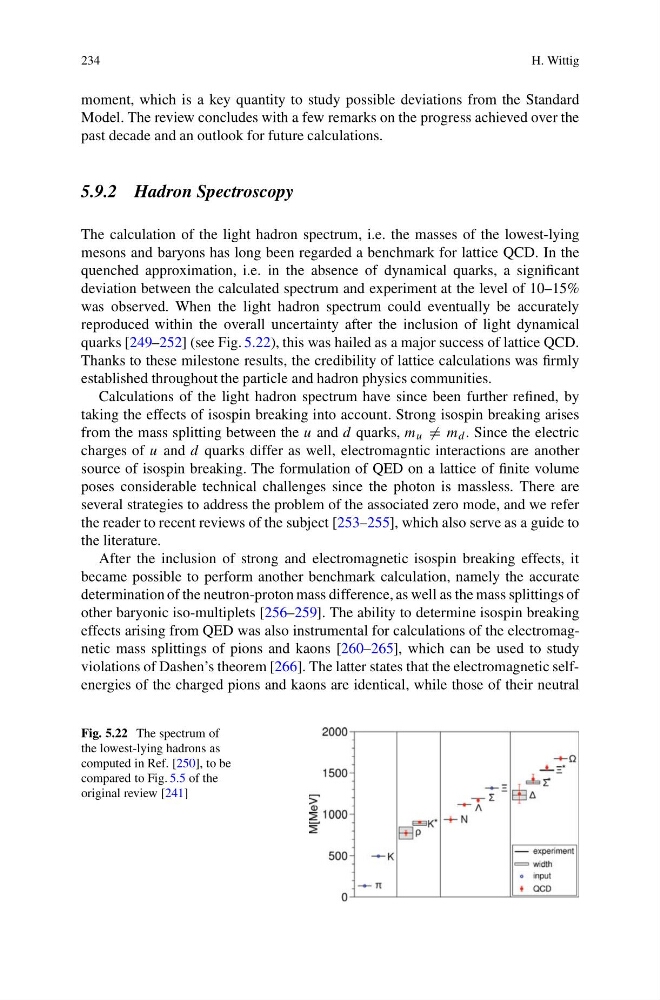
quarks [249–252] (see Fig. 5.22), this was hailed as a major success of lattice QCD.
Thanks to these milestone results, the credibility of lattice calculations was firmly
established throughout the particle and hadron physics communities.
Calculations of the light hadron spectrum have since been further refined, by
taking the effects of isospin breaking into account. Strong isospin breaking arises
from the mass splitting between the u and d quarks, m u = m d . Since the electric
charges of u and d quarks differ as well, electromagntic interactions are another
source of isospin breaking. The formulation of QED on a lattice of finite volume
poses considerable technical challenges since the photon is massless. There are
several strategies to address the problem of the associated zero mode, and we refer
the reader to recent reviews of the subject [253–255], which also serve as a guide to
the literature.
After the inclusion of strong and electromagnetic isospin breaking effects, it
became possible to perform another benchmark calculation, namely the accurate
determination of the neutron-proton mass difference, as well as the mass splittings of
other baryonic iso-multiplets [256–259]. The ability to determine isospin breaking
effects arising from QED was also instrumental for calculations of the electromagnetic mass splittings of pions and kaons [260–265], which can be used to study
violations of Dashen’s theorem [266]. The latter states that the electromagnetic selfenergies of the charged pions and kaons are identical, while those of their neutral
Fig. 5.22 The spectrum of
the lowest-lying hadrons as
computed in Ref. [250], to be
compared to Fig. 5.5 of the
original review [241]
H. Wittig
moment, which is a key quantity to study possible deviations from the Standard
Model. The review concludes with a few remarks on the progress achieved over the
past decade and an outlook for future calculations.
5.9.2 Hadron Spectroscopy
The calculation of the light hadron spectrum, i.e. the masses of the lowest-lying
mesons and baryons has long been regarded a benchmark for lattice QCD. In the
quenched approximation, i.e. in the absence of dynamical quarks, a significant
deviation between the calculated spectrum and experiment at the level of 10–15%
was observed. When the light hadron spectrum could eventually be accurately
reproduced within the overall uncertainty after the inclusion of light dynamical
quarks [249–252] (see Fig. 5.22), this was hailed as a major success of lattice QCD.
Thanks to these milestone results, the credibility of lattice calculations was firmly
established throughout the particle and hadron physics communities.
Calculations of the light hadron spectrum have since been further refined, by
taking the effects of isospin breaking into account. Strong isospin breaking arises
from the mass splitting between the u and d quarks, m u = m d . Since the electric
charges of u and d quarks differ as well, electromagntic interactions are another
source of isospin breaking. The formulation of QED on a lattice of finite volume
poses considerable technical challenges since the photon is massless. There are
several strategies to address the problem of the associated zero mode, and we refer
the reader to recent reviews of the subject [253–255], which also serve as a guide to
the literature.
After the inclusion of strong and electromagnetic isospin breaking effects, it
became possible to perform another benchmark calculation, namely the accurate
determination of the neutron-proton mass difference, as well as the mass splittings of
other baryonic iso-multiplets [256–259]. The ability to determine isospin breaking
effects arising from QED was also instrumental for calculations of the electromagnetic mass splittings of pions and kaons [260–265], which can be used to study
violations of Dashen’s theorem [266]. The latter states that the electromagnetic selfenergies of the charged pions and kaons are identical, while those of their neutral
Fig. 5.22 The spectrum of
the lowest-lying hadrons as
computed in Ref. [250], to be
compared to Fig. 5.5 of the
original review [241]