

230
H. Wittig
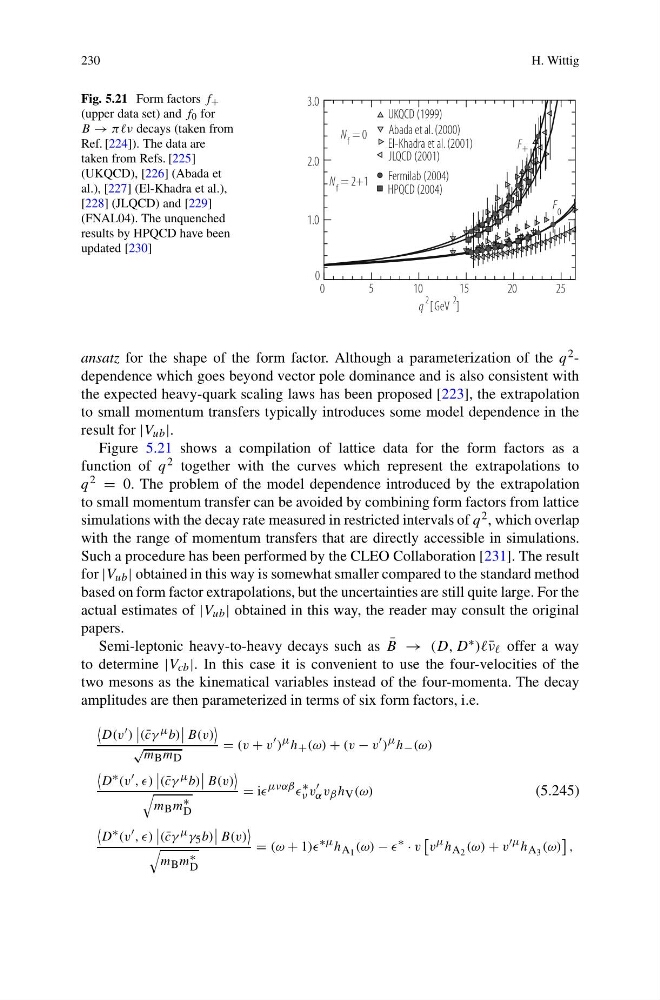
Fig. 5.21 Form factors f +
(upper data set) and f 0 for
B → ππν decays (taken from
Ref. [224]). The data are
taken from Refs. [225]
(UKQCD), [226] (Abada et
al.), [227] (El-Khadra et al.),
[228] (JLQCD) and [229]
(FNAL04). The unquenched
results by HPQCD have been
updated [230]
UKQCD (1999)
Abada et al.(2000)
El-Khadra et al.(2001)
JLQCD (2001)
0
5
10
15
20
0
1.0
2.0
3.0
N f = 0
N f = 2+1
F 0
F +
25
Fermilab (2004)
HPQCD (2004)
q
2
2
[GeV ]
ansatz for the shape of the form factor. Although a parameterization of the q 2 -
dependence which goes beyond vector pole dominance and is also consistent with
the expected heavy-quark scaling laws has been proposed [223], the extrapolation
to small momentum transfers typically introduces some model dependence in the
result for |V ub |.
Figure 5.21 shows a compilation of lattice data for the form factors as a
function of q 2 together with the curves which represent the extrapolations to
q 2 = 0. The problem of the model dependence introduced by the extrapolation
to small momentum transfer can be avoided by combining form factors from lattice
simulations with the decay rate measured in restricted intervals of q 2 , which overlap
with the range of momentum transfers that are directly accessible in simulations.
Such a procedure has been performed by the CLEO Collaboration [231]. The result
for |V ub | obtained in this way is somewhat smaller compared to the standard method
based on form factor extrapolations, but the uncertainties are still quite large. For the
actual estimates of |V ub | obtained in this way, the reader may consult the original
papers.
Semi-leptonic heavy-to-heavy decays such as ¯
B → (D, D ∗ ))¯ ν offer a way
to determine |V cb |. In this case it is convenient to use the four-velocities of the
two mesons as the kinematical variables instead of the four-momenta. The decay
amplitudes are then parameterized in terms of six form factors, i.e.
D(v )
( ¯
cγ μ b)
B(v)
√
m B m D
= (v + v ) μ h + (ω) + (v − v ) μ h − (ω)
D ∗ (v , ,)
( ¯
cγ μ b)
B(v)
m B m ∗
D
= i μναβ ∗
ν v
α v β h V (ω)
(5.245)
D ∗ (v , ,)
( ¯
cγ μ γ 5 b)
B(v)
m B m ∗
D
= (ω + 1)) ∗μ h A 1 (ω) − ∗ · v
v μ h A 2 (ω) + v h A 3 (ω)
,
H. Wittig
Fig. 5.21 Form factors f +
(upper data set) and f 0 for
B → ππν decays (taken from
Ref. [224]). The data are
taken from Refs. [225]
(UKQCD), [226] (Abada et
al.), [227] (El-Khadra et al.),
[228] (JLQCD) and [229]
(FNAL04). The unquenched
results by HPQCD have been
updated [230]
UKQCD (1999)
Abada et al.(2000)
El-Khadra et al.(2001)
JLQCD (2001)
0
5
10
15
20
0
1.0
2.0
3.0
N f = 0
N f = 2+1
F 0
F +
25
Fermilab (2004)
HPQCD (2004)
q
2
2
[GeV ]
ansatz for the shape of the form factor. Although a parameterization of the q 2 -
dependence which goes beyond vector pole dominance and is also consistent with
the expected heavy-quark scaling laws has been proposed [223], the extrapolation
to small momentum transfers typically introduces some model dependence in the
result for |V ub |.
Figure 5.21 shows a compilation of lattice data for the form factors as a
function of q 2 together with the curves which represent the extrapolations to
q 2 = 0. The problem of the model dependence introduced by the extrapolation
to small momentum transfer can be avoided by combining form factors from lattice
simulations with the decay rate measured in restricted intervals of q 2 , which overlap
with the range of momentum transfers that are directly accessible in simulations.
Such a procedure has been performed by the CLEO Collaboration [231]. The result
for |V ub | obtained in this way is somewhat smaller compared to the standard method
based on form factor extrapolations, but the uncertainties are still quite large. For the
actual estimates of |V ub | obtained in this way, the reader may consult the original
papers.
Semi-leptonic heavy-to-heavy decays such as ¯
B → (D, D ∗ ))¯ ν offer a way
to determine |V cb |. In this case it is convenient to use the four-velocities of the
two mesons as the kinematical variables instead of the four-momenta. The decay
amplitudes are then parameterized in terms of six form factors, i.e.
D(v )
( ¯
cγ μ b)
B(v)
√
m B m D
= (v + v ) μ h + (ω) + (v − v ) μ h − (ω)
D ∗ (v , ,)
( ¯
cγ μ b)
B(v)
m B m ∗
D
= i μναβ ∗
ν v
α v β h V (ω)
(5.245)
D ∗ (v , ,)
( ¯
cγ μ γ 5 b)
B(v)
m B m ∗
D
= (ω + 1)) ∗μ h A 1 (ω) − ∗ · v
v μ h A 2 (ω) + v h A 3 (ω)
,