

5 QCD on the Lattice
231
where ω = v·v . In the limit of infinite heavy quark mass, four out of these six form
factors can be replaced by a single, universal form factor, ξ(ω), which is called the
Isgur-Wise function [232]
m b , m c → ∞ ⇒ h + (ω) = h A 1 (ω) = h A 3 (ω) = h V (ω) = ξ(ω),
(5.246)
while h − (ω) and h A 2 (ω) vanish as m b , m c become infinitely heavy. Outside the
exact heavy-quark limit, the relation between the Isgur-Wise function and the form
factors is modified. For instance,
h + (ω) = (1 + β + (ω) + γ + (ω)) ξ(ω),
(5.247)
where β + , γ + parameterize radiative corrections and corrections arising from
operators of higher dimension, which are suppressed by additional inverse powers of
the heavy quark mass. Similar relations hold for h A 1 , h A 3 and h V . Another important
result, known as Luke’s Theorem [233], states that at zero recoil, v = v , i.e. ω = 1,
the leading corrections to the form factors h + and h A 1 are quadratic in the inverse
heavy quark mass.
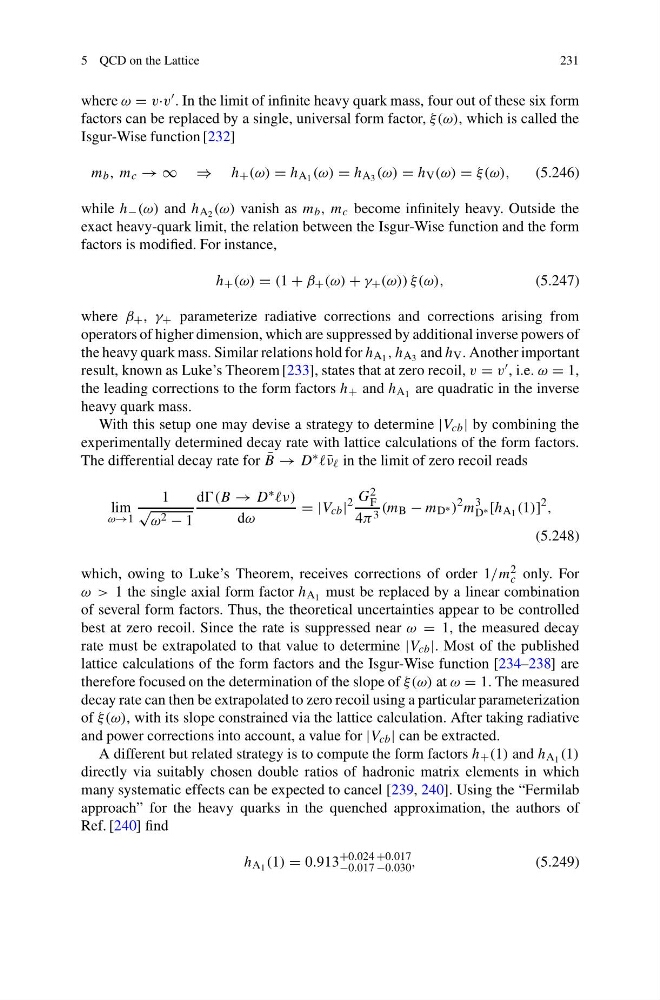
With this setup one may devise a strategy to determine |V cb | by combining the
experimentally determined decay rate with lattice calculations of the form factors.
The differential decay rate for ¯
B → D ∗ ν in the limit of zero recoil reads
lim
ω→1
1
√
ω 2 − 1
d → D ∗ ν)
dω
= |V cb |
2 G 2
F
4π 3 (m B − m D ∗ )
2 m
3
D ∗ [h A 1 (1)]
2 ,
(5.248)
which, owing to Luke’s Theorem, receives corrections of order 1/m 2
c only. For
ω > 1 the single axial form factor h A 1 must be replaced by a linear combination
of several form factors. Thus, the theoretical uncertainties appear to be controlled
best at zero recoil. Since the rate is suppressed near ω = 1, the measured decay
rate must be extrapolated to that value to determine |V cb |. Most of the published
lattice calculations of the form factors and the Isgur-Wise function [234–238] are
therefore focused on the determination of the slope of ξ(ω) at ω = 1. The measured
decay rate can then be extrapolated to zero recoil using a particular parameterization
of ξ(ω), with its slope constrained via the lattice calculation. After taking radiative
and power corrections into account, a value for |V cb | can be extracted.
A different but related strategy is to compute the form factors h + (1) and h A 1 (1)
directly via suitably chosen double ratios of hadronic matrix elements in which
many systematic effects can be expected to cancel [239, 240]. Using the “Fermilab
approach” for the heavy quarks in the quenched approximation, the authors of
Ref. [240] find
h A 1 (1) = 0.913
+0.024 +0.017
−0.017 −0.030 ,
(5.249)
231
where ω = v·v . In the limit of infinite heavy quark mass, four out of these six form
factors can be replaced by a single, universal form factor, ξ(ω), which is called the
Isgur-Wise function [232]
m b , m c → ∞ ⇒ h + (ω) = h A 1 (ω) = h A 3 (ω) = h V (ω) = ξ(ω),
(5.246)
while h − (ω) and h A 2 (ω) vanish as m b , m c become infinitely heavy. Outside the
exact heavy-quark limit, the relation between the Isgur-Wise function and the form
factors is modified. For instance,
h + (ω) = (1 + β + (ω) + γ + (ω)) ξ(ω),
(5.247)
where β + , γ + parameterize radiative corrections and corrections arising from
operators of higher dimension, which are suppressed by additional inverse powers of
the heavy quark mass. Similar relations hold for h A 1 , h A 3 and h V . Another important
result, known as Luke’s Theorem [233], states that at zero recoil, v = v , i.e. ω = 1,
the leading corrections to the form factors h + and h A 1 are quadratic in the inverse
heavy quark mass.
With this setup one may devise a strategy to determine |V cb | by combining the
experimentally determined decay rate with lattice calculations of the form factors.
The differential decay rate for ¯
B → D ∗ ν in the limit of zero recoil reads
lim
ω→1
1
√
ω 2 − 1
d → D ∗ ν)
dω
= |V cb |
2 G 2
F
4π 3 (m B − m D ∗ )
2 m
3
D ∗ [h A 1 (1)]
2 ,
(5.248)
which, owing to Luke’s Theorem, receives corrections of order 1/m 2
c only. For
ω > 1 the single axial form factor h A 1 must be replaced by a linear combination
of several form factors. Thus, the theoretical uncertainties appear to be controlled
best at zero recoil. Since the rate is suppressed near ω = 1, the measured decay
rate must be extrapolated to that value to determine |V cb |. Most of the published
lattice calculations of the form factors and the Isgur-Wise function [234–238] are
therefore focused on the determination of the slope of ξ(ω) at ω = 1. The measured
decay rate can then be extrapolated to zero recoil using a particular parameterization
of ξ(ω), with its slope constrained via the lattice calculation. After taking radiative
and power corrections into account, a value for |V cb | can be extracted.
A different but related strategy is to compute the form factors h + (1) and h A 1 (1)
directly via suitably chosen double ratios of hadronic matrix elements in which
many systematic effects can be expected to cancel [239, 240]. Using the “Fermilab
approach” for the heavy quarks in the quenched approximation, the authors of
Ref. [240] find
h A 1 (1) = 0.913
+0.024 +0.017
−0.017 −0.030 ,
(5.249)