

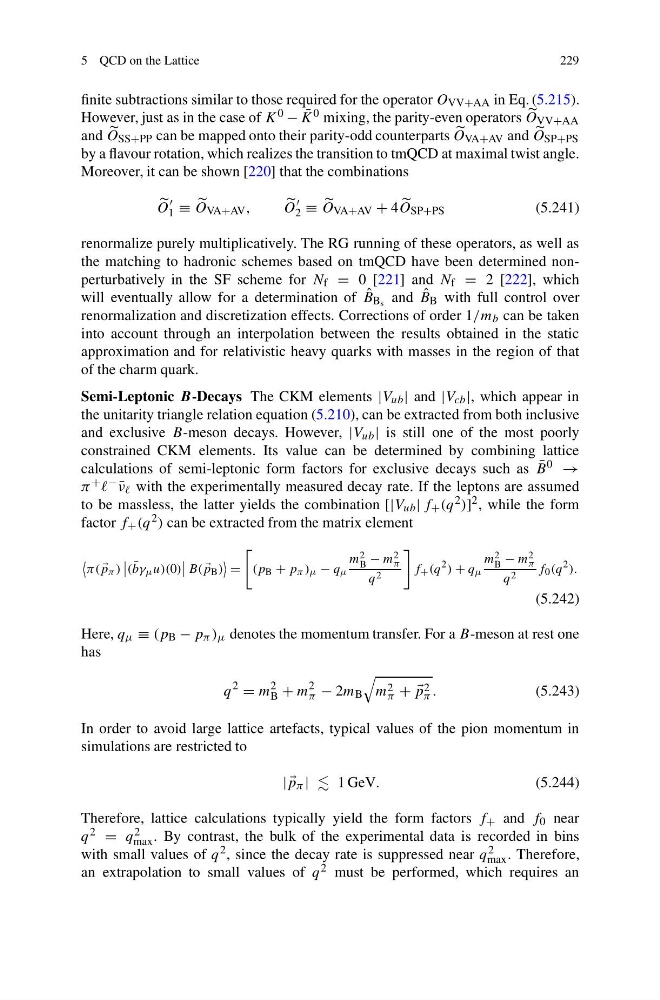
5 QCD on the Lattice
229
finite subtractions similar to those required for the operator O VV+AA in Eq. (5.215).
However, just as in the case of K 0 − ¯
K 0 mixing, the parity-even operators
O VV+AA
and
O SS+PP can be mapped onto their parity-odd counterparts
O VA+AV and
O SP+PS
by a flavour rotation, which realizes the transition to tmQCD at maximal twist angle.
Moreover, it can be shown [220] that the combinations
O
1 ≡
O VA+AV ,
O
2 ≡
O VA+AV + 4
O SP+PS
(5.241)
renormalize purely multiplicatively. The RG running of these operators, as well as
the matching to hadronic schemes based on tmQCD have been determined nonperturbatively in the SF scheme for N f = 0 [221] and N f = 2 [222], which
will eventually allow for a determination of ˆ
B B s and ˆ
B B with full control over
renormalization and discretization effects. Corrections of order 1/m b can be taken
into account through an interpolation between the results obtained in the static
approximation and for relativistic heavy quarks with masses in the region of that
of the charm quark.
Semi-Leptonic B-Decays The CKM elements |V ub | and |V cb |, which appear in
the unitarity triangle relation equation (5.210), can be extracted from both inclusive
and exclusive B-meson decays. However, |V ub | is still one of the most poorly
constrained CKM elements. Its value can be determined by combining lattice
calculations of semi-leptonic form factors for exclusive decays such as ¯
B 0 →
π + − ¯
ν with the experimentally measured decay rate. If the leptons are assumed
to be massless, the latter yields the combination [|V ub | f + (q 2 )] 2 , while the form
factor f + (q 2 ) can be extracted from the matrix element
π(
p π )
( ¯
bγ μ u)(0)
B(
p B )
=
(p B + p π ) μ − q μ
m 2
B − m 2
π
q 2
f + (q
2 ) + q μ
m 2
B − m 2
π
q 2
f 0 (q
2 ).
(5.242)
Here, q μ ≡ (p B − p π ) μ denotes the momentum transfer. For a B-meson at rest one
has
q
2
= m
2
B + m
2
π − 2m B
m 2
π + +
p 2
π .
(5.243)
In order to avoid large lattice artefacts, typical values of the pion momentum in
simulations are restricted to
|
p π | 1 GeV.
(5.244)
Therefore, lattice calculations typically yield the form factors f + and f 0 near
q 2 = q 2
max . By contrast, the bulk of the experimental data is recorded in bins
with small values of q 2 , since the decay rate is suppressed near q 2
max . Therefore,
an extrapolation to small values of q 2 must be performed, which requires an
229
finite subtractions similar to those required for the operator O VV+AA in Eq. (5.215).
However, just as in the case of K 0 − ¯
K 0 mixing, the parity-even operators
O VV+AA
and
O SS+PP can be mapped onto their parity-odd counterparts
O VA+AV and
O SP+PS
by a flavour rotation, which realizes the transition to tmQCD at maximal twist angle.
Moreover, it can be shown [220] that the combinations
O
1 ≡
O VA+AV ,
O
2 ≡
O VA+AV + 4
O SP+PS
(5.241)
renormalize purely multiplicatively. The RG running of these operators, as well as
the matching to hadronic schemes based on tmQCD have been determined nonperturbatively in the SF scheme for N f = 0 [221] and N f = 2 [222], which
will eventually allow for a determination of ˆ
B B s and ˆ
B B with full control over
renormalization and discretization effects. Corrections of order 1/m b can be taken
into account through an interpolation between the results obtained in the static
approximation and for relativistic heavy quarks with masses in the region of that
of the charm quark.
Semi-Leptonic B-Decays The CKM elements |V ub | and |V cb |, which appear in
the unitarity triangle relation equation (5.210), can be extracted from both inclusive
and exclusive B-meson decays. However, |V ub | is still one of the most poorly
constrained CKM elements. Its value can be determined by combining lattice
calculations of semi-leptonic form factors for exclusive decays such as ¯
B 0 →
π + − ¯
ν with the experimentally measured decay rate. If the leptons are assumed
to be massless, the latter yields the combination [|V ub | f + (q 2 )] 2 , while the form
factor f + (q 2 ) can be extracted from the matrix element
π(
p π )
( ¯
bγ μ u)(0)
B(
p B )
=
(p B + p π ) μ − q μ
m 2
B − m 2
π
q 2
f + (q
2 ) + q μ
m 2
B − m 2
π
q 2
f 0 (q
2 ).
(5.242)
Here, q μ ≡ (p B − p π ) μ denotes the momentum transfer. For a B-meson at rest one
has
q
2
= m
2
B + m
2
π − 2m B
m 2
π + +
p 2
π .
(5.243)
In order to avoid large lattice artefacts, typical values of the pion momentum in
simulations are restricted to
|
p π | 1 GeV.
(5.244)
Therefore, lattice calculations typically yield the form factors f + and f 0 near
q 2 = q 2
max . By contrast, the bulk of the experimental data is recorded in bins
with small values of q 2 , since the decay rate is suppressed near q 2
max . Therefore,
an extrapolation to small values of q 2 must be performed, which requires an