

228
H. Wittig
Table 5.6 Published lattice results for the B-parameter B B d (m b ) in the MS-scheme and the ratio
B Bs /B B d
Collaboration
N f
Action
B B d (m b )
B Bs /B B d
Gadiyak et al. [213]
2
DWF
1.06(6)(3)
static
JLQCD [209]
2
Clover
0.836(27)(
56
62 )
1.017(16)(
56
17 )
NRQCD
Gimenez et al. [214, 215]
0
Clover
0.81(5)(4)
1.01(1)
Static
UKQCD [215, 216]
0
Clover
0.79(4)(4)
1.02(2)
Static
Christensen et al. [217]
0
Wilson
0.98(4)
0.99(1)(1)
Static
SPQ cd R [218, 219]
0
Clover
0.87(4)( 5
4 )
0.99(2)
rel./ext.
UKQCD [195]
0
Clover
0.98(2)(
0
2 )
rel./ext.
The method to treat the heavy quark is specified in the last column
added complication which arises from the fact that the b-quark cannot be simulated
directly.
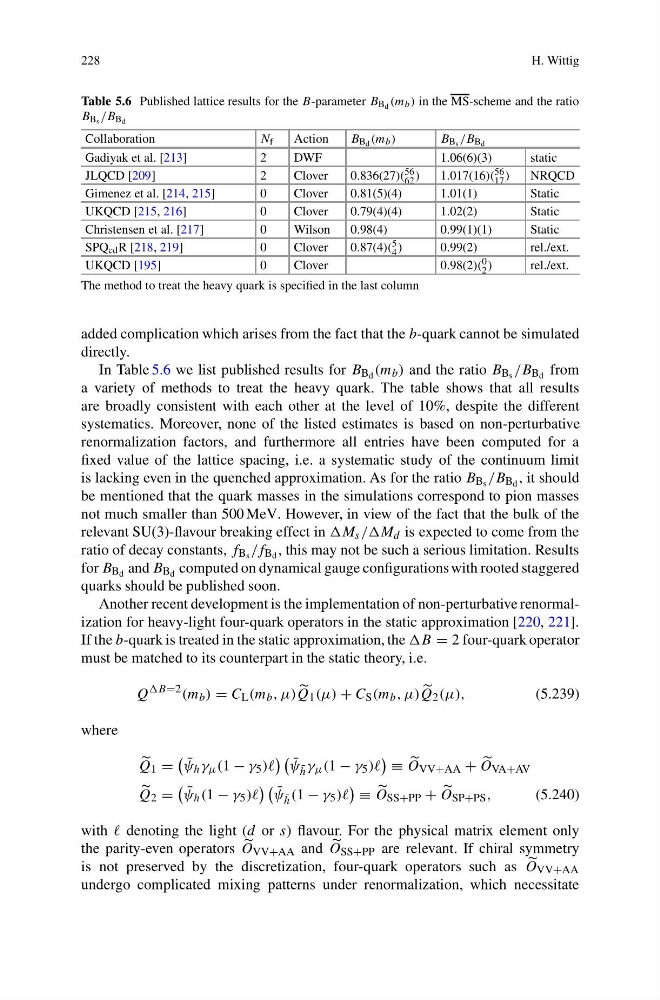
In Table 5.6 we list published results for B B d (m b ) and the ratio B B s /B B d from
a variety of methods to treat the heavy quark. The table shows that all results
are broadly consistent with each other at the level of 10%, despite the different
systematics. Moreover, none of the listed estimates is based on non-perturbative
renormalization factors, and furthermore all entries have been computed for a
fixed value of the lattice spacing, i.e. a systematic study of the continuum limit
is lacking even in the quenched approximation. As for the ratio B B s /B B d , it should
be mentioned that the quark masses in the simulations correspond to pion masses
not much smaller than 500 MeV. However, in view of the fact that the bulk of the
relevant SU(3)-flavour breaking effect in s //M d is expected to come from the
ratio of decay constants, f B s /f B d , this may not be such a serious limitation. Results
for B B d and B B d computed on dynamical gauge configurations with rooted staggered
quarks should be published soon.
Another recent development is the implementation of non-perturbative renormalization for heavy-light four-quark operators in the static approximation [220, 221].
If the b-quark is treated in the static approximation, the = 2 four-quark operator
must be matched to its counterpart in the static theory, i.e.
Q
(m b ) = C L (m b , μ)
Q 1 (μ) + C S (m b , μ)
Q 2 (μ),
(5.239)
where
Q 1 =
¯
ψ h γ μ (1 − γ 5 ))
¯
ψ ¯
h γ μ (1 − γ 5 ))
≡
O VV+AA +
O VA+AV
Q 2 =
¯
ψ h (1 − γ 5 ))
¯
ψ ¯
h (1 − γ 5 ))
≡
O SS+PP +
O SP+PS ,
(5.240)
with denoting the light (d or s) flavour. For the physical matrix element only
the parity-even operators
O VV+AA and
O SS+PP are relevant. If chiral symmetry
is not preserved by the discretization, four-quark operators such as
O VV+AA
undergo complicated mixing patterns under renormalization, which necessitate
H. Wittig
Table 5.6 Published lattice results for the B-parameter B B d (m b ) in the MS-scheme and the ratio
B Bs /B B d
Collaboration
N f
Action
B B d (m b )
B Bs /B B d
Gadiyak et al. [213]
2
DWF
1.06(6)(3)
static
JLQCD [209]
2
Clover
0.836(27)(
56
62 )
1.017(16)(
56
17 )
NRQCD
Gimenez et al. [214, 215]
0
Clover
0.81(5)(4)
1.01(1)
Static
UKQCD [215, 216]
0
Clover
0.79(4)(4)
1.02(2)
Static
Christensen et al. [217]
0
Wilson
0.98(4)
0.99(1)(1)
Static
SPQ cd R [218, 219]
0
Clover
0.87(4)( 5
4 )
0.99(2)
rel./ext.
UKQCD [195]
0
Clover
0.98(2)(
0
2 )
rel./ext.
The method to treat the heavy quark is specified in the last column
added complication which arises from the fact that the b-quark cannot be simulated
directly.
In Table 5.6 we list published results for B B d (m b ) and the ratio B B s /B B d from
a variety of methods to treat the heavy quark. The table shows that all results
are broadly consistent with each other at the level of 10%, despite the different
systematics. Moreover, none of the listed estimates is based on non-perturbative
renormalization factors, and furthermore all entries have been computed for a
fixed value of the lattice spacing, i.e. a systematic study of the continuum limit
is lacking even in the quenched approximation. As for the ratio B B s /B B d , it should
be mentioned that the quark masses in the simulations correspond to pion masses
not much smaller than 500 MeV. However, in view of the fact that the bulk of the
relevant SU(3)-flavour breaking effect in s //M d is expected to come from the
ratio of decay constants, f B s /f B d , this may not be such a serious limitation. Results
for B B d and B B d computed on dynamical gauge configurations with rooted staggered
quarks should be published soon.
Another recent development is the implementation of non-perturbative renormalization for heavy-light four-quark operators in the static approximation [220, 221].
If the b-quark is treated in the static approximation, the = 2 four-quark operator
must be matched to its counterpart in the static theory, i.e.
Q
(m b ) = C L (m b , μ)
Q 1 (μ) + C S (m b , μ)
Q 2 (μ),
(5.239)
where
Q 1 =
¯
ψ h γ μ (1 − γ 5 ))
¯
ψ ¯
h γ μ (1 − γ 5 ))
≡
O VV+AA +
O VA+AV
Q 2 =
¯
ψ h (1 − γ 5 ))
¯
ψ ¯
h (1 − γ 5 ))
≡
O SS+PP +
O SP+PS ,
(5.240)
with denoting the light (d or s) flavour. For the physical matrix element only
the parity-even operators
O VV+AA and
O SS+PP are relevant. If chiral symmetry
is not preserved by the discretization, four-quark operators such as
O VV+AA
undergo complicated mixing patterns under renormalization, which necessitate