

5 QCD on the Lattice
223
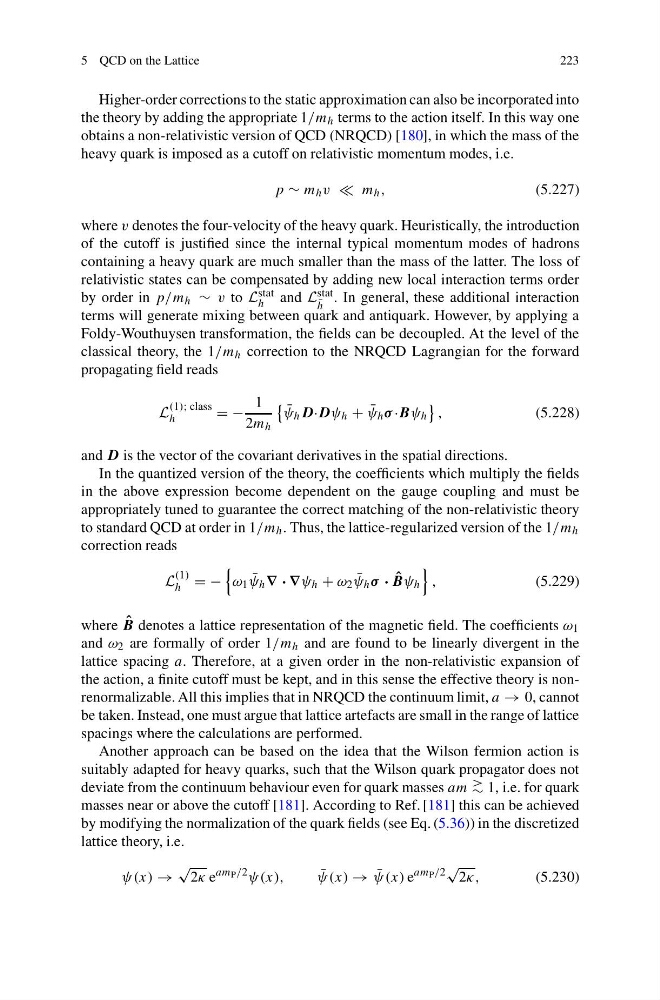
Higher-order corrections to the static approximation can also be incorporated into
the theory by adding the appropriate 1/m h terms to the action itself. In this way one
obtains a non-relativistic version of QCD (NRQCD) [180], in which the mass of the
heavy quark is imposed as a cutoff on relativistic momentum modes, i.e.
p ∼ m h v m h ,
(5.227)
where v denotes the four-velocity of the heavy quark. Heuristically, the introduction
of the cutoff is justified since the internal typical momentum modes of hadrons
containing a heavy quark are much smaller than the mass of the latter. The loss of
relativistic states can be compensated by adding new local interaction terms order
by order in p/m h ∼ v to L stat
h and L stat
¯
h
. In general, these additional interaction
terms will generate mixing between quark and antiquark. However, by applying a
Foldy-Wouthuysen transformation, the fields can be decoupled. At the level of the
classical theory, the 1/m h correction to the NRQCD Lagrangian for the forward
propagating field reads
L
(1); class
h
= −
1
2m h
¯
ψ h D·Dψ h + ¯
ψ h σ ·Bψ h
,
(5.228)
and D is the vector of the covariant derivatives in the spatial directions.
In the quantized version of the theory, the coefficients which multiply the fields
in the above expression become dependent on the gauge coupling and must be
appropriately tuned to guarantee the correct matching of the non-relativistic theory
to standard QCD at order in 1/m h . Thus, the lattice-regularized version of the 1/m h
correction reads
L
(1)
h = −
ω 1 ¯
ψ h ∇ · ∇ψ h + ω 2 ¯
ψ h σ · ˆ
Bψ h
,
(5.229)
where ˆ
B denotes a lattice representation of the magnetic field. The coefficients ω 1
and ω 2 are formally of order 1/m h and are found to be linearly divergent in the
lattice spacing a. Therefore, at a given order in the non-relativistic expansion of
the action, a finite cutoff must be kept, and in this sense the effective theory is nonrenormalizable. All this implies that in NRQCD the continuum limit, a → 0, cannot
be taken. Instead, one must argue that lattice artefacts are small in the range of lattice
spacings where the calculations are performed.
Another approach can be based on the idea that the Wilson fermion action is
suitably adapted for heavy quarks, such that the Wilson quark propagator does not
deviate from the continuum behaviour even for quark masses am >
∼ 1, i.e. for quark
masses near or above the cutoff [181]. According to Ref. [181] this can be achieved
by modifying the normalization of the quark fields (see Eq. (5.36)) in the discretized
lattice theory, i.e.
ψ(x) →
√
2κ e
am P /2 ψ(x),
¯
ψ(x) → ¯
ψ(x) e
am P /2
√
2κ,
(5.230)
223
Higher-order corrections to the static approximation can also be incorporated into
the theory by adding the appropriate 1/m h terms to the action itself. In this way one
obtains a non-relativistic version of QCD (NRQCD) [180], in which the mass of the
heavy quark is imposed as a cutoff on relativistic momentum modes, i.e.
p ∼ m h v m h ,
(5.227)
where v denotes the four-velocity of the heavy quark. Heuristically, the introduction
of the cutoff is justified since the internal typical momentum modes of hadrons
containing a heavy quark are much smaller than the mass of the latter. The loss of
relativistic states can be compensated by adding new local interaction terms order
by order in p/m h ∼ v to L stat
h and L stat
¯
h
. In general, these additional interaction
terms will generate mixing between quark and antiquark. However, by applying a
Foldy-Wouthuysen transformation, the fields can be decoupled. At the level of the
classical theory, the 1/m h correction to the NRQCD Lagrangian for the forward
propagating field reads
L
(1); class
h
= −
1
2m h
¯
ψ h D·Dψ h + ¯
ψ h σ ·Bψ h
,
(5.228)
and D is the vector of the covariant derivatives in the spatial directions.
In the quantized version of the theory, the coefficients which multiply the fields
in the above expression become dependent on the gauge coupling and must be
appropriately tuned to guarantee the correct matching of the non-relativistic theory
to standard QCD at order in 1/m h . Thus, the lattice-regularized version of the 1/m h
correction reads
L
(1)
h = −
ω 1 ¯
ψ h ∇ · ∇ψ h + ω 2 ¯
ψ h σ · ˆ
Bψ h
,
(5.229)
where ˆ
B denotes a lattice representation of the magnetic field. The coefficients ω 1
and ω 2 are formally of order 1/m h and are found to be linearly divergent in the
lattice spacing a. Therefore, at a given order in the non-relativistic expansion of
the action, a finite cutoff must be kept, and in this sense the effective theory is nonrenormalizable. All this implies that in NRQCD the continuum limit, a → 0, cannot
be taken. Instead, one must argue that lattice artefacts are small in the range of lattice
spacings where the calculations are performed.
Another approach can be based on the idea that the Wilson fermion action is
suitably adapted for heavy quarks, such that the Wilson quark propagator does not
deviate from the continuum behaviour even for quark masses am >
∼ 1, i.e. for quark
masses near or above the cutoff [181]. According to Ref. [181] this can be achieved
by modifying the normalization of the quark fields (see Eq. (5.36)) in the discretized
lattice theory, i.e.
ψ(x) →
√
2κ e
am P /2 ψ(x),
¯
ψ(x) → ¯
ψ(x) e
am P /2
√
2κ,
(5.230)